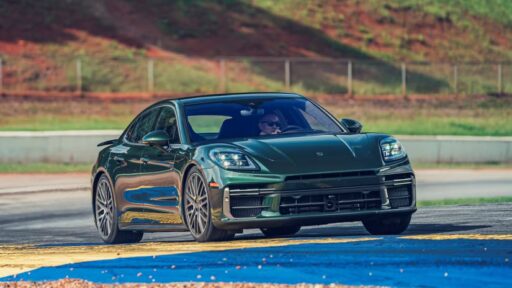
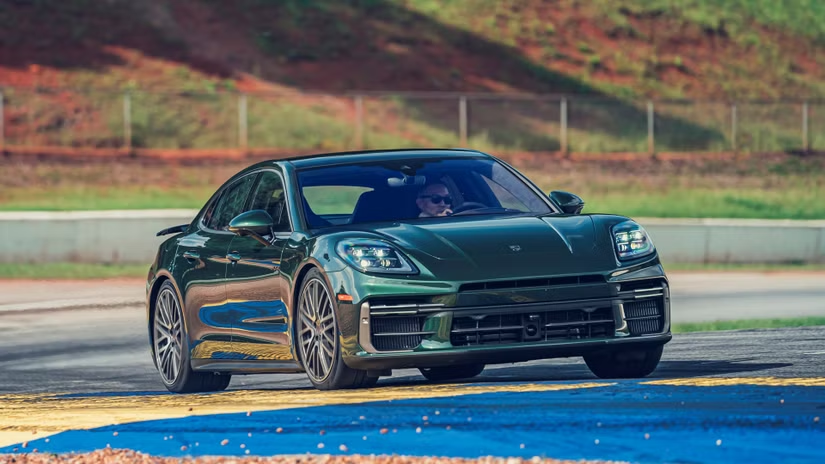

Modern performance sedans have become astonishingly fast, technically sophisticated and increasingly expensive. A new BMW M5 now starts above $120,000, while an Audi RS 7 performance costs more than $130,000 before options. Buyers looking at Porsche’s latest Panamera Turbo models can easily enter the $200,000 range.
That makes the first-generation Porsche Panamera Turbo S unusually compelling. A well-maintained example from the final years of the 970 generation can now be found around the $45,000 mark, yet it still offers a twin-turbocharged V8, all-wheel drive, a dual-clutch transmission and acceleration capable of troubling much newer machinery.
The purchase price makes it look like one of the used performance market’s greatest bargains. However, buyers must remember that depreciation has reduced the car’s value, not the cost of maintaining the complex Porsche that originally sold for well into six figures.
A $45,000 Panamera Turbo S Is a Realistic Proposition
Used-car values vary according to mileage, condition, accident history and service records, but the $45,000 figure is not unrealistic for a later first-generation Turbo S. Kelley Blue Book currently places the fair purchase price of a 2016 Panamera Turbo S at approximately $43,500, with private-party values generally ranging from about $38,000 to $42,800 depending on condition.
The broader first-generation market also supports that range. Specialist guidance covering the 2010–2016 Panamera places Turbo S values between approximately $25,000 and $54,000, with the cleanest, lowest-mileage and best-maintained cars commanding the strongest prices. The complete first-generation Panamera buying guide also warns that cheaper examples are frequently the ones carrying neglected maintenance or unresolved mechanical problems.
That means $45,000 can potentially secure a desirable facelifted model rather than merely an early, high-mileage car. The 2014–2016 Panamera, commonly called the 970.2, received revised exterior styling, updated engines and several technical improvements while retaining the original generation’s distinctive cockpit-style cabin.
The Turbo S Still Has Serious Performance
Early Panamera Turbo S models used a 4.8-litre twin-turbocharged V8 producing 550 horsepower and 553 pound-feet of standard torque, with up to 590 pound-feet available through overboost. Power reached all four wheels through Porsche’s seven-speed PDK dual-clutch transmission. Porsche listed a 3.6-second 0–60 mph time with Sport Chrono and a 190 mph maximum speed.
The facelifted Turbo S became even more powerful. Porsche increased output to 570 horsepower, while maximum overboost torque remained 590 pound-feet. Official specifications listed a 3.6-second 0–60 mph time, an 11.8-second quarter-mile and a 192 mph top speed. Carbon-ceramic brakes, active all-wheel drive and 20-inch wheels were standard on the 2014 Turbo S.
Those numbers remain impressive more than a decade later. A current Audi RS 7 performance produces 621 horsepower, reaches 60 mph in a claimed 3.3 seconds and starts at $130,700. The latest BMW M5 uses a 717-horsepower hybrid system, reaches 60 mph in a claimed 3.4 seconds and starts above $123,000.
The modern cars are faster, more efficient and substantially more advanced. However, the gap in real-world acceleration is far smaller than the gap in purchase price. A $45,000 Panamera Turbo S can deliver most of the speed and theatre for roughly one-third of the cost of a new M5 or RS 7.
It Was a $174,000 Flagship When New
The Panamera Turbo S was never designed as an affordable performance sedan. Car and Driver reported a 2012 starting price of $174,175, while praising its acceleration, stability, hydraulic steering and ability to conceal its considerable weight. The publication also described it as one of the best-handling large luxury cars of its period.
At a present-day price near $45,000, the car has lost roughly three-quarters of its original value before accounting for optional equipment. That depreciation allows a used buyer to access hardware originally reserved for wealthy customers shopping at the top of Porsche’s four-door range.
The original price was reflected throughout the vehicle. The Turbo S received adaptive air suspension, Porsche Active Suspension Management, Porsche Dynamic Chassis Control, torque vectoring and a speed-sensitive rear spoiler. Its cabin featured four individual seats, extensive leather, an Alcantara headliner, memory seats, navigation and a Bose sound system as standard on the 2012 model.
The infotainment now looks dated beside modern multi-screen interiors, but the physical controls and dense centre console give the first-generation Panamera a mechanical, cockpit-like character that newer touchscreen-heavy sedans often lack.
It Is More Practical Than Its Performance Suggests
The Turbo S was not simply a stretched sports car. Porsche designed it as a genuine four-door grand tourer with usable passenger accommodation and a liftback cargo area.
The facelifted car offered approximately 15.3 cubic feet of luggage space with the rear seats raised and around 44.1 cubic feet when they were folded. Its four individual seats provided a more focused cabin than a conventional five-seat luxury sedan, while all-wheel drive made the immense performance usable in a wider range of conditions.
This combination remains one of the Panamera’s strongest attractions. It can serve as a long-distance cruiser, family car and high-performance machine without requiring the owner to move into an SUV. The hatchback opening also makes it considerably more versatile than its low roofline initially suggests.
Modern Panameras Show How Expensive This Formula Has Become
The newest Panamera Turbo S E-Hybrid demonstrates how far Porsche has advanced the concept. It combines a twin-turbocharged V8 with electric assistance to produce 771 horsepower, reach 60 mph in a claimed 2.8 seconds and continue to a 202 mph top speed.
It also starts at $245,200 before options and associated charges. Porsche’s current Panamera Turbo S E-Hybrid specifications therefore place it more than five times above the approximate cost of a used first-generation Turbo S.
The new car is objectively superior in acceleration, technology, emissions performance and chassis sophistication. Yet the older model still provides a 570-horsepower V8, four-wheel drive and near-supercar speed. For a buyer primarily interested in the experience rather than the newest interface or fastest published time, the value difference is difficult to ignore.
The Purchase Price Is Only the Entry Fee
The main reason these cars have depreciated so heavily is not a lack of performance. It is the financial risk attached to maintaining an ageing, complex luxury vehicle.
The first-generation Panamera uses sophisticated systems that can become expensive when neglected. Specialist buying guidance identifies the PDK transmission, all-wheel-drive transfer case, cooling system, air suspension, active rear spoiler and braking system as areas requiring careful inspection. A complete PDK replacement can exceed $20,000, while carbon-ceramic brake components can also produce substantial bills.
A pre-purchase inspection by a Porsche specialist is therefore essential. The inspection should examine fault codes, transmission behaviour, transfer-case operation, suspension height, coolant leaks, turbocharger performance and the condition of the brakes and tyres.
Service history matters more than an unusually low asking price. A properly maintained 70,000-mile car may be a better purchase than a neglected 40,000-mile example that has spent years avoiding expensive scheduled work.
Fuel costs should also be expected. The 2012 Turbo S received EPA ratings of 15 mpg in the city, 23 mpg on the highway and 18 mpg combined, and it requires premium fuel.
A Bargain for the Right Buyer, but Not a Cheap Car
At approximately $45,000, the first-generation Porsche Panamera Turbo S makes many newer performance sedans look expensive. It offers acceleration that remains genuinely rapid, a 190-plus-mph top speed, an advanced chassis and a high-quality four-seat interior for the price of a well-equipped ordinary new car.
It does not make the modern alternatives irrelevant. Newer sedans provide stronger warranties, better driver-assistance systems, improved infotainment and lower short-term repair risk. They also deliver their performance with greater efficiency and increasingly sophisticated hybrid technology.
The used Porsche instead appeals to a different buyer: someone willing to accept higher maintenance risk in exchange for exceptional performance and engineering at a deeply depreciated price.
The correct example could be one of the most exciting four-door bargains available. The wrong example could consume the purchase-price savings through repairs. At this level, the service records and inspection report are every bit as important as the 570-horsepower V8.