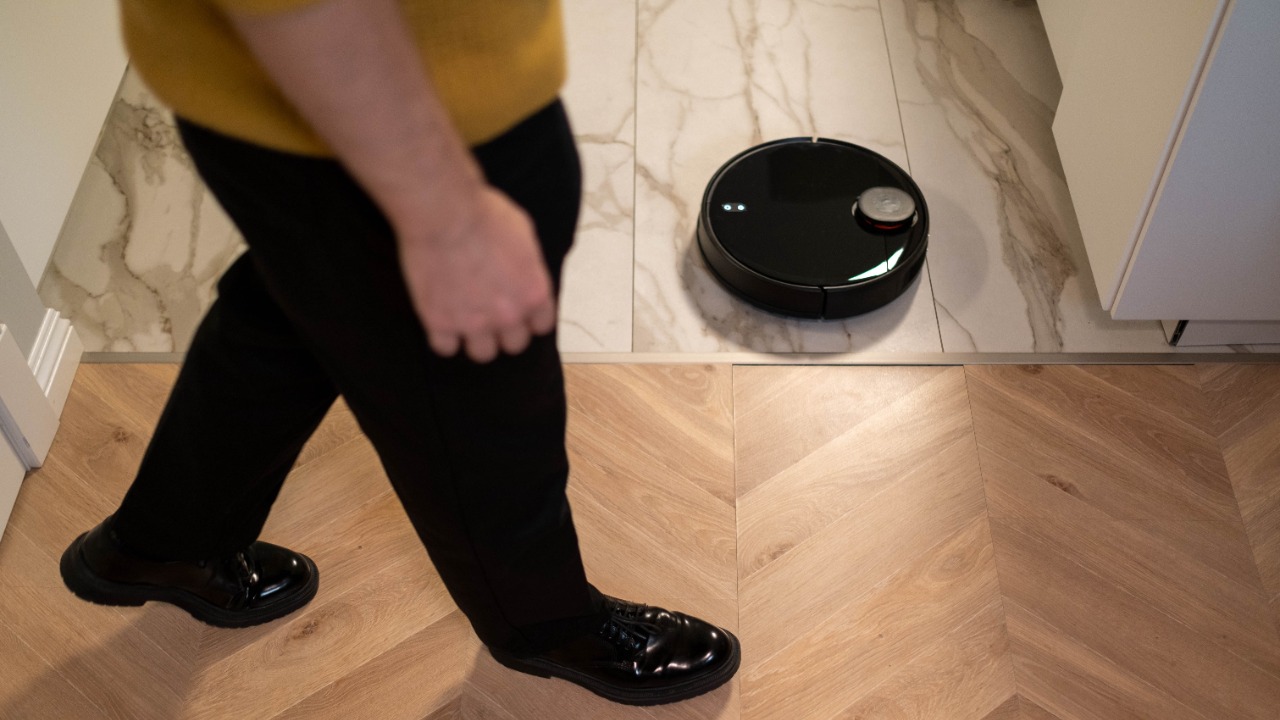

The Roborock Saros 20 is the kind of robot vacuum that initially sounds exaggerated. It promises 36,000Pa of suction, AI-powered stain recognition, advanced obstacle avoidance, automatic mop removal, hot-water self-cleaning and a chassis capable of climbing unusually high thresholds.
Most importantly, many of those claims translate into strong real-world performance. Independent testing shows that the Saros 20 is an excellent vacuum, a highly effective mop and one of the most autonomous floor-cleaning systems currently available.
It is not completely flawless, however. Average battery efficiency, occasional navigation mistakes, a complicated app and a $1,599.99 suggested retail price prevent it from becoming an obvious purchase for every household. Roborock launched the Saros 20 in North America in March 2026 as a premium model designed for larger and more complicated homes.
The Slim Design Reaches Places Other Robots Miss
Many robot vacuums use a raised laser-navigation tower that prevents them from travelling beneath low sofas, cabinets and beds. The Saros 20 replaces that traditional tower with Roborock’s embedded StarSight Autonomous System 2.0.
The result is a body measuring only 7.98 centimetres, or approximately 3.14 inches, in height. Roborock says its slightly flexible front structure can enter spaces with clearance as low as 7.95 centimetres, although contact or scraping may occur in particularly tight areas.
That low profile is genuinely useful. A robot vacuum provides little value under furniture when its sensors make the body too tall to enter. During a two-week home test involving carpet, rugs and hard flooring, the Saros 20 successfully cleaned beneath furniture while its extending side brush and mop reached close to walls and room edges.
The trade-off is the dock. Although attractively designed, the RockDock is large and requires a permanent position on a flat, hard surface with access to power and reliable Wi-Fi. A plumbed refill-and-drainage edition is available in selected regions, but installation requires suitable water and drainage connections. The standard model uses removable clean- and dirty-water tanks.
Its 36,000Pa Suction Is More Than a Marketing Number
Suction ratings do not tell the complete story of robot-vacuum performance. Brush design, airflow, floor contact and navigation can matter as much as the maximum Pascal figure.
Even with that qualification, the Saros 20 performs extremely well as a vacuum. Its 36,000Pa HyperForce motor handled debris on both carpets and hard floors effectively in several independent evaluations. The split DuoDivide main brush guides hair towards its central opening instead of allowing it to wrap around the roller.
In Vacuum Wars’ controlled testing, the robot removed 89% of sand embedded in medium-pile carpet, compared with a category average of 78%. It also removed 88% of flattened pet hair, exceeding the 82% average recorded across comparable models.
The anti-tangle system was equally impressive. No hair wrapped around the main brush during a seven-inch hair test, while the average competing robot accumulated 26%. That result makes the Saros 20 particularly attractive for households with pets or occupants with long hair.
Its internal dustbin is relatively small at 259 millilitres, but this limitation matters less because the dock automatically removes debris after cleaning. Homes with heavy pet shedding may still require more frequent dock-emptying cycles during a single large job.
The Mopping System Is Among Its Strongest Features
The Saros 20 uses two circular mop pads spinning at up to 200 revolutions per minute. The robot normally applies eight newtons of downward pressure but can increase that pressure to 13 newtons when its sensors identify a more difficult stain.
Its DirTect system uses an RGB camera to recognise different kinds of dirt. Roborock says it can increase suction for dry material such as coffee grounds or cat litter and switch to a mop-focused strategy when it identifies liquid. Some of these AI functions must be enabled manually through the app, and performance can vary according to lighting, floor patterns and the appearance of the spill.
Published tests support the broader claim that the mopping system is highly capable. Vacuum Wars gave the Saros 20 a score of 116 for dried-coffee removal, compared with a category average of 94. It also left less excess water behind than the average robot, helping reduce streaks and unnecessarily wet flooring.
A separate household test found that its rotating pads removed tomato sauce after only a few passes. The physical stain disappeared, although some odour remained because no cleaning solution was used. Roborock provides a detergent compartment but does not necessarily include a bottle of cleaning fluid, which feels unnecessarily stingy in such an expensive package.
Carpets Are Protected Through Automatic Mop Removal
Many vacuum-and-mop robots simply lift their pads slightly when moving onto carpet. That works for low-pile rugs but can still allow damp pads to touch thicker carpet.
The Saros 20 can return to its dock and detach the mop pads completely before beginning a vacuum-only job. It can also raise its chassis and stabilise the main brush when cleaning medium- or high-pile carpet. These behaviours depend on the chosen cleaning mode and may require configuration through the Roborock app.
Automatic detachment is slower than simply lifting the pads, but it provides greater protection against moisture transfer. It also allows the robot to vacuum carpet without carrying dirty, damp pads around the home.
Threshold Climbing Is Impressive but Not Magical
Roborock’s AdaptiLift Chassis 3.0 is one of the Saros 20’s most distinctive features. The system combines adjustable wheels, a climbing arm, cameras and software that analyses how to cross raised transitions.
The manufacturer claims support for double-layer thresholds measuring as much as 4.5 centimetres followed by another 4.3 centimetres. It can also elevate its body when stuck and adapt its height for carpets with pile up to three centimetres.
Controlled testing found that the robot crossed a 57-millimetre threshold, an exceptional result for a conventional disc-shaped vacuum. Real homes remain less predictable, however. One reviewer found that it still could not cross a four-centimetre transition between two rooms, probably because the shape and approach angle differed from ideal test conditions.
The climbing system is therefore useful for thick rugs, sliding-door tracks and uneven floor transitions, but it does not make the Saros 20 capable of climbing stairs or crossing every obstacle below its advertised maximum.
Obstacle Avoidance Is Excellent, Not Infallible
The StarSight system combines RGB imaging, three-dimensional time-of-flight sensing and side-facing VertiBeam technology. Roborock claims that it can recognise more than 300 categories of objects, including cables, shoes, furniture and pet-related obstacles.
In Vacuum Wars testing, the robot avoided 17 of 24 obstacles, placing it above average but still leaving room for failure. Another reviewer praised the major improvement in obstacle recognition while noting that the robot could occasionally become stuck and sometimes swallowed cables positioned on patterned rugs.
That means floors should not be treated as completely preparation-free. Charging cables, thin strings and very small objects should still be removed when practical. The Saros 20 requires far less supervision than a basic robot vacuum, but “AI obstacle avoidance” does not guarantee that every valuable or fragile object will be recognised.
The RockDock Handles Almost All Routine Maintenance
After cleaning, the robot returns to the RockDock to empty its dustbin, refill its internal water tank and wash its mop pads.
The dock uses water heated to as much as 100 degrees Celsius, or 212 degrees Fahrenheit, to loosen grease and dried residue from the pads. It can monitor the dirt released during washing and order the robot to remop heavily soiled areas. Warm air at up to 55 degrees Celsius then dries the pads and dock base to reduce moisture, odour and mould growth.
Roborock says the dust bag can provide up to 65 days of operation before replacement, although the actual interval depends on floor area, cleaning frequency, pets and debris levels. The dock can also dispense detergent and freshen the dust bag with ambient airflow.
This automation is arguably the Saros 20’s greatest achievement. Owners still need to replace bags, refill clean water, empty dirty water and remove occasional debris from the brushes, but daily interaction can be minimal.
The App Offers Exceptional Control at the Cost of Simplicity
The Roborock app supports room mapping, schedules, no-go zones, virtual barriers, cleaning sequences, suction adjustment, water control, pet monitoring and targeted spot cleaning.
This depth makes the Saros 20 highly customisable. It can clean the kitchen after dinner, vacuum carpets before attaching the mops, avoid a pet’s feeding area or perform an extra pass over a heavily used hallway.
The disadvantage is complexity. One hands-on review counted five vacuum settings and 30 water-flow levels. Experienced robot-vacuum owners may appreciate that control, while first-time buyers may spend considerable time deciding which options should be enabled.
The built-in voice assistant and compatibility with Alexa, Google Home and Siri add convenience, although voice control has been identified as less refined than the core cleaning functions.
Battery Performance Is Good but Not Class-Leading
Roborock lists a maximum operating time of approximately 200 minutes, and the dock supports a relatively fast 2.5-hour recharge. Actual runtime depends heavily on suction, mopping pressure, carpet use and the number of dock visits.
Independent measurements found that battery and navigation efficiency were closer to average than the Saros 20’s cleaning scores. That does not create a major problem because the robot can return to charge and resume an unfinished job, but very large homes may require more than one cleaning cycle.
Is the Saros 20 Too Good to Be True?
The Roborock Saros 20 is not too good to be true, but its price explains why it can perform so many tasks well.
Its strengths are substantial. It vacuums carpets effectively, controls long hair, scrubs hard floors, reaches edges, navigates beneath low furniture and performs most of its own maintenance. Its threshold-climbing system and automatic mop removal solve problems that still affect many competing robots.
Its weaknesses are less dramatic but still relevant. The app can feel excessive, the robot occasionally misjudges obstacles, battery efficiency is only average and the dock occupies significant space. The absence of included cleaning solution also feels unreasonable at this price.
At approximately $1,599.99, the Saros 20 is best suited to a large mixed-floor home, especially one containing pets, long hair, thick rugs or difficult room transitions. A smaller household seeking basic scheduled vacuuming can achieve acceptable results with a far less expensive model.
For buyers who want one of the most complete hands-free floor-cleaning systems available, however, the Saros 20 comes remarkably close to delivering on its ambitious promises.