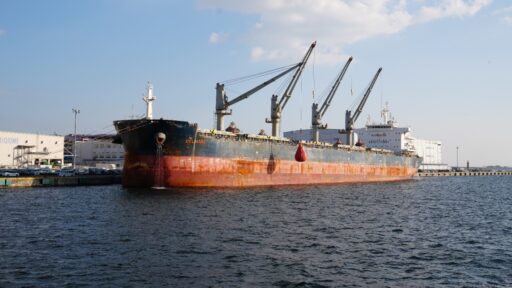
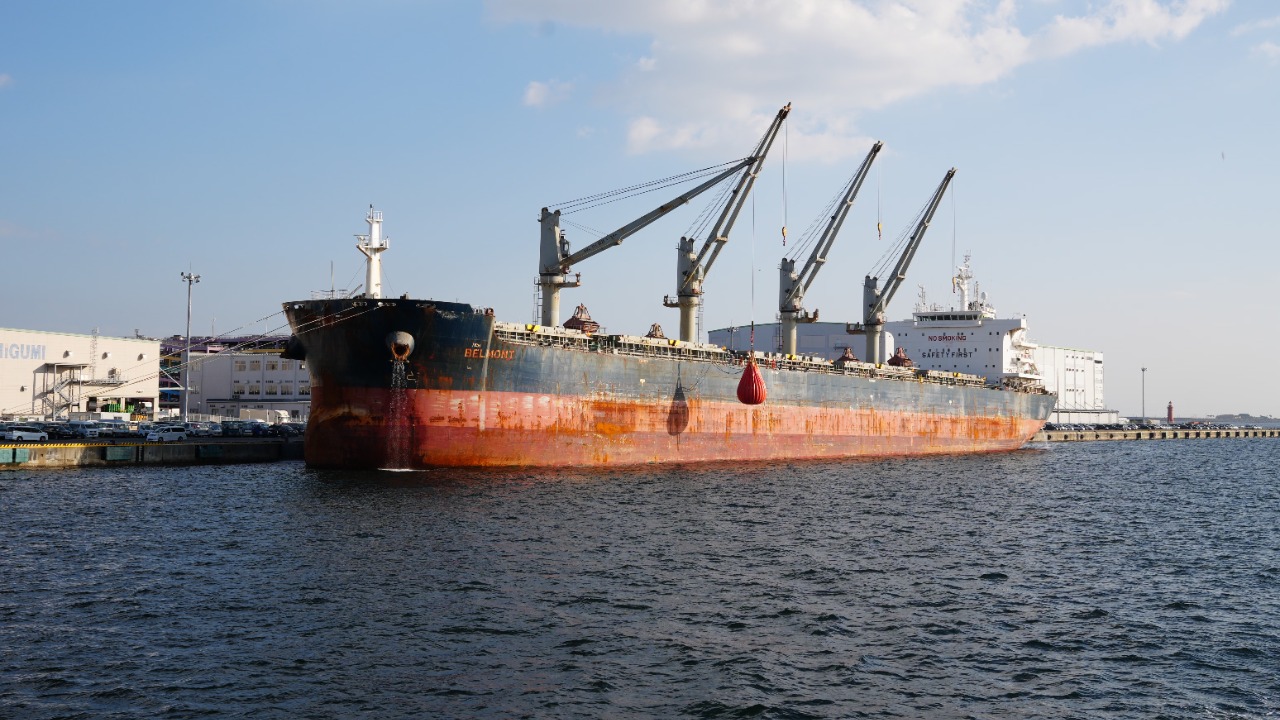

Japanese shipping company Mitsui O.S.K. Lines is exploring an unexpected new role for ageing commercial vessels. Instead of sending suitable ships for dismantling, the company wants to convert them into floating data centres capable of housing the servers and high-performance computing systems needed for artificial intelligence.
Mitsui O.S.K. Lines, commonly known as MOL, signed an agreement with Hitachi and Hitachi Systems in March 2026 to investigate the development, operation and commercialisation of a data centre built inside a second-hand vessel. The companies intend to complete technical and commercial feasibility studies with the possibility of beginning operations in 2027 or later. The project is outlined in the official MOL and Hitachi announcement.
The ship would not “power AI” by generating intelligence on its own. It would provide the physical space, electricity, cooling and network connections required to operate the powerful computer systems behind AI training, inference, cloud services and other data-intensive applications.
Why Japan Is Looking Beyond Land-Based Data Centres
The growth of generative AI is creating enormous demand for computing capacity. Modern AI systems require large groups of specialised processors operating continuously, which means data-centre developers need substantial land, dependable electricity, advanced cooling and high-capacity network connections.
Japan’s existing data-centre capacity is heavily concentrated around Tokyo and Osaka. Those two regions account for approximately 85% of the country’s facilities, increasing concern about land availability, grid congestion and exposure to regional disasters. Japan is also planning a major 3.1-gigawatt data-centre cluster in Toyama Prefecture as part of a wider effort to decentralise infrastructure and meet growing AI demand.
A floating facility could avoid some of the competition for expensive urban land. It could be moored near a port with suitable power and communications infrastructure rather than requiring developers to purchase and prepare a large terrestrial site.
MOL says reusing an existing hull could also reduce construction time, environmental impact and initial costs. The company estimates that converting a suitable vessel may take around one year, approximately three years less than developing a conventional land-based data centre.
A Car Carrier Could Offer Enormous Interior Space
The companies have considered converting an existing car carrier because this type of ship contains several wide internal decks originally designed to hold vehicles.
A large car carrier can provide tens of thousands of square metres of floor space. That space could potentially accommodate modular server rooms, electrical equipment, liquid-cooling systems, backup power infrastructure, network hardware and maintenance areas.
Reports concerning the Hitachi-backed plan suggest that a suitable vessel could provide approximately 54,000 square metres of internal capacity. However, the final ship, computing density and total server capacity have not yet been announced. Those details will depend on the feasibility studies, customer requirements and the amount of power available at the chosen location.
Hitachi and Hitachi Systems are expected to design and operate the information-technology infrastructure, engage potential customers and establish the computing requirements. MOL would manage the ship conversion, maritime maintenance, mooring arrangements, financing considerations and discussions with port authorities.
Seawater Could Help Cool Thousands of AI Processors
Cooling is one of the most difficult and expensive parts of operating an AI data centre. Graphics processors and other high-performance chips generate large quantities of heat, and their performance can be restricted or interrupted when that heat is not removed effectively.
A floating data centre could use seawater or river water as part of its cooling system. Water would pass through heat exchangers rather than flowing directly over the electronics, allowing heat to be transferred away from the servers while reducing dependence on freshwater.
MOL’s earlier floating-data-centre design specified direct water cooling using seawater or river water. The proposed facility had a planned capacity of between 20 and 73 megawatts, depending on the number and configuration of installed modules.
The marine environment does not make cooling effortless. Saltwater is highly corrosive, while marine organisms, sediment and mineral deposits can affect pipes and heat exchangers. The facility would need filtration, corrosion-resistant materials, monitoring systems and regular maintenance to operate reliably.
Power Could Come From Several Different Sources
The servers inside the ship would still require a large and continuous electricity supply. A floating data centre cannot rely only on the vessel’s original engines or a small collection of onboard solar panels.
MOL previously partnered with Kinetics, an initiative connected to Turkish floating-power specialist Karpowership, to develop a separate offshore data-centre platform. That design could receive dedicated electricity from a nearby Powership, a land-based grid, an onshore solar farm, offshore wind turbines or another locally available source. The project’s power plan is described in the MOL and Kinetics floating-data-centre agreement.
A Powership is effectively a floating power station. It can be positioned beside the data-centre vessel and supply electricity through a dedicated connection. The proposed Karpowership option could use fuels such as liquefied natural gas, although the ability to integrate renewable electricity would vary according to the project’s location.
This flexibility could allow the data centre to operate near regions where electricity generation is available but land, transmission capacity or construction permits are limited. However, the environmental impact would depend heavily on the actual power source. A ship supplied by fossil-fuel generators would not automatically be cleaner than an efficient land-based facility connected to low-carbon electricity.
Floating Data Centres Could Move With Demand
A conventional data centre is permanently tied to the site where it is constructed. A ship-based facility could theoretically be relocated when customer demand, energy prices or infrastructure requirements change.
MOL says a floating data centre could be towed or sailed to a different port, provided the new location offered suitable power, cooling, mooring and network access. In some configurations, the vessel might even continue operating while travelling between locations, although that would create additional technical and regulatory complexity.
Mobility could also make the concept useful as temporary infrastructure. A floating facility might provide computing capacity while a permanent campus is being constructed, support regions experiencing a sudden rise in demand or replace capacity interrupted by an emergency.
In practice, moving the ship would not be as simple as relocating ordinary cargo. Server systems are sensitive to vibration, humidity, power interruption and network latency. Each new location would require regulatory approval, a secure mooring position, high-capacity communications and dependable electricity.
Submarine Cables Would Connect the Ship to the Internet
AI servers are useful only when they can receive data and return results quickly. The floating facility would therefore need fibre-optic links to terrestrial internet exchanges and customer networks.
MOL’s earlier design proposed connections to land-based internet exchanges through submarine cables. The chosen port would need sufficient network capacity to carry large volumes of traffic without creating unacceptable delays.
Latency would influence which workloads could be placed onboard. AI model training and batch-processing tasks may tolerate greater physical distance from end users. Real-time applications, financial services and interactive cloud systems may require the vessel to remain close to major network hubs.
Cybersecurity would also become critical. Operators would need to protect the servers, fibre connections, ship-control systems and remote-management platforms from intrusion. Physical security would have to cover both digital infrastructure and the vessel itself.
Conversion Could Extend the Useful Life of Existing Ships
Reusing a ship could prevent some materials and systems from being discarded prematurely. The hull, decks, electrical rooms, cooling equipment, water-intake systems and other onboard infrastructure may be adapted rather than recreated from the beginning.
That does not mean every old cargo vessel is suitable. The hull must have sufficient remaining life, structural integrity and stability. Engineers must also consider fire safety, weight distribution, vibration, corrosion, evacuation routes and the consequences of placing dense computing equipment across several decks.
A conversion would still require significant new hardware and may involve removing much of the ship’s original interior. Its environmental advantage can only be established through a complete assessment comparing conversion, operation and eventual dismantling with the construction of an equivalent land-based facility.
The Project Is Promising but Not Yet Operational
Japan’s floating-data-centre proposal remains at the study and development stage. MOL, Hitachi and Hitachi Systems are evaluating demand, technical specifications, operating procedures and commercial viability. No final vessel, customer list or confirmed operating site has been publicly announced.
The concept must prove that sensitive computing equipment can operate safely and economically in a maritime environment. It must also secure permits, electricity contracts, network connections and customers willing to place valuable AI infrastructure offshore.
Should those challenges be resolved, ageing cargo ships could gain a remarkable second career. Vessels that once transported vehicles or goods across oceans may eventually remain near ports, filled with processors rather than cargo and supplying the computing capacity required by the expanding AI economy.