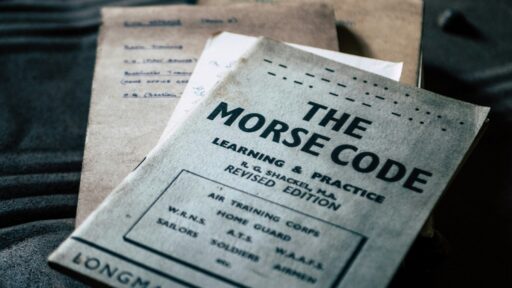

Morse code is one of the simplest communication systems ever created. It turns letters, numbers and punctuation into patterns of short and long signals that can be transmitted through sound, light, electricity, radio or physical movement.
The short signal is called a dot, while the long signal is called a dash. The letter A, for example, is represented by a dot followed by a dash. The letter N reverses that order with a dash followed by a dot. The internationally recognized distress signal SOS uses three dots, three dashes and three dots: ... --- ....
Morse code once powered long-distance telegraph networks and early radio communication. Modern digital systems have replaced it in most commercial operations, yet it remains popular among amateur-radio operators and useful in maritime signalling, aviation navigation, emergency communication and accessibility systems.
Its survival is based on one major advantage: Morse code can carry understandable information through an extremely basic signal.
Morse Code Converts Language Into Timed Signals
Morse code does not transmit the appearance of a written letter. It represents that letter through a sequence of signal durations.
A dot is the basic unit of time. A dash lasts three times as long as a dot. The space between parts of the same letter equals one dot, the gap between letters lasts three dots and the separation between words lasts seven dots.
These timing rules help a listener distinguish one character from another. Without consistent spacing, even correctly transmitted dots and dashes can become difficult to understand.
The International Telecommunication Union’s Morse code standard defines the characters, signal lengths, spacing and operating procedures used for International Morse code. The recommendation remains officially in force, showing that the system still has recognized technical value.
When Morse is sent by sound, the operator usually hears short and long tones rather than thinking consciously about printed dots and dashes. Radio operators often call them “dits” and “dahs” because those sounds reproduce the rhythm of each character more naturally.
Every Letter Has Its Own Pattern
Frequently used English letters were generally assigned shorter patterns, making common messages faster to transmit.
The letter E is one dot, while T is one dash. A is dot-dash, N is dash-dot and I is two dots. Less common letters usually require longer combinations.
Numbers use five signals. The number 1 is one dot followed by four dashes, while 5 is five dots and 0 is five dashes.
Punctuation marks also have defined combinations. This allows operators to transmit complete sentences, coordinates, call signs and technical instructions rather than only individual words.
Morse code is not a language by itself. It is an encoding system that can represent text from different languages. International Morse includes Latin letters, numbers and common punctuation, while additional codes and accented characters have been developed for other writing systems.
It Began With the Electric Telegraph
Morse code emerged during the development of the electric telegraph in the nineteenth century.
Samuel F. B. Morse, Alfred Vail and their collaborators developed a system in which electrical pulses travelled through a wire and operated a receiving mechanism at the other end. The pulses could mark paper tape or produce audible clicks that an operator learned to interpret.
In 1844, Morse transmitted the famous message “What hath God wrought” over a telegraph line connecting Washington, D.C., and Baltimore. The Smithsonian’s record of the original transmission notes that Morse and Vail completed the approximately 40-mile line after Congress provided funding for the project.
Alfred Vail also improved the telegraph key used to send the electrical signals. A surviving early key associated with the first Washington–Baltimore line is preserved by the Smithsonian’s National Museum of American History.
The original American system was not identical to the International Morse code commonly learned today. As telegraph networks spread across national borders, a more standardized version was developed to reduce confusion between operators.
Telegraph Operators Learned the Rhythm by Ear
Early systems recorded marks on paper, but experienced operators soon discovered that they could understand messages by listening to the telegraph mechanism.
Each press of the key completed an electrical circuit. A short press produced a dot, and a longer press produced a dash. At the receiving end, an electromagnet moved a sounder or marking device.
Operators began recognizing characters as rhythmic patterns rather than counting individual marks. This remains the most effective way to learn Morse code.
For example, a beginner may initially remember the letter C as dash-dot-dash-dot. An experienced operator hears the complete rhythm as one recognizable sound.
This distinction becomes important at higher speeds. Mentally translating every signal into a visual dot or dash creates an additional step that slows comprehension.
Radio Allowed Morse to Cross Oceans Without Wires
The arrival of wireless telegraphy gave Morse code a much larger role.
Radio transmitters could switch a carrier signal on and off to reproduce the same short and long patterns previously sent through wires. Ships, military units and remote stations could communicate without needing a physical cable between them.
In radio, this operating method is generally called continuous wave, or CW. Pressing a telegraph key turns the radio-frequency signal on, while releasing it turns the signal off.
The receiver converts those transmissions into audible tones. A trained operator listens to the tones and records the message.
The American Radio Relay League’s explanation of CW notes that Morse was the primary communication method during the earliest period of amateur radio. Modern equipment now supports voice, images and digital data, but CW remains actively used.
Why SOS Became the Famous Distress Signal
SOS is probably the world’s best-known Morse sequence.
It consists of three short signals, three long signals and three short signals. The pattern is easy to recognize, repeat and transmit under stressful conditions.
Contrary to a common belief, SOS was not originally selected as an abbreviation for “Save Our Ship” or “Save Our Souls.” Those phrases became memorable explanations after the signal had already been adopted.
The sequence was valuable because of its symmetry and simplicity. It could be transmitted through radio, a flashing lamp, a whistle, tapping or almost any method capable of producing two distinguishable signal lengths.
SOS remains recognized as a maritime distress signal. The International Maritime Organization’s collision-prevention regulations list ... --- ... among the signals indicating distress and the need for assistance.
Modern ships primarily use automated satellite and digital distress systems, but the visual or audible SOS pattern still provides a low-technology backup.
Morse Works With More Than Sound
One of Morse code’s greatest strengths is that it is independent of the transmission medium.
A person can send it with a radio tone, flashlight, signal lamp, horn, whistle or tapping sound. It can also be communicated through blinking, hand movement or pressure switches.
This flexibility has produced dramatic historical examples. During captivity in North Vietnam, US Navy pilot Jeremiah Denton blinked the word “TORTURE” in Morse code during a televised interview, secretly communicating information about prisoner treatment. The episode is documented by the Naval History and Heritage Command.
A person with extremely limited movement may similarly use a switch, eye blink or other repeatable action to select dots and dashes. The method is slow, but it can create a communication channel when ordinary speech or typing is impossible.
Why Morse Can Succeed With a Weak Radio Signal
Morse code is especially effective when radio conditions are poor.
Voice communication requires enough signal strength and bandwidth for the listener to distinguish complex speech sounds. A Morse transmission only needs the receiver to detect whether a simple tone is present or absent.
A skilled operator may understand CW through interference that makes speech unreadable. Narrow receiver filters can isolate the signal and reduce surrounding noise.
Morse transmitters can also be relatively simple and energy efficient. Amateur operators sometimes communicate across long distances using low power, small antennas and portable battery equipment.
This makes CW attractive for field operations, emergency exercises and locations where carrying large equipment is impractical.
Amateur Radio Keeps Morse Code Active
Commercial telegraph networks have largely disappeared, and professional radio operators are no longer routinely required to copy long Morse messages.
Amateur radio remains the system’s most visible modern community.
Operators use CW to make local and international contacts, enter radio contests, activate remote locations and experiment with low-power communication. The ARRL describes Morse code as a still widely used and popular amateur-radio mode.
In the United States, passing a Morse test is no longer required for an amateur-radio licence. The requirement was gradually reduced and then eliminated entirely in 2007, according to the ARRL’s Morse learning history.
Removing the examination did not end CW operation. It turned Morse into a voluntary skill learned by operators who value its efficiency, challenge and traditions.
Ships and Navies Still Use Visual Morse
Modern naval vessels have secure radio, satellite and digital communication systems, but visual signalling remains useful in certain situations.
Signal lamps can transmit Morse between ships without broadcasting a radio signal in every direction. The method may be valuable when radio silence is required, when equipment fails or when two nearby vessels need a direct visual channel.
The US Navy has even tested technology that automatically converts typed text into Morse flashes and converts incoming lamp signals back into text. Its signal-lamp project combined traditional optical communication with digital processing.
International maritime training standards also continue to recognize the ability to send and receive certain visual Morse signals, including SOS.
Aviation Uses Morse Identifiers
Pilots may still encounter Morse code when identifying radio-navigation facilities.
Certain aviation beacons repeatedly transmit short letter identifiers in Morse. A pilot can listen to the pattern and verify that the aircraft has tuned to the correct station.
This does not involve exchanging complete written conversations. Morse serves as a compact identity label for the navigation transmitter.
Some remote airway beacons also flash Morse patterns to identify their locations, according to US Navy aviation-planning documentation.
Satellite navigation is reducing dependence on older ground-based radio systems, but Morse identifiers remain part of aviation procedures where those facilities are still operating.
Learning Morse Requires Recognizing Sound Patterns
Beginners often start with charts showing every letter as printed dots and dashes. The chart is useful for understanding the system, but prolonged visual memorization can slow later progress.
Effective training usually introduces letters as complete sounds at realistic character speed, with generous pauses between them. As the learner improves, the pauses gradually become shorter.
This teaches the brain to recognize the rhythm of a whole character rather than count each signal.
Regular short practice sessions are generally more effective than occasional long sessions. Learners can listen to random characters, common words, call signs or simulated radio contacts.
Sending practice also matters. A computer or electronic keyer can help maintain correct timing, while a traditional straight key requires the operator to control every dot, dash and space manually.
Morse Code Survives Because It Is Fundamentally Simple
Morse is no longer the fastest way to send ordinary information. Text messaging, digital radio and satellite networks can transfer far more data with less human effort.
Its purpose today is different.
It remains useful when equipment must be simple, signals are weak or communication needs to cross between sound, light and physical movement. It also survives as a technical skill, competitive radio mode and link to the earliest era of electronic communication.
A Morse message does not require a particular language interface, screen resolution or software platform. It only requires a sender and receiver capable of distinguishing a short signal from a long one.
That is why a system developed for nineteenth-century telegraph wires still appears on modern radios, ships, navigation equipment and emergency-training materials.
Morse code has outlived much of the technology that originally carried it. Its continuing relevance comes from the same quality that made it revolutionary: complex human language can be reduced to a sequence of signals simple enough to travel almost anywhere.