
When Mount Vesuvius buried Pompeii in ash and pumice, thousands died in a matter of minutes. Recent work in one of the city’s grandest houses has revealed a single victim frozen in a final, intimate gesture: crouched on the floor, using a simple bowl to shield his head as the volcanic fury closed in. That small act of self‑protection, preserved for nearly two millennia, is reshaping how archaeologists describe the last moments inside the doomed Roman city.
Combined with new scientific techniques that can now reconstruct faces and bodies from long‑buried remains, the discovery is giving researchers an unusually personal view of the disaster. Instead of anonymous casts, the dead of Pompeii are emerging as individuals caught in specific, heartbreaking decisions.
New details from a single victim inside a lavish Pompeian house
The man with the bowl was found during renewed excavations in an elegant residence identified as the House of the Painters at Work, a building known for its unfinished wall frescoes that suggest painters were still active when Vesuvius erupted. Archaeologists uncovered his skeleton in a service area of the house, close to storage jars and domestic equipment, which implies he may have been a household worker rather than the owner.
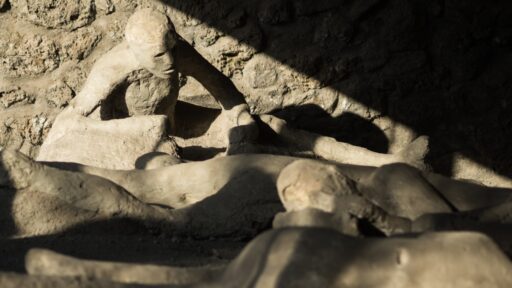
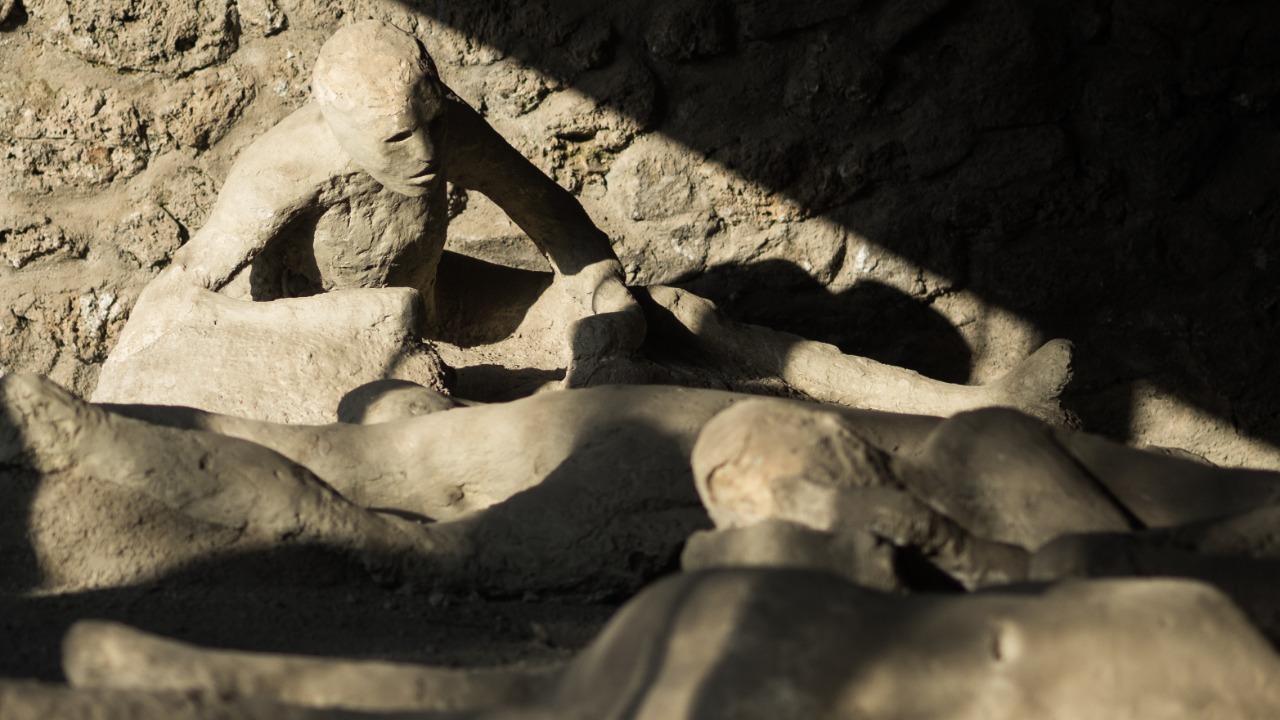
He lay on his side, knees drawn up, with one arm bent over his head and a shallow bowl positioned above the skull. The posture suggests he had dropped to the floor in a defensive crouch and tried to use the nearest object as a shield against falling debris or searing ash. Unlike some of the famous plaster casts that show victims sprawled in open courtyards, this man appears to have sought what little cover the interior space could provide.
The room where he died contained everyday utensils and signs of hurried abandonment, such as scattered pottery and partially moved items. That pattern fits a scene in which people had only moments to react as pumice stones and roof tiles began to crash down. The bowl, likely a common kitchen vessel, became a last‑second helmet when there was no time to reach a sturdier refuge.
The skeleton also offers clues about his life before the catastrophe. Early analysis suggests a relatively young adult, with joints that show the wear typical of physical labor. That would match a role as a servant or craftsman attached to the household, someone who stayed on site while others fled. For archaeologists, the combination of domestic context, working‑class status, and the improvised shield captures a very specific human story within the broader tragedy.
How technology is changing the story of Pompeii’s dead
The bowl‑shielded victim is emerging at the same time as new methods are transforming what can be learned from Pompeii’s remains. Researchers have begun using artificial intelligence and advanced imaging to rebuild the faces and bodies of those who died in the eruption. In one project, specialists applied AI tools to skull scans from a different victim to generate a highly detailed facial reconstruction, turning fragmentary bones into a lifelike portrait that shows skin texture, hair, and expression for a man who died in the disaster, as described in AI‑based reconstruction.
These reconstructions rely on CT scans, digital modeling, and large datasets of modern faces that allow algorithms to infer missing tissue. Combined with traditional osteological analysis, they can estimate age, sex, and even some aspects of health. When applied to victims found in specific rooms or postures, like the man with the bowl, they promise to connect a recognizable human face to a precisely documented final moment.
Archaeologists are also re‑examining older casts and skeletons with similar tools. Micro‑CT scans can reveal dental problems, healed fractures, and nutritional stress that plaster once concealed. Stable isotope analysis of bones can indicate diet and geographic origin, showing whether a victim grew up in the Bay of Naples region or migrated from elsewhere in the empire. In some cases, DNA sequencing has begun to trace family relationships between bodies found together.
Within that broader wave of scientific work, the new find in the House of the Painters at Work highlights how much context matters. The bowl and the surrounding objects were documented in place before removal, allowing researchers to tie any future facial reconstruction or genetic analysis back to the specific act of self‑defense captured in the skeleton’s pose. The result is not just a technical achievement but a narrative that connects physical data to a moment of fear and decision.
Why a single defensive gesture resonates today
The image of a man crouched on the floor, holding a bowl over his head, has drawn attention because it feels both futile and deeply relatable. Modern readers know that no ceramic dish could stop a pyroclastic surge, yet the instinct to grab whatever is at hand and shield the skull is instantly recognizable. It turns an ancient catastrophe into something that looks like a split‑second choice anyone might make.
Archaeologists working at the site have emphasized that such details help counter the tendency to see Pompeii as a static museum of ruins. The victim in the House of the Painters at Work did not die in a theatrical pose. He died in motion, reacting to sounds, heat, and darkness. His gesture shows that people inside the city were not passive, but tried to navigate collapsing buildings, choking ash, and falling stones with whatever strategies they could improvise.
The discovery also feeds into a larger shift in how the site is presented to the public. Curators and guides increasingly focus on individuals, from enslaved workers to children, rather than only on wealthy homeowners and monumental architecture. A worker who tried to protect his head with a bowl fits into that more inclusive narrative, reminding visitors that the eruption cut across social classes and that many who died left no inscriptions or written records.
For scientists who study natural hazards, such finds carry another kind of relevance. They provide concrete evidence of how quickly conditions deteriorated inside buildings and how people responded when escape routes failed. When combined with volcanic models and geological deposits, the posture and location of bodies help refine estimates of ash load, roof collapse timing, and the sequence of lethal events. The bowl, in that sense, is both a personal object and a data point in reconstructing the dynamics of a major eruption.
Next steps for excavations and interpretation at Pompeii
The team working in the House of the Painters at Work is expected to carry out detailed laboratory analysis of the newly uncovered skeleton. That will likely include high‑resolution scanning of the skull, study of the bowl and associated ceramics, and attempts to identify any micro‑traces on the bones that might indicate burns or blunt‑force injuries from falling debris. Those results will help determine whether the victim died primarily from building collapse, inhalation of hot gases, or a combination of both.
Plans are also underway to integrate this individual into broader digital reconstructions of the house and its occupants. Virtual reality models already allow visitors to move through some Pompeian spaces as they might have looked before the eruption. Adding the victim’s position, along with the unfinished frescoes and scattered tools, could let viewers see the precise corner where he made his final stand and understand how little distance separated him from potential exits that were already blocked.
Site managers have signaled that the find will eventually feature in updated displays and interpretive material, alongside other recent discoveries that emphasize the lived experience of ordinary residents. One report on the excavation of the house, which detailed the posture of the victim and the placement of the bowl, framed the discovery as part of a continuing effort to read Pompeii room by room rather than only street by street, as described in coverage of the new Pompeii find.