
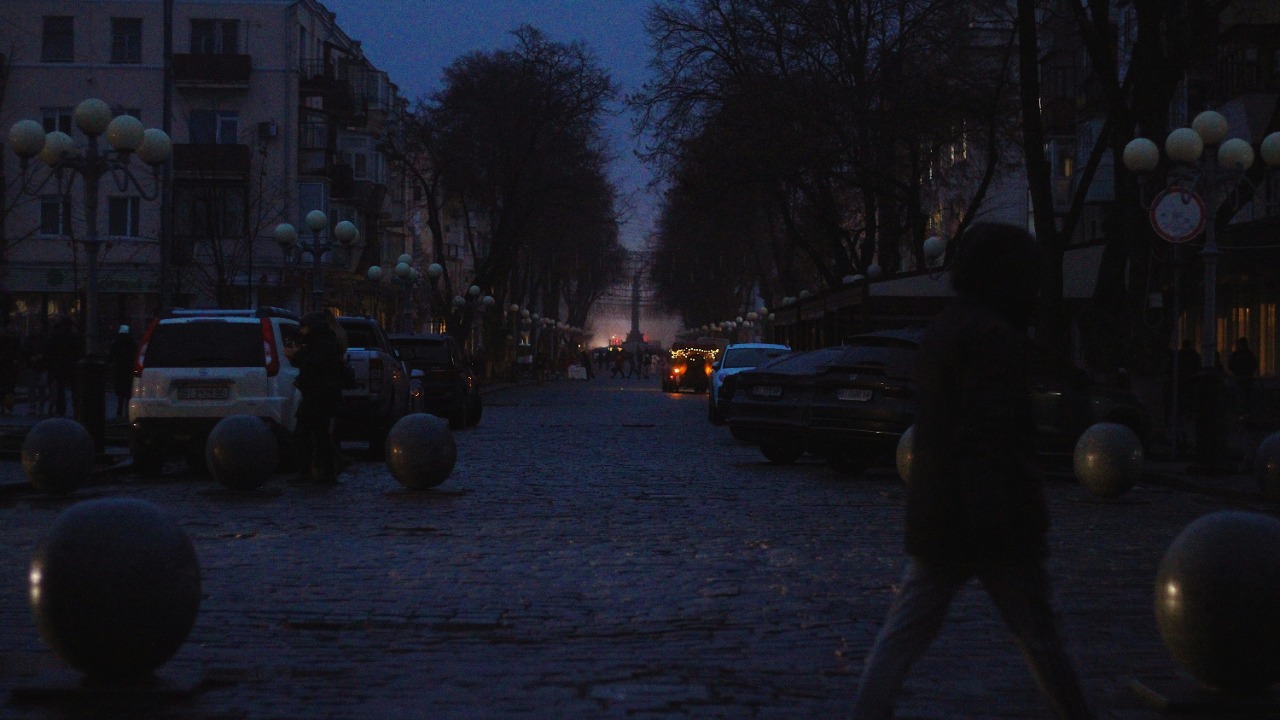

Ukraine and Moldova were plunged into sudden darkness after a major grid malfunction triggered cascading power cuts across both countries, before engineers managed to restore electricity within hours. The blackout, which hit in the depths of winter, exposed how fragile a war-battered energy system has become and how tightly the region’s power networks are intertwined. Officials now face urgent questions about whether a technical failure alone can explain such a sweeping collapse.
What unfolded was not a single city outage but a chain reaction that briefly knocked out power from Kyiv to Chișinău, disrupted transport, and forced nuclear plants to dial back output as a precaution. Even as lights came back on, the episode underscored how months of strikes and emergency repairs have left the grid operating with little margin for error.
How a ‘malfunction’ cascaded across Ukraine’s grid
Ukrainian authorities have framed the event as a large scale technical failure, describing a Malfunction that cut power across multiple regions rather than a fresh wave of missile strikes. Ukraine’s power grid experienced mass outages after what officials called a technical malfunction, with operators stressing there was no evidence of external interference or cyberattacks. By Saturday evening, the power companies had restored power to all regions of Kyiv, according to Ukraine’s Energy Minister Denys. The International Atomic Energy Agency said Ukraine’s nuclear power plants temporarily reduced output on Saturday after a grid issue, a sign of how seriously operators treated the instability.
Earlier, Ukrainian President Volodymyr Zelensky had called the incident an emergency, saying the causes are being investigated but pointing to the strain of months of Russian strikes that have repeatedly damaged high voltage lines and substations. Reports on the national outage described how Ukraine suffered a national power outage as lines failed, with electricity and water supplies cut in multiple regions before services resumed after several hours. In effect, a grid already weakened by persistent attacks was pushed into a self protective shutdown, triggering automatic disconnections that rippled across the country.
Kyiv’s blackout and the scramble to restore Power
The most visible impact came in the capital, where a sudden Power blackout in left traffic lights dark and apartment blocks without heating. The metro in Kyiv suspended operations after being disconnected from the grid, as Prime Minister Denys Shmyhal later explained when he said the system had been suspended from the grid to stabilise frequency. Emergency power cuts swept across several Ukrainian cities as well as neighbouring Moldova on Saturday, with operators citing low voltage on the network as they tried to prevent a wider collapse.
Power was restored later in the day, and Officials did not directly link the accident to war damage, although they acknowledged the system has been heavily degraded. Reports on the wider outage noted that Ukraine suffers national as lines fail, with trains and subways resuming operations only after engineers rebalanced the grid. For residents of Kyiv, it was another reminder that even on days without air raid sirens, the war’s impact on basic infrastructure is never far from the surface.
Moldova’s nationwide blackout and rapid Repair
The shockwaves did not stop at Ukraine’s western border. Disruptions to Ukraine’s power grid led to outages there and in neighbouring Moldova, which is tightly connected to Ukrainian transmission lines. A nationwide power outage hit Moldova, plunging much of the small country lying between Ukraine and Romania into darkness. Moldova was hit by widespread power cuts amid Ukraine grid problems, with authorities there stressing that the cause lay outside their own territory.
Repair work was under way on January 31 to restore power in regions affected by the blackout, and officials urged drivers to slow down and follow road signs as traffic lights failed across Repair zones. Most of the Moldovan capital had power back within hours, but the episode revived memories of earlier winters when Russian strikes on Ukrainian infrastructure also cut electricity to Moldova. For a country that has tried to pivot away from Russian energy, the blackout was a stark reminder that its security still depends on the stability of Ukraine’s grid.
War damage, Disruptions and a fragile regional system
Even if officials avoid directly tying this incident to fresh attacks, the backdrop is impossible to ignore. Ukraine and Moldova have been hit by massive power cuts after repeated Disruptions to Ukraine’s power grid, which has been battered by months of Russian strikes on energy infrastructure. Reports on how Ukraine and Moldova were hit by blackouts from a grid malfunction noted that the system had already been weakened by months of Russian strikes, leaving operators with fewer backup routes when something goes wrong. In that context, a technical fault can trigger a far larger crisis than it would in peacetime.
Emergency power cuts swept across several cities as well as neighbouring Moldova on Saturday, as operators tried to cope with low voltage on the network. Analysts have pointed out that Ukraine, Moldova and other neighbours are now more tightly synchronised with the European grid, which offers long term resilience but also means failures can propagate quickly if safeguards falter. In effect, the region is racing to modernise its energy links while still fighting a war that targets those very connections.
Living with rolling cuts: Another day of planned outages
For Ukrainians, the blackout did not mark a return to normal once lights came back on. Grid operator Ukrenergo has warned of Another day with and without schedules, saying that tomorrow, power outages are planned throughout Ukraine as demand remains high and capacity constrained. In a follow up note, Ukrenergo summarised the situation as Another day with and without schedules, a phrase that has become shorthand for the stop start rhythm of daily life. The same report cited the figure $42.850, a reminder of how even technical updates now sit alongside economic stress indicators.
Emergency power cuts have become part of the winter routine, with Live and On demand coverage describing how Ukraine and Moldova are facing one of their bleakest winters in years. For many households, that means planning around Ukraine’s outage schedules, charging phones and stocking water when the grid is up, then switching to candles and battery powered radios when it is not. The latest malfunction did not create that reality, but it reinforced how precarious the balance remains between keeping the lights on and protecting a grid that has already endured more than two years of war.