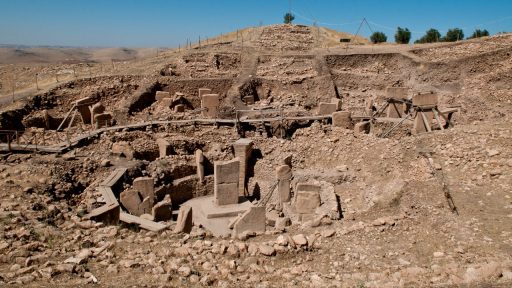
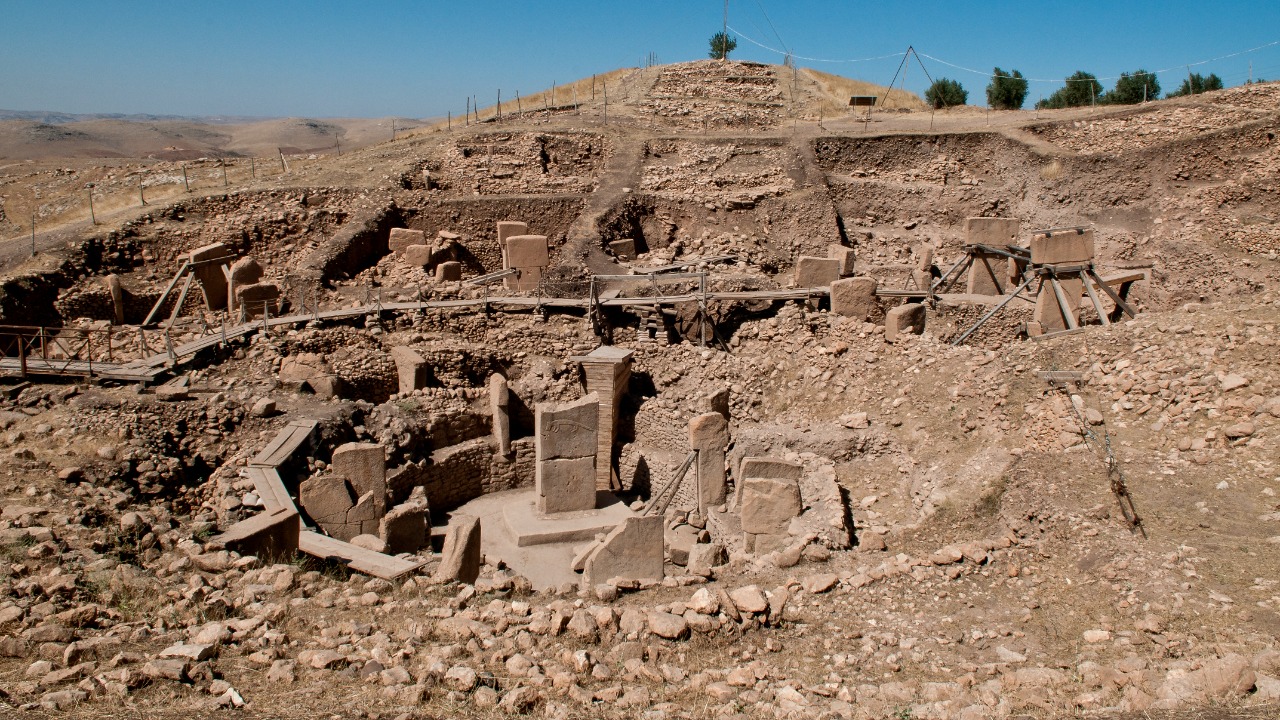

On a windswept hill in southeastern Turkey, a ring of towering stone pillars has forced archaeologists to rewrite the story of civilization. Long before cities, writing, or metal tools, people gathered here to carve animals into limestone and raise megaliths that rival much later monuments.
This 12,000-year-old site, known as Göbekli Tepe, should not exist according to the standard timeline of human development. Yet the stones are real, the dates are firm, and the more researchers uncover, the less the place fits neatly into any existing theory of how complex societies began.
Where Göbekli Tepe sits in the story of humanity
Göbekli Tepe rises from the dry plateau of southeastern Turkey, a region that later became part of the Fertile Crescent but was still home to small bands of hunter gatherers when the first stones went up. The complex lies near the modern city of Şanlıurfa, on a ridge that commands sweeping views of the surrounding landscape, a vantage point that helps explain why early communities might have chosen this particular hill as a ritual focus, as shown in detailed mapping of the location.
Archaeologists now place the earliest activity at Göbekli Tepe around 12,000 years ago, which makes it older than Stonehenge and the Egyptian pyramids by several millennia. Excavations have revealed multiple circular and oval enclosures, each defined by massive T shaped pillars, that predate settled farming villages and appear to have been built by mobile groups who had not yet adopted agriculture, a sequence that has been carefully reconstructed in long term fieldwork at the site.
A 12,000-year-old site that breaks the rules
What makes Göbekli Tepe so disruptive is not just its age but its sophistication. The pillars, some weighing many tons, are carved with reliefs of foxes, snakes, wild boar, birds, and abstract symbols, suggesting a rich symbolic world that required shared stories and coordinated labor to express. In standard models of prehistory, such large scale projects emerge only after farming creates food surpluses and social hierarchies, yet here the monumental architecture appears first, with agriculture following later in nearby valleys, a reversal that has led some researchers to argue that ritual gatherings may have helped drive the shift to cultivation, a pattern that is visible in the earliest phases of Göbekli.
Popular accounts often describe Göbekli Tepe as a 12,000-year-old site that “should not exist” because it appears to have been built long before villages, pottery, or metal tools, and even some specialists concede that the combination of age and complexity does not fully make sense within older frameworks. Video explainers have underlined that Göbekli Tepe is a 12,000-year-old sanctuary built long before writing or cities, and that even after decades of excavation, the overall purpose and social organization behind it remain unresolved.
Stones, symbols, and the puzzle of meaning
Walking through the excavated enclosures, what stands out is the deliberate arrangement of the T shaped pillars, with two central monoliths often towering over smaller stones set around the perimeter. Many of these pillars carry low relief carvings of animals and abstract signs, which some researchers interpret as totemic emblems or mythic scenes that encoded group identities and cosmological ideas. Detailed surveys of the carved stones at Göbekli Tepe show recurring motifs, such as predatory mammals and birds of prey, that may have marked different clans or ritual functions within the broader gathering place.
Some of the most striking pillars depict stylized human like figures, with arms, hands, and belts rendered in minimalist lines, suggesting that the T shapes themselves may represent anthropomorphic beings rather than simple supports. This blurring of architecture and iconography has led to debates over whether the enclosures should be seen as temples, communal houses, or something more fluid that combined social and spiritual roles, a debate that is fueled by the density of imagery cataloged in high resolution studies of the pillars.
Why archaeologists say it rewrites prehistory
For decades, the standard narrative held that agriculture came first, then villages, then temples and large scale ritual spaces. Göbekli Tepe turns that sequence on its head, because the evidence points to hunter gatherer groups organizing themselves to quarry, transport, and erect multi ton stones before they planted fields. Archaeologists working at the site in Tepe have argued that this astonishing archaeological complex forces a reassessment of the capabilities of our ancestors, who clearly could coordinate large workforces and sustain shared projects without the bureaucratic structures usually associated with later civilizations.
That inversion of cause and effect has led some researchers to suggest that the desire to gather for feasts and rituals may have encouraged people to experiment with cultivating cereals and managing herds, so they could reliably feed large crowds. Commentators in specialist forums describe Göbekli Tepe as so ancient and massive that it “breaks the history,” because dating it to 12,000 years ago means it is older than many key milestones that once defined the story of human development.
The deliberate burial and the rise of speculation
Perhaps the most confounding aspect of Göbekli Tepe is that it was not destroyed by erosion or conquest but carefully buried. Excavations show that the enclosures were intentionally filled with rubble and soil, which preserved the carvings but also suggests a conscious decision to close the site. Some researchers propose that this backfilling marked the end of a ritual era, while others see it as a way to protect sacred structures from desecration, a tension reflected in discussions where Others think it could have been a way to protect it from oblivion, like a buried message for the future.
The combination of age, scale, and deliberate burial has inevitably attracted more speculative theories, ranging from lost advanced civilizations to extraterrestrial influence, none of which are supported by the excavated evidence. Archaeologists emphasize that the stone tools, animal bones, and construction techniques all fit within what is known of late Pleistocene and early Holocene hunter gatherers in the region, even if the overall organization still puzzles them, a point underscored in summaries that describe how Archaeologists continue to grapple with the enigmatic nature of Göbekli Tepe in Turkey and its approximate 12000 to 11000 year age range.