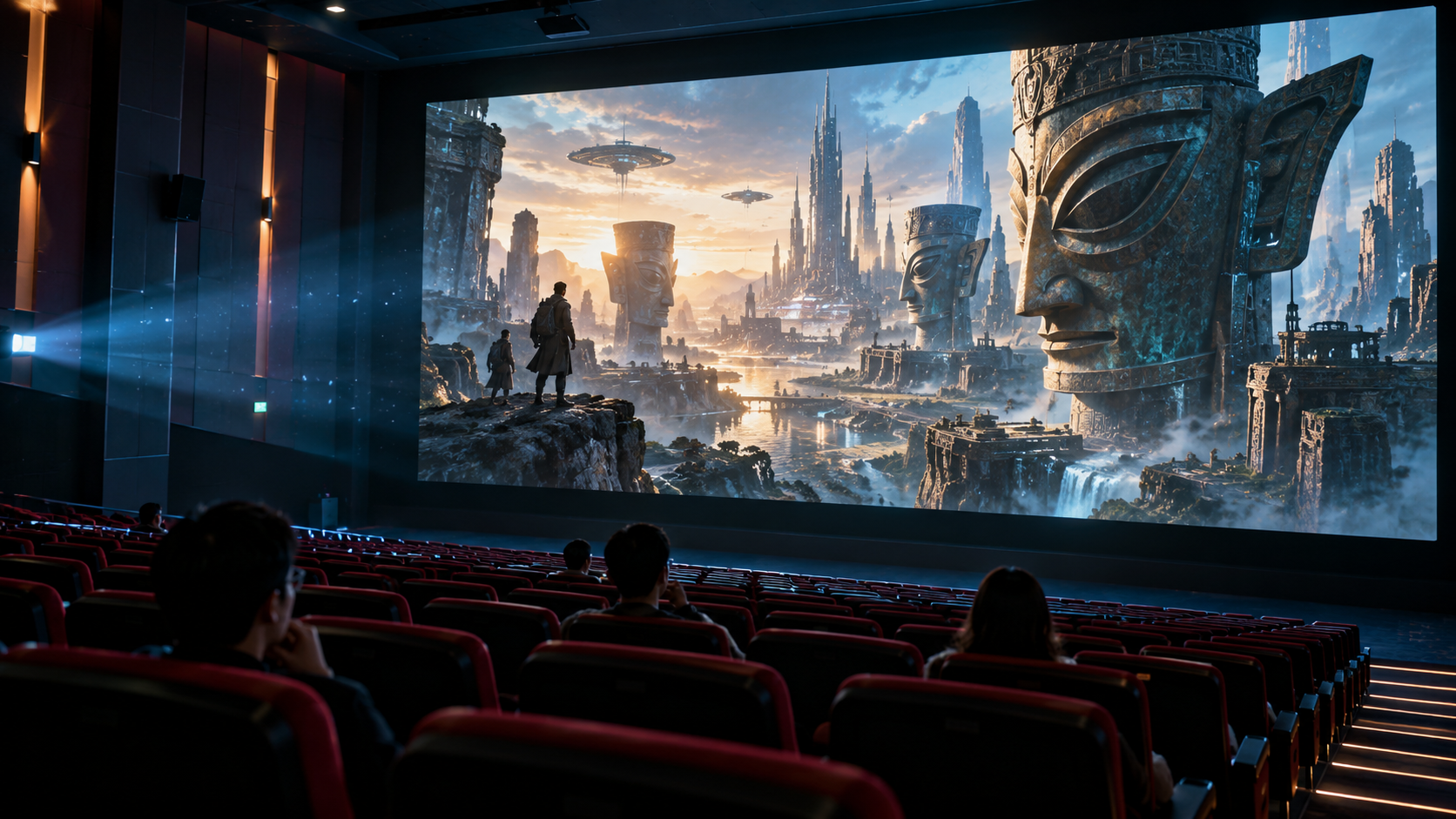

China has reached a significant milestone in artificial intelligence and entertainment with the theatrical release of its first fully AI-generated feature film. However, the historic debut has been overshadowed by disappointing ticket sales, raising questions about whether audiences are ready to pay for movies created using artificial intelligence.
The science fiction thriller Sanxingdui: Future Past opened in Chinese cinemas on October 23, 2026, with more than 10,000 screenings scheduled nationwide. Despite substantial promotional attention and an estimated production budget exceeding 10 million yuan, approximately $1.5 million, the film struggled to attract paying viewers.
According to Agence France-Presse (AFP), advance ticket revenue stood at just 65,000 yuan on Thursday evening, highlighting the gap between technological innovation and commercial demand.
Updated reporting on October 24 indicated that box-office revenue had approached 290,000 yuan by Friday evening, with projected takings of approximately 390,000 yuan. Although higher than the original forecasts, these figures remained far below the production investment.
The film’s debut highlights a growing challenge for the entertainment industry: artificial intelligence can generate cinematic content, but technological achievement alone may not convince audiences to purchase tickets.
What Is Sanxingdui: Future Past, China’s First AI Film?
Sanxingdui: Future Past is a science fiction feature film produced by Chinese entertainment company Bona Film Group.
The movie explores humanity’s relationship with artificial intelligence in a technologically advanced future, combining science fiction storytelling with imagery inspired by Chinese cultural heritage.
Its production is particularly notable because the characters, voices and cinematic backgrounds were generated using artificial intelligence.
Unlike traditional films that rely on live-action performers or conventional computer animation, the project uses generative AI as the foundation of its visual presentation.
However, the film was not created without human involvement. Nearly 100 people worked on the production over more than two years, demonstrating that AI-generated filmmaking can still require extensive creative planning, technical supervision and production management.
The project represents a significant experiment in how digital storytelling might evolve as generative video technology becomes more sophisticated.
It also provides an opportunity to examine whether audiences judge AI-generated movies differently from conventional productions.
Why Are Ticket Sales for China’s First AI Movie So Low?
The film’s weak box-office performance suggests that technological novelty is not necessarily enough to generate strong audience interest.
Before its release, the movie attracted attention because of its unusual production method. However, early viewers appeared more concerned about the quality of the cinematic experience than the technology behind it.
One preview attendee, Iris Yang, told AFP that she would not have purchased a ticket based on the film’s quality.
She compared her expectations with the visual experience offered by major Hollywood productions such as Avatar.
Her reaction reflects an important challenge for AI filmmakers.
Audiences may appreciate technological experimentation, but they still expect compelling storytelling, convincing characters and professional-quality visuals.
Chinese social media discussions also indicated hesitation toward paying for AI-generated films.
Some users suggested that such productions might be more acceptable as free streaming entertainment rather than premium theatrical releases.
These reactions suggest that the film’s difficulties may involve consumer expectations, perceived production quality and uncertainty about the value of AI-generated entertainment.
How Much Did China’s First AI Film Cost to Produce?
Bona Film Group reported that the production cost exceeded 10 million yuan, equivalent to approximately $1.5 million.
Although relatively modest compared with major international blockbusters, this remains a substantial investment for an experimental AI-generated production.
The project required nearly 100 employees and more than two years of development.
Those figures challenge the popular assumption that generative artificial intelligence automatically makes filmmaking cheap, quick and effortless.
AI tools may automate portions of character generation, background creation and visual production, but they do not eliminate the need for human decision-making.
Filmmakers must still develop stories, design characters, select suitable outputs, maintain visual consistency and assemble scenes into a coherent narrative.
In some cases, AI-generated footage may require repeated revisions before achieving acceptable quality.
For Sanxingdui: Future Past, the production investment makes its weak theatrical revenue particularly significant.
However, early box-office receipts should not be confused with final financial results. The film could potentially generate additional revenue through streaming agreements, licensing and other distribution channels.
Those outcomes remain uncertain.
Bona Film Group Defends the Experimental AI Production
Despite the disappointing commercial reception, Bona Film Group has presented the release as an important technological achievement.
Its chief executive, Jiang Defu, acknowledged the challenges associated with launching an experimental film into mainstream cinemas.
In comments reported by AFP, he emphasised that the company had taken an unusual step by pursuing a theatrical release for a fully AI-generated production.
The company also secured the necessary theatrical release approval, making the project a significant test of AI-generated filmmaking within China’s commercial cinema industry.
From the producer’s perspective, the importance of the film may therefore extend beyond immediate ticket sales.
Its release provides practical experience in production workflows, distribution, audience reactions and the technical limitations of generative AI.
Nevertheless, establishing a technological milestone and building a sustainable entertainment business are different objectives.
The commercial future of AI-generated films will depend on whether producers can create experiences that compete with traditional cinema.
How Artificial Intelligence Was Used to Create the Film
Generative AI technology allows filmmakers to create visual and audio content through computational models trained to recognise patterns in existing information.
For AI-assisted filmmaking, these systems can potentially generate characters, environments, visual effects and synthetic voices.
They may also help production teams develop storyboards, experiment with camera compositions and explore different visual styles.
In Sanxingdui: Future Past, the filmmakers relied on AI-generated actors, voices and backgrounds rather than conventional filmed performances.
However, the exact combination of AI models and production tools used throughout the project has not been fully documented in the available reporting.
The involvement of a substantial production team indicates that human supervision remained important.
Creating a complete feature film introduces challenges that short AI-generated videos do not necessarily encounter.
Characters must remain recognisable between scenes, movements must appear natural and visual details must remain consistent.
Dialogue, pacing and emotional expression must also support the story.
These requirements help explain why a fully AI-generated feature can still involve considerable development time and expense.
Why AI Videos Are Popular Online but Struggle in Cinemas
The weak theatrical debut contrasts sharply with the popularity of AI-generated videos on Chinese digital platforms.
According to AFP, AI-generated short dramas on Douyin accumulated more than 200 billion views during September 2026.
The enormous audience demonstrates that Chinese consumers are already engaging with artificial intelligence as an entertainment technology.
However, viewing short online videos and purchasing cinema tickets involve different expectations.
Social media users can watch brief AI-generated content with relatively little financial commitment.
Cinema audiences, by comparison, pay for a complete entertainment experience that usually involves higher expectations for visual quality, storytelling and emotional engagement.
A short experimental video may attract attention because of its unusual appearance.
A feature film must sustain viewer interest over a much longer period.
Independent AI filmmaker Zhang Jun highlighted this distinction in comments to AFP, arguing that audiences would not automatically purchase tickets simply because a movie was created with artificial intelligence.
His observation illustrates why online popularity cannot reliably predict theatrical performance.
Can AI-Generated Movies Compete With Hollywood Productions?
Generative AI has the potential to change how film studios produce visual content.
Its ability to create complex environments and digital characters could eventually reduce certain technical barriers associated with filmmaking.
However, competing with established cinematic productions requires more than impressive computer-generated imagery.
Major Hollywood films frequently combine elaborate visual effects with experienced actors, sophisticated storytelling and substantial production expertise.
Audiences also develop expectations based on familiar franchises and filmmakers.
AI-generated movies must demonstrate that they can provide comparable entertainment value.
Technical limitations involving facial expressions, physical movement, scene continuity and believable performances remain important challenges.
Even visually advanced AI systems can struggle to maintain consistency across complex sequences.
The strongest future applications may involve collaboration between human filmmakers and generative technology rather than attempting to remove conventional production methods entirely.
AI could support pre-production planning, visual experimentation and specialised effects while human creators retain responsibility for narrative quality.
Such approaches may offer a more practical path toward broader industry adoption.
What Does China’s AI Film Debut Mean for the Global Movie Industry?
The release of Sanxingdui: Future Past arrives during a period of rapid technological change across the international entertainment sector.
Studios, independent filmmakers and technology companies are exploring how generative artificial intelligence might influence content creation.
The development has also attracted concern from actors, writers and other film professionals who fear that increasingly capable AI systems could reduce employment opportunities.
In Hollywood, debates over synthetic performers and digital likenesses have become particularly prominent.
The emergence of virtual actors, including the AI-generated character Tilly Norwood, has intensified conversations about consent, artistic ownership and professional representation.
Meanwhile, other experimental AI films are moving toward commercial release.
The science fiction production Gods Don’t Give Gifts was reported to be scheduled for a United States release on December 4, 2026.
These developments suggest that Sanxingdui: Future Past is part of a broader international experiment rather than an isolated technological project.
Nevertheless, the success of future AI productions will depend on audience acceptance as much as technical capability.
Will Artificial Intelligence Replace Human Actors and Filmmakers?
The growing use of generative AI has raised legitimate concerns about employment and creative ownership.
AI systems can produce synthetic characters, imitate voices and generate visual environments that previously required performers or production specialists.
As these technologies improve, some studios may reconsider how certain production tasks are completed.
However, AI-generated filmmaking is not necessarily synonymous with completely automated filmmaking.
The Chinese production itself involved nearly 100 people, despite relying heavily on artificial intelligence.
Human workers remained responsible for managing the project and producing the completed film.
The future relationship between AI and filmmaking may therefore involve changes in professional roles rather than the immediate disappearance of entire occupations.
Questions concerning consent, copyright and digital replicas will also influence how studios adopt these technologies.
Organisations such as SAG-AFTRA have addressed issues involving performers’ rights and the use of artificial intelligence in entertainment.
Protecting creative professionals while allowing technological development will remain an important challenge for the industry.
Could Streaming Platforms Offer a Better Future for AI Films?
The early audience response suggests that streaming platforms could offer an alternative distribution route for experimental AI productions.
Streaming audiences often encounter a wider range of formats, including independent films, short dramas and unconventional storytelling projects.
Without the additional commitment associated with a cinema visit, viewers may be more willing to experiment with unfamiliar content.
Streaming distribution can also allow filmmakers to reach international audiences without depending entirely on theatrical screenings.
However, online distribution does not guarantee profitability.
AI-generated films would still need to compete for viewers’ attention and justify their production costs through licensing, advertising, subscriptions or other revenue arrangements.
For producers, streaming could provide an opportunity to test different storytelling formats and gather audience feedback.
It may also help determine which applications of generative AI offer genuine creative advantages.
Nevertheless, a theatrical release remains a valuable benchmark because it reveals whether audiences are willing to pay specifically for an AI-generated cinematic experience.
What Can Filmmakers Learn From Sanxingdui: Future Past?
The early performance of China’s first fully AI-generated feature film highlights the difference between technological innovation and commercial appeal.
Creating a feature-length movie with AI-generated performers, voices and environments represents an important production experiment.
However, the weak ticket sales demonstrate that audiences do not automatically reward technological breakthroughs.
Storytelling remains central to cinema.
Viewers expect narratives that hold their attention, characters they can understand and visual experiences that justify the cost of admission.
AI technology may help filmmakers produce content in new ways, but it cannot guarantee audience satisfaction.
The film also demonstrates that production costs and development timelines remain important considerations.
If experimental AI features require large teams and lengthy production periods, their commercial advantages over traditional filmmaking may be less immediate than anticipated.
For studios, the challenge is identifying where artificial intelligence adds meaningful creative or operational value.
Final Thoughts: China’s AI Film Breakthrough Faces a Commercial Reality Check
Sanxingdui: Future Past represents a noteworthy moment in the development of artificial intelligence and cinema.
Its October 23 release demonstrated that a fully AI-generated feature could reach commercial theatres in China.
However, disappointing early ticket sales revealed that technical achievement and audience demand do not always develop at the same pace.
Despite an estimated production investment exceeding $1.5 million and more than 10,000 scheduled screenings on opening day, the film struggled to establish strong commercial momentum.
For Bona Film Group, the project may still deliver valuable experience in AI production and digital filmmaking.
For the wider entertainment industry, its debut offers an important reminder that viewers ultimately judge films through the quality of their experience.
Artificial intelligence may transform how movies are created, but technology alone is unlikely to determine which productions become successful.
The next generation of AI filmmakers will need to demonstrate that innovation can support compelling stories rather than simply provide a new method of generating images.
China’s first AI film has made history. Whether similar productions can build sustainable cinema audiences remains an open question.