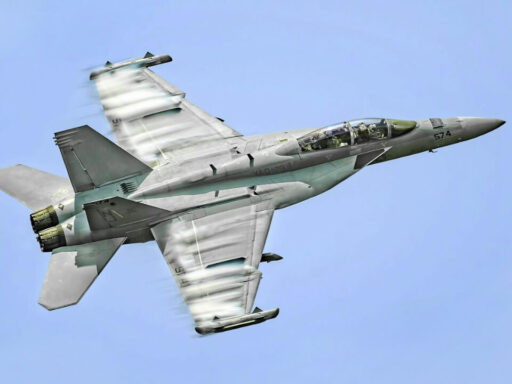

The U.S. Air Force has quietly crossed a new threshold in human-machine teaming, using an F-22 Raptor in flight to direct an MQ-20 Avenger combat drone through a complex autonomy trial. The collaborative combat exercise turned the stealth fighter into a command node, with the unmanned jet executing tasks that would normally demand a dedicated pilot and sensor crew.
Rather than relying on a distant ground station, the Raptor crew served as the brain for the MQ-20, issuing commands and monitoring the drone’s autonomous behavior in real time. Inside the Air Force, the event is being treated as a proof of concept for future Collaborative Combat Aircraft, in which piloted fighters could orchestrate entire formations of loyal wingman drones in contested airspace.
Inside the F-22 and MQ-20 autonomy trial
The recent flight paired a single F-22 Raptor with an MQ-20 Avenger in a scenario designed to mimic a high-end air combat mission. According to detailed accounts, the fighter acted as a command aircraft while the unmanned jet responded to tasking through an autonomy stack and a tactical data link that allowed rapid exchanges of targeting and sensor information between the two aircraft. The U.S. Air Force and General Atomics Aeronautical Systems, Inc. treated the event as a manned-unmanned teaming trial to validate how a frontline fighter can direct a jet-powered drone in contested conditions, a concept highlighted in reporting on the F-22 Raptor and.
The MQ-20 Avenger itself is a turbofan-powered unmanned aircraft that can fly at high subsonic speeds and carry a meaningful weapons and sensor payload, so the test went far beyond a simple communication check. Air Force and General Atomics Aeronauti teams used the flight to push autonomy software, data link integration, and human-machine interface concepts that will be central to future Collaborative Combat Aircraft. One account of the trial notes that the interface aboard the MQ-20 allowed the unmanned jet to interpret commands from the F-22 and then execute them with a high degree of independence, while the Raptor crew retained supervisory control over the mission profile.
General Atomics, Autonodyne and the software behind the teaming
The technology stack that made the trial possible reflects a growing ecosystem of autonomy and control software tailored for combat aviation. General Atomics Aeronautical Systems, Inc. described the event as a joint autonomy exercise with the Air Force, emphasizing that the MQ-20’s onboard systems were able to accept tasking from the fighter, plan routes, and manage sensors without a human pilot in the loop for every action. The company framed the demonstration as part of a broader effort by General Atomics Aeronautical and the Air Force to prove that software-driven autonomy can be reused across airframes and vendors, rather than locked into a single platform.
Autonodyne, a firm that specializes in control systems for air, land, and maritime autonomous platforms, has also disclosed its role in the project. The company’s Bashi software powered key elements of the command-and-control link between the F-22 and MQ-20, allowing the manned cockpit to issue high-level instructions that the unmanned jet could translate into executable flight and sensor actions. In its description of the event, Autonodyne explained that the Bashi system is intended to work across different classes of vehicles, a design choice that aligns with the Air Force goal of fielding a family of Collaborative Combat Aircraft that can be controlled through common autonomy frameworks.
From data links to loyal wingmen
This latest exercise did not emerge in isolation. Earlier testing already paired an F-22 with an MQ-20 to integrate L3Harris BANSHEE Advanced Tactical Datalinks, which established the communications backbone required for more ambitious autonomy trials. In that previous event, the focus was on proving that the fighter and drone could share data securely and at speed, while the new flight shifted attention to how autonomy software can use that link to carry out complex tasks against simulated airborne threats. Together, the tests show a progression from basic connectivity toward full-spectrum teaming in which the unmanned jet acts as a loyal wingman that can scout, jam, or even engage targets under fighter direction.
Analysts tracking the Air Force’s Collaborative Combat Aircraft program see the F-22 and MQ-20 pairing as a live-fire rehearsal for concepts that will later involve purpose-built drones. Reporting on the autonomy trial notes that the Avenger was tasked to perform surveillance and targeting functions while the Raptor crew concentrated on higher-level tactical decisions, a division of labor that mirrors how future loyal wingmen are expected to operate. One detailed account of the event described how the exercise validated real-time data exchange and target prosecution through government reference autonomy software, a capability that aligns with the Air Force vision for Avengers working with and other fighters in contested airspace.
Why the Air Force cares about reusable autonomy
The Air Force has repeatedly stressed that its next-generation combat aircraft will need to fight in large, dispersed formations, with piloted jets directing multiple unmanned systems at once. That concept only becomes practical if autonomy software can be reused across fleets, rather than rewritten for every new drone. The joint autonomy exercise with the F-22 and MQ-20 was designed to show that government reference autonomy and industry-developed systems like Bashi can be ported between platforms, allowing the same core logic to control different aircraft types. In official descriptions, the Air Force and General Atomics framed the demonstration as a step toward a library of reusable behaviors that can be updated and certified once, then fielded widely.
The industrial side of the project reflects that ambition. General Atomics MQ-20 Avenger trials with the Air Force have been described as part of a broader push to align company roadmaps with government requirements for Collaborative Combat Aircraft, including the ability to support air-to-air missions, electronic warfare, and other tasks against airborne threats. Flight test reporting notes that the MQ-20 used autonomy software to respond to fighter tasking in ways that could be extended to other unmanned platforms, a capability that sits at the center of manned unmanned teaming efforts. For the Air Force, that kind of reuse promises faster fielding and lower integration costs as new drones join the fleet.
Edwards Air Force Base, test culture and what comes next
The autonomy trial took place at Edwards Air Force Base in Southern California and was integrated into an ongoing series of experiments that blend government reference autonomy with industry hardware and software. Edwards has long served as a hub for experimental flight programs, and the F-22 and MQ-20 pairing fits that tradition by combining cutting-edge data links, autonomy stacks, and human-machine interfaces in a controlled but operationally relevant environment. Reports on the event note that the test leveraged autonomy and the tactical data link to carry out a complex mission profile, with the MQ-20 responding to commands from the fighter while still managing its own flight and sensor operations, a setup highlighted in coverage of the manned unmanned flight.
Next steps for the Air Force will likely involve scaling this model to additional aircraft and more demanding scenarios. Autonodyne has already positioned its Bashi software as a cross-domain control solution for air, land, and maritime autonomous systems, which suggests future tests could involve other platforms beyond the MQ-20. General Atomics Aeronautical Systems, Inc has also signaled through its joint announcements with the Air Force that it sees manned-unmanned teaming as central to future combat aircraft markets, a view reflected in broader industry analyses of By Michael Scanlon and related coverage. As more tests accumulate, the F-22 and MQ-20 exercise is likely to be remembered as one of the early points where a frontline fighter began to treat a jet-powered drone as a true teammate rather than a remote-controlled asset.