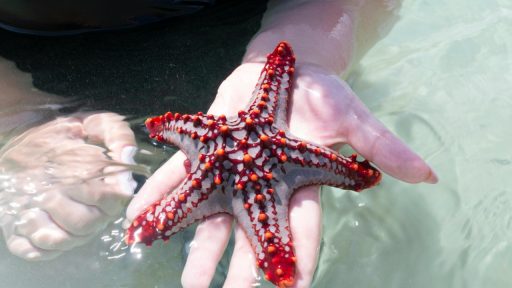
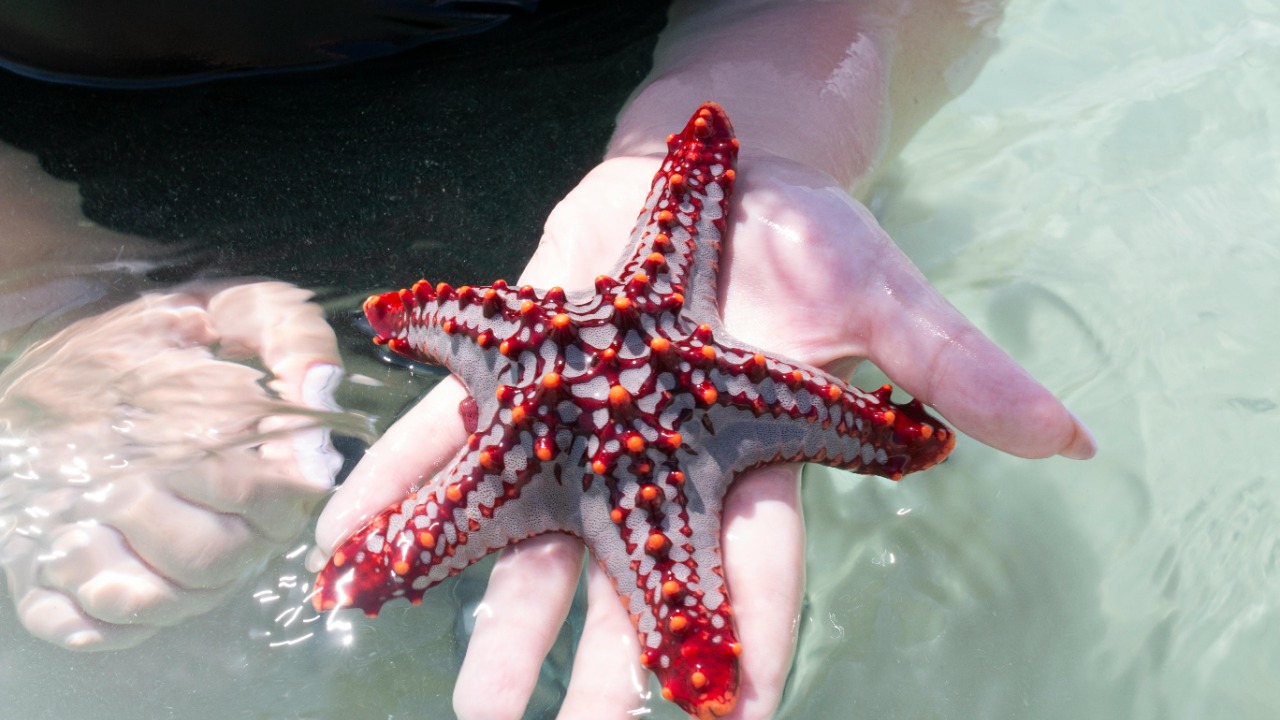

Starfish look like simple icons from a child’s drawing, but their bodies hide one of the strangest navigation systems in the ocean. With no brain, no head and not even blood, they still manage to walk, climb and even sprint across the seafloor using hundreds of tiny feet. The result is a kind of distributed intelligence that lets a starfish travel hundreds of feet, hunt down prey and escape danger with a coordination that feels almost unreal.
Instead of a single command center, each arm and each foot makes local decisions that somehow add up to smooth motion. For engineers trying to build swarms of robots or flexible machines that can adapt on the fly, this brainless choreography is not just a curiosity, it is a working blueprint.
Hundreds of tiny feet, zero brain
At first glance, the basic facts sound impossible: starfish have no brains and no blood, yet they move with hundreds of tiny feet that act like a living conveyor belt. Those feet, called tube feet, line the underside of every arm and grip the seafloor with suction, letting the animal glide along sand, rock and even vertical walls. As one explainer puts it bluntly, Starfish have no brains and no blood but they have hundreds of tiny feet, and those feet are the key to everything they do.
Instead of pumping blood, sea stars move filtered seawater through an internal plumbing system that powers those feet like miniature hydraulic pistons. One aquarium description notes that Sea stars do not have a brain or blood and instead pump filtered seawater through their bodies to move nutrients around and power movement. Without a brain, starfish rely on a nerve network and this water vascular system to coordinate their arms and feet, helping them survive predator attacks and long searches for food.
A radial body built for distributed control
Part of the secret lies in the way a sea star is built. Rather than a front and back like a fish, most species are organized around five-part radial symmetry, with arms radiating from a central disc. One detailed profile notes that movement and other key functions are Based on five-part radial symmetry, with coordination focused in the center of the body where there are also spines for protection. That layout means any arm can become the “front” at a moment’s notice, which is exactly what happens when the animal changes direction.
Inside that star-shaped outline is a surprisingly complex skeleton. Researchers studying Starfish in the order Asteroidea describe a complex endoskeleton made of thousands of calcareous ossicles, tiny plates embedded in tissue that can shift and lock together. This flexible armor lets the arms bend, arch and twist as the tube feet pull, a mechanical foundation that makes distributed control physically possible.
The nerve ring that replaces a brain
Instead of a centralized brain, sea stars use a ring of nerves around the central disc that links to a cord in each arm. One research group describes how, Without a brain, starfish use a nerve ring around their central disc, connected to nerve cords in each arm, to coordinate movement. Each arm has a degree of independence, yet they still work together in harmony, which is why a sea star can keep crawling even if one arm is damaged or regenerating.
Recent work has gone further, showing that coordination emerges from local rules rather than top-down commands. In one set of experiments, Starfish coordinate movement without a brain or central nervous system by using local mechanical feedback, with each tube foot acting autonomously but responding to the push and pull of its neighbors. Another analysis of Starfish, also known as sea stars, emphasizes that They have no head, no brain and no central nervous system, yet their tube feet still coordinate in ways that could inspire better robots in the future.
Walking, galloping and “bouncing” across the seafloor
Watch a sea star from the side and its motion looks almost like levitation. One marine science program notes that When a starfish moves along the bottom of the ocean, it almost looks like it is gliding, but in reality it is walking on hundreds of tube feet that grip and release in sequence. Those same feet let the animal pry open the shell of a mussel or clam, then work the shell open far enough for the stomach to emerge from the mouth and ooze inside.
Under the right conditions, that slow glide turns into something closer to a sprint. In lab recordings, researchers have seen sea stars switch from a crawl to a faster, more synchronized pattern that one study calls a “bouncing gait.” One report notes that While they are not very coordinated when they crawl, they can become highly synchronised to generate a faster, bouncing style of movement. Video work has even captured sea stars that appear to gallop, with one account explaining that Oct observations showed that In the wild, starfish might also gallop to flee predators, lifting their bodies and driving forward with waves of tube feet.
How each tube foot “decides” what to do
To understand how this works at the level of individual feet, researchers have tracked how many tube feet are in contact with the ground and how that affects speed. One analysis found that Jan experiments showed the starfish crawled at roughly the same pace regardless of how many of their tube feet were in contact with the substrate, but when more feet were engaged the gait became smoother and more stable. That suggests each foot is not waiting for a global signal, it is reacting to local forces and the stiffness of the body around it.
High resolution videos reinforce that picture. One clip asks How do starfish move with hundreds of legs but no brain, then shows the marine invertebrates lifting their bodies on arches of tube feet while others reach forward to pull. Another explainer on Mar details how, using their feet, they pry open clams or oysters and their stomach emerges from their mouth and oozes inside the shell. The stomach then digests the prey externally before retracting, a feeding strategy that depends entirely on precise, local control of those hydraulic feet.