
Far from the bright inner planets, scientists are tracking a strange visitor and an emerging new world that are rewriting expectations for the outer solar system. A high speed interstellar comet is racing through local space while a distant, frozen body lurks near the edge of the Sun’s influence. Together, these discoveries reveal a solar system that is less settled and more surprising than textbooks once suggested.
The “bizarre hidden object” is not a single mystery so much as a pair of linked puzzles: a suspected dwarf planet on an extreme orbit and an interstellar comet lighting up telescopes. Both are forcing astronomers to rethink how the solar system formed, how many worlds remain unseen, and whether long hypothesized giants like Planet Nine are really needed to explain what is happening in the dark.
Meet 2017 OF201, the secretive world at the edge
Astronomers have identified a massive new trans Neptunian object, 2017 OF201, that appears to trace an orbit far beyond Neptune and even beyond much more well known Pluto. Early analysis suggests that this body is large enough to qualify as a dwarf planet candidate and that its elongated path takes it into some of the coldest, least explored territory around the Sun. The discovery of 2017 OF201 was not a quick find but the result of years of careful survey work that gradually revealed its slow, distant motion against the background stars, leading one team to describe it as a hidden world on the solar system’s edge in a detailed report on Astronomers have uncovered.
Catalogs that track the most distant known objects list 2017 OF201 among bodies with extremely wide orbits and connect it directly to a technical study titled Discovery of a dwarf planet candidate in an extremely wide orbit. Follow up work through an arXiv entry linked as An Extreme orbit analysis, along with coverage from research groups at the Institute for Advanced Study that described how Astronomers have Discovered an “extreme cousin of Pluto” on the solar system’s edge, reinforces the idea that 2017 OF201 resides in a population of distant bodies that had previously existed only in models. Taken together, these findings suggest that the outer solar system is crowded with large icy worlds that have remained effectively invisible until the latest generation of deep surveys and data mining techniques brought them into view.
Why this distant dwarf planet matters for Planet Nine
The orbit of 2017 OF201 is not just a curiosity; it is a new data point in a long running debate about whether a hidden giant planet is shaping the outer solar system. One detailed analysis stresses that 2017 OF 201 is probably not alone in the outer solar system and that its detection was largely a matter of chance, since it happened to be close enough and bright enough to be seen while many similar objects likely remain beyond current reach. That same work notes that the number 201 in the designation has become shorthand for a new class of extreme objects that may collectively reduce the need for a single dominant sculptor in the far reaches, an argument laid out in a study that suggests the discovery could spell bad news for Planet 9 fans and is summarized under the phrase Intriguingly.
Popular level explainers pick up this theme and highlight how each new extreme trans Neptunian object weakens the statistical case that a single massive Planet Nine is tugging smaller bodies into aligned orbits. Earlier coverage of a related sednoid nicknamed Ammonite, described in a feature that opens with the phrase Incredibly Rare Celestial, explains how such orbits can either support or erode the Planet Nine hypothesis depending on their exact orientations. In that piece, Astronomers Learn that Ammonite might be part of a broader population whose collective gravity could mimic the effects once attributed to a single unseen planet. Together, Ammonite and 2017 OF201 provide a new way to test whether the outer solar system is governed by one dominant hidden world or by a swarm of smaller but still significant bodies that share similar extreme paths.
A second mystery: interstellar comet 3I/ATLAS
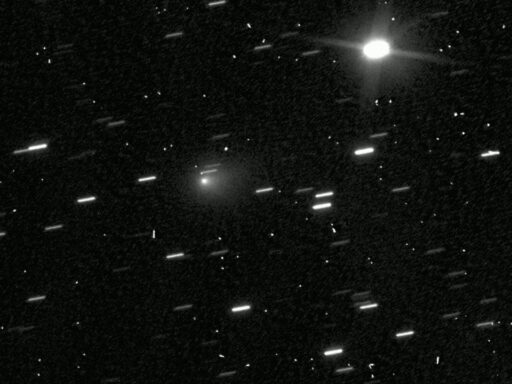
While 2017 OF201 creeps slowly around the Sun, another bizarre object is sprinting through the solar system on a one way path. Comet 3I/ATLAS is an interstellar visitor that originated outside Sol and is only the third known object to pass through the solar system from interstellar space. Official descriptions of Comet 3I/ATLAS emphasize that it will never return once it leaves, because its trajectory is hyperbolic rather than bound. That path, combined with its composition, offers a rare chance to sample material that condensed around another star and to compare it with the ices and dust that built the planets around the Sun.
Measurements of this object have already set new records. According to a detailed technical summary, 3I/ATLAS is moving at an incredible 245,000 kilometers per hour, a figure that comes directly from precise Measurement of its motion through the sky and its changing distance from the Sun. Researchers behind that work, presented in a report on 3I/ATLAS sets new, argue that this speed makes it the fastest known interstellar comet yet observed and implies that it may have been flung out of its home system during a violent phase of planet formation that predates the formation of the Sun itself. That scenario links 3I/ATLAS directly to broader questions about how common planetary systems like ours really are and whether the solar system is, as some theorists suggest, one of the rarest arrangements in the galaxy.
What spacecraft and telescopes are seeing
The passage of 3I/ATLAS has triggered a coordinated observing campaign that stretches from ground based observatories to spacecraft. A newly released set of eight spacecraft images reveals the interstellar comet 3I ATLAS with astonishing, unprecedented clarity, according to a mission update that highlights how a distant probe captured the coma and tail in detail and notes that this view helps scientists trace how the object interacts with the solar wind and the Sun’s radiation pressure. That release, which frames the object as a key to understanding both our solar system and beyond, is summarized in a report that introduces the images with the line newly released set.
Other spacecraft are providing complementary views. One high profile set of observations shows Comet 3I/ATLAS as seen from ESA’s JUICE mission, with mission scientists stressing that While 3I/ATLAS is a visitor from interstellar space, traveling from outside the Solar System, its behavior in sunlight looks surprisingly familiar. That perspective appears in a feature that focuses on interstellar comet images and explains how JUICE, originally built to study the icy moons of Jupiter, has become an opportunistic comet observer. In parallel, X ray astronomers report that Scientists detect X ray glow from interstellar comet 3I/ATLAS extending 250,000 miles into space, a measurement described in a piece that groups the result under the phrase Strange New Words. That extended glow reveals how fast ions from the solar wind collide with neutral gas streaming off the comet, turning 3I/ATLAS into a natural laboratory for plasma physics on an interstellar sample.