
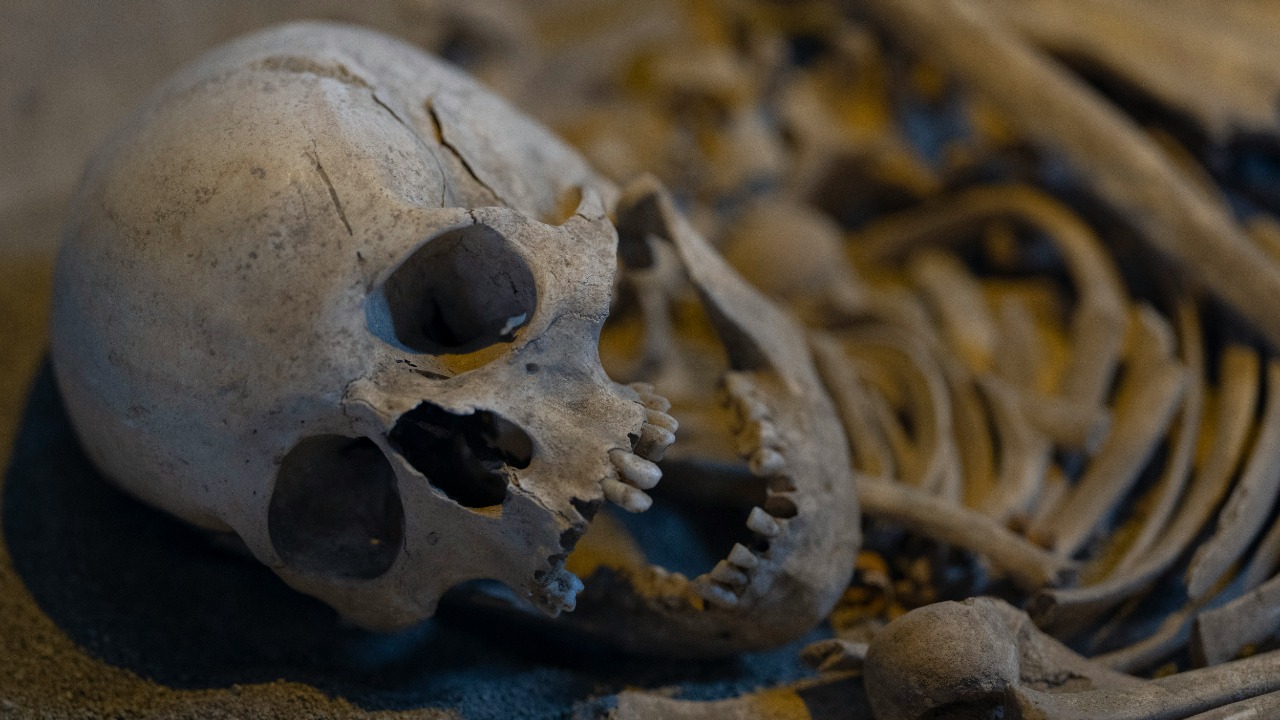

A single object, buried for tens of millennia, is forcing scientists to redraw the map of our origins. The discovery of a 60,000-year-old artefact has slotted into a cascade of recent finds that collectively challenge the tidy story of a lone exodus from Africa and a simple handover from archaic humans to us. Instead, the emerging picture is of overlapping species, repeated migrations and a deep past that looks less like a straight line and more like a braided river.
As I follow the latest research, what stands out is not just the age of these discoveries but how they connect. From Neanderthal craftsmanship in Europe to puzzling skulls and tools in China, from a 3.67 m year-old skeleton in Africa to a 7 Million year pivot in how our ancestors walked, each piece is nudging the narrative away from inevitability and toward contingency, chance and survival.
The 60,000-year-old clue that upgrades Neanderthals
The artefact at the heart of this shift is described as a 60,000-year-old object linked to Neanderthal life, and it is not the crude tool many people still imagine when they picture our extinct cousins. Instead, it reflects planning, fine motor control and a sense of symbolism that once seemed reserved for Homo sapiens. In the video record of the find, the words Neanderthal, BBC, REEL, Learn and Sign sit alongside the description, a reminder of how quickly such discoveries now move from excavation trench to global debate.
What this object really undermines is the caricature of Neanderthals as a dead-end species that could not compete with us. When I place it alongside other evidence of Neanderthal art, burial practices and complex hunting, the line between “them” and “us” blurs. The artefact’s age, firmly in the Neanderthal window, shows that sophisticated behaviour was present in Europe long before the supposed cultural explosion of modern humans, and it hints that ideas and technologies may have flowed both ways wherever these populations overlapped.
Asia’s strange skulls and Neanderthal-style tools
Far from Europe, a different set of finds in China is complicating the story of who lived where, and when. Fossilized remains from sites known as Xujiayao and Xuchang have been turned into Digitally reconstructed craniums, revealing large, low and wide skulls that do not fit neatly into any existing species. The combination of traits looks like a mosaic, with echoes of archaic humans, Denisovans and perhaps a population that has not yet been formally named. The fact that these remains come from Xujiayao and Xuchang, deep inside Asia, underscores how incomplete an Africa-and-Europe-only view of our past really is.
Layered on top of those skulls are stone implements that look strikingly familiar. In northern China, researchers have identified Findings of Neanderthal-style tools, crafted with the same kind of prepared-core techniques that defined European Middle Paleolithic technology. This era is also closely linked to the origin and evolution of modern humans, Homo sapiens, in the region, which means these tools could represent either cultural convergence or contact between very different groups. Either way, they erode the idea that Neanderthal-like technology was confined to the West and suggest that Asia was a crucible where multiple hominin lineages experimented with similar solutions.
Out of Africa, but not in a single wave
For decades, school textbooks leaned on a simple timeline: modern humans evolved in Africa, then swept out in a single migration roughly 60,000 years ago. That neat story has been steadily dismantled by new fossils and genetics, and it is now clear that Evidence points to earlier movements. One influential analysis argued that Out of Africa, Prehistoric Humans Left Africa 60,000 Years Earlier Than We Thought, and that Other discoveries support a much more staggered pattern of dispersal. The key figure, 60,000, has become a pivot, not a fixed departure date.
When I look at the broader literature, the consensus is shifting toward multiple exits and returns. A detailed review of paleoanthropological, archaeological and genetic data concluded that the classic model of a single late migration from Africa can no longer be considered valid. Instead, the data point to waves of Homo sapiens leaving at different times, sometimes mixing with resident groups and sometimes replacing them. That picture aligns with the Asian fossil record, where the traditional view, that modern humans swept out of Africa as a single exodus 60,000 years ago, is now being called into question by new material from across the continent.
Ancient skeletons that redraw the family tree
While the 60,000-year horizon is crucial for migration, the roots of our lineage run far deeper. In Africa, a remarkable fossil described as a possible new human ancestor has been dated to a 3.67 m year-old skeleton. Scientists argue that this individual could represent a new species, one that helps bridge the gap between earlier australopiths and later members of our genus. The skeleton’s completeness allows researchers to examine how the spine, pelvis and limbs balanced the demands of upright walking with climbing, a key transition in our story.
Even deeper in time, another study has focused on a Million year-old fossil that may reveal when ancient humans started walking upright. The analysis suggests that bipedalism, one of the defining traits of our lineage, emerged in a mosaic fashion, with early hominins alternating between tree-climbing and ground-walking. The same research stream has highlighted how Ancient Mummified Cheetahs Found in Saudi Caves Rewrite the Species, History and Its Future, underscoring that the environments our ancestors navigated were shared with predators whose own histories are being rewritten. Together, these finds show that the human family tree is not a simple ladder but a branching, tangled structure with many experiments in what it meant to be “human-like.”
Giving a face to human evolution’s biggest mystery
All of these discoveries feed into what some researchers now call Human evolution’s biggest mystery: the identity and appearance of the elusive Denisovans. Over the past year, a series of studies has started to unravel that puzzle, to the point where one review argued that Human evolution’s biggest mystery has started to unravel and that How 2025 tipped the scales in favour of a clearer picture. The story began with a pinkie finger found in a Siberian cave, but it has expanded to include teeth, jaw fragments and now digital reconstructions that turn DNA and bone into faces.
A separate analysis described how a digital reconstruction published in recent months suggests that this mysterious population diverged from Homo sapiens and Homo neanderthalensis by roughly 400,000 years. Another account of the same work emphasised that Human evolution’s biggest mystery, which once rested on a single bone, now has a plausible face and timeline, and that How this lineage interacted with ours is being pieced together from genetic traces in modern populations. When I connect those reconstructions to the puzzling skulls from Xujiayao and Xuchang, and to the Neanderthal-style tools in China, the possibility emerges that Denisovans or related groups were major players across Asia, not just a Siberian footnote.