
Skywatchers are about to get a rare overnight spectacle as a total lunar eclipse lines up with a bright full moon on Tuesday. For just under an hour, the moon will slip fully into Earth’s shadow and take on a deep red hue that has inspired the nickname “blood moon” across cultures. With the event visible from multiple continents and timed for convenient evening and pre-dawn hours in several regions, it is set to be one of the most accessible astronomical shows of the year.
The eclipse will unfold as the full worm moon crosses the dark core of Earth’s shadow, turning from silver to coppery red before gradually brightening again. With careful timing, a clear horizon, and a bit of planning, observers can watch the entire transformation, from the first nibble of darkness to the peak of totality and the moon’s slow return to its usual glow.
When and where Tuesday’s blood moon will be visible
The total lunar eclipse will occur overnight from Monday into Tuesday, with the main event unfolding in the early hours of Tuesday for much of the world. Earlier coverage of the event notes that the full worm moon will pass through Earth’s shadow on March 2 to 3 and remain a “blood moon” for 58 m as the eclipse reaches its deepest stage, a period that defines the heart of totality for observers who have the moon high in their sky. This timing places the spectacle in convenient pre-dawn hours for much of North America and in the evening or late night for large parts of Asia, Africa, and Australia, giving a broad swath of the globe a front row seat.
Forecasts for the event highlight that the eclipse will be visible across many continents as the moon crosses the night sky while Earth’s shadow sweeps over it. Regions in North America, including areas that have been urged to mark their calendars for the next “blood moon” visible from North America on March 2 to 3, are expected to see the moon already high when the partial phase begins, followed by the dramatic onset of totality. Observers across parts of Asia, Africa, and Australia are also within the visibility zone, with the geometry of the orbits aligning so that the moon, Earth, and sun fall into the straight line needed for a full eclipse.
How the eclipse will unfold in the sky
From first contact with Earth’s shadow to the end of the event, the eclipse will progress through a series of distinct stages that reward anyone watching from a dark location. The partial phase begins when the moon moves into the umbra, Earth’s darker inner shadow, and a growing bite appears along one edge of the lunar disk. Guides to the event explain that during this phase the moon will gradually dim and change color as more of its surface is covered, with the total phase arriving when the disk is completely immersed and the familiar bright face is replaced by a dim, reddish globe. Visualizations based on NASA’s Scientific Visualization Studio show how the shadow will creep across the moon and how the color will deepen as totality approaches.
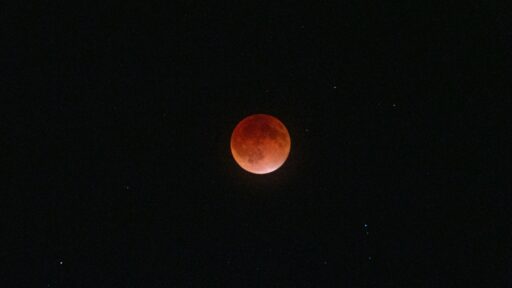
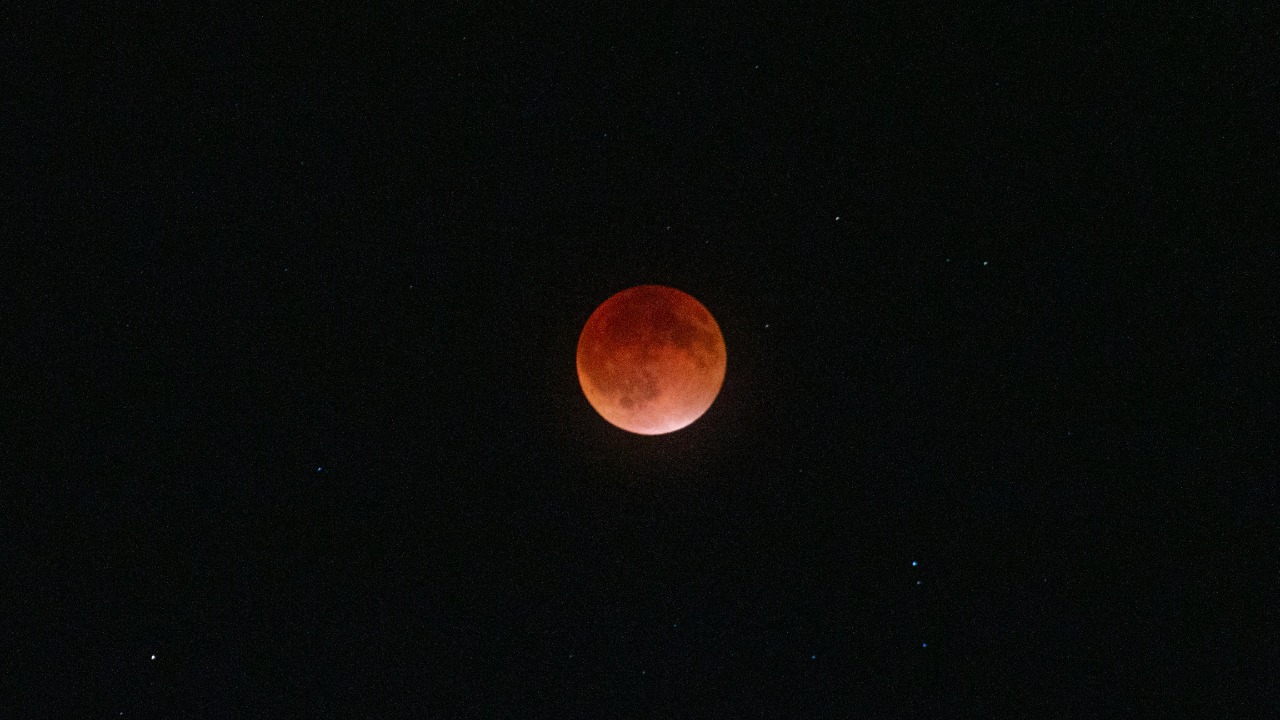
Once totality begins, sunlight skimming through Earth’s atmosphere is bent into the umbra and filtered, removing bluer wavelengths and bathing the lunar surface in shades of copper and crimson. Analysts describe this as the moment when the full worm moon becomes a true “blood moon,” with the red coloration persisting for the entire 58 m that the moon spends fully inside the umbra. The exact shade will depend on the state of Earth’s atmosphere, including dust and cloud cover worldwide, so some viewers may see a bright orange disk while others witness a darker, wine-colored moon that looks almost ghostly against the surrounding stars.
Why the moon turns blood red instead of disappearing
The blood red color that gives this eclipse its drama is a direct consequence of how Earth’s atmosphere bends and scatters sunlight. If Earth had no air, the moon would vanish completely once it entered the umbra, since the planet would block all direct light from the sun. Instead, the atmosphere acts like a vast lens that refracts sunlight into the shadow while also scattering short blue wavelengths, leaving mostly red and orange light to reach the lunar surface. Scientific explainers of the March event note that this refracted light is what paints the eclipsed moon in eerie hues, with the intensity of the color shaped by conditions such as volcanic aerosols and global weather patterns at the time.
Observers sometimes compare the effect to seeing all the world’s sunsets projected onto the moon at once, since the light that reaches the lunar surface has passed through the edges of Earth’s atmosphere where sunrise and sunset are taking place. Detailed previews of the eclipse describe how, during totality, the moon will sit deep within Earth’s shadow yet remain clearly visible because of this indirect illumination, often appearing brighter along one edge where it lies closer to the boundary of the umbra. The same geometry explains why earlier and later eclipses, such as the event on September 7, 2025 that is documented in eclipse catalogs, can look more brownish or gray if the atmosphere is relatively clear of dust compared with periods following major volcanic eruptions.
How this eclipse compares with recent and upcoming events
For many skywatchers, Tuesday’s event will feel like a step up in drama compared with the partial and penumbral eclipses that have dotted recent years. Astronomers have highlighted that the next major total lunar eclipse after this one will not arrive immediately, which adds urgency for those who want to catch a full blood moon while it is conveniently timed for multiple continents. Overviews of the March 2026 eclipse emphasize that it is part of a broader sequence of lunar events, including the partial eclipse in early September 2025, but stands out because the moon passes centrally through the umbra and spends nearly an hour in full shadow.
Specialist guides to the March eclipse explain that the moon will be near its average distance from Earth, so it will appear of average apparent size rather than unusually large or small in the sky. That means the spectacle will come not from a supersized disk but from the depth of the red coloration and the length of totality. Comparisons with earlier eclipses, such as the March 13 to 14, 2025 event that reached totality as the moon crossed Earth’s darker inner umbral shadow, show that each eclipse has its own character depending on the exact alignment and atmospheric conditions. In this case, the combination of a full worm moon, a central path through the umbra, and a long 58 m of totality gives Tuesday’s eclipse a strong claim as the standout lunar event of the year.
Best ways to watch, photograph, and share the show
Unlike a solar eclipse, a total lunar eclipse is safe to view with the naked eye, binoculars, or a telescope for the entire duration. Observing guides recommend finding a dark area without bright lights, such as a local park or beach away from city glare, and giving eyes at least 20 minutes to adapt to the darkness before totality begins. For people in the United States, local coverage has advised that the partial phase will begin at about 4:50 a.m. ET, with totality following soon after and the moon still above the horizon at 6:33 a.m. for many locations, so planning ahead to secure an unobstructed view low in the western sky can make the difference between a fleeting glimpse and a full experience of the blood red phase.