
A high-altitude NASA research jet slid to a stop on its belly at a Houston airfield after a mechanical problem left its landing gear retracted, sending sparks and smoke trailing behind the aircraft. The WB-57, a specialized platform used for atmospheric and spaceflight-related missions, came to rest at Ellington Field with its crew unhurt, turning a potentially catastrophic failure into a vivid demonstration of training and aircraft resilience. Early indications point to a landing gear malfunction that forced the pilots into a textbook gear-up landing rather than a routine return to base.
The incident has quickly become a focal point for aviation watchers because the WB-57 fleet is both rare and central to several cutting-edge NASA programs. Video of the jet skimming the runway on its fuselage has circulated widely, but behind the dramatic visuals is a more technical story about how a complex aircraft, a seasoned crew, and a well-practiced emergency response combined to prevent serious injury or fire.
How the WB-57 ended up sliding on its belly
According to multiple accounts, the aircraft involved was a NASA WB-57 high-altitude research jet operating from Ellington Field in Houston, Texas, when a mechanical issue affected its landing gear system. The crew reported the problem and prepared for a gear-up landing, ultimately touching down at Ellington Airport late in the morning after the malfunction made a normal approach impossible. Local officials said the landing happened around 11:30 a.m. Tuesday, a timeline that matches descriptions of the jet returning to Ellington Airport after the in-flight problem.
NASA later confirmed that the aircraft performed what it described as a gear-up belly landing at Ellington Field in Houston, Texas, and that all crew members were safe. One detailed account of the event notes that a NASA WB-57 high-altitude research aircraft executed the emergency maneuver at Ellington Field in Houston, Texas, with the jet sliding along the runway on its underside after the landing gear failed to deploy. In that description, the specialized aircraft is identified as part of NASA’s high-altitude fleet, with the number 57 explicitly tied to the model designation in both narrative and visual coverage of the gear-up landing.
The dramatic runway sequence, captured from the air
From above, the landing looked as dramatic as any emergency sequence in a training simulator. Aerial footage shows the WB-57 descending with its landing gear still tucked away, then contacting the runway on its belly and sending a plume of smoke and sparks streaming behind it as the aircraft skidded along the concrete. One video, captured from a helicopter, shows smoke and what appear to be small flames as the plane slid across the runway, with the white fuselage and distinctive black nose of the aircraft clearly visible as it decelerated. That same sequence, shared widely online, underscores how close the jet came to a more serious fire as friction heated the underside of the airframe.
Ground-level and telephoto views reinforce the sense of controlled urgency. In one clip, the WB-57 is seen already on its belly, sliding straight down the centerline with a trail of smoke marking its path, before coming to a stop surrounded by emergency vehicles. Another detailed description notes that video shows smoke and what appear to be flames as the aircraft skids, but that the crew members are doing well after the incident, a testament to both the structural strength of the jet and the crew’s handling of the emergency. The same reporting emphasizes that NASA will lead a thorough investigation into the mechanical issue, with one account quoting a post that referenced the landing time at approximately 11:19 a.m. CST and identified Stevens as the person noting that NASA will conduct the review and that the crew members are doing well, a detail linked directly to the post by Stevens.
Who was on board and how they got out safely
NASA has confirmed that the WB-57 was crewed by a pilot and a mission equipment operator seated in tandem, a typical configuration for this aircraft type. The agency said all crew members were safe after the incident, and subsequent updates indicated that they were doing well despite the violent nature of a belly landing. Local coverage from Houston noted that NASA confirmed the crew’s status shortly after the aircraft came to rest, emphasizing that there were no serious injuries and that the emergency response at Ellington Field unfolded as planned. One report specifically highlighted that NASA confirms crew safe after the incident at the Houston airfield, identifying the two-person crew arrangement with a pilot and mission equipment operator seated in tandem inside the WB-57 cockpit.
Airport officials have also provided context on how the emergency unfolded from the ground perspective. Jim Szczesniak, director of aviation for Houston Airports, said in a statement that the landing happened around 11:30 a.m. Tuesday, aligning with the timeline NASA provided for the gear-up touchdown. His comments framed the event as a response to an in-flight problem with the NASA WB-57, underscoring that the airport’s emergency services were ready as the aircraft approached. Szczesniak’s statement, which described the landing as the result of a flight problem involving the NASA WB-57, has been cited as a key local confirmation of the sequence of events and the timing of the emergency landing.
What the incident reveals about NASA’s WB-57 fleet
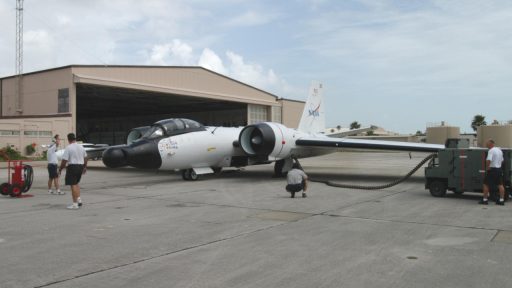
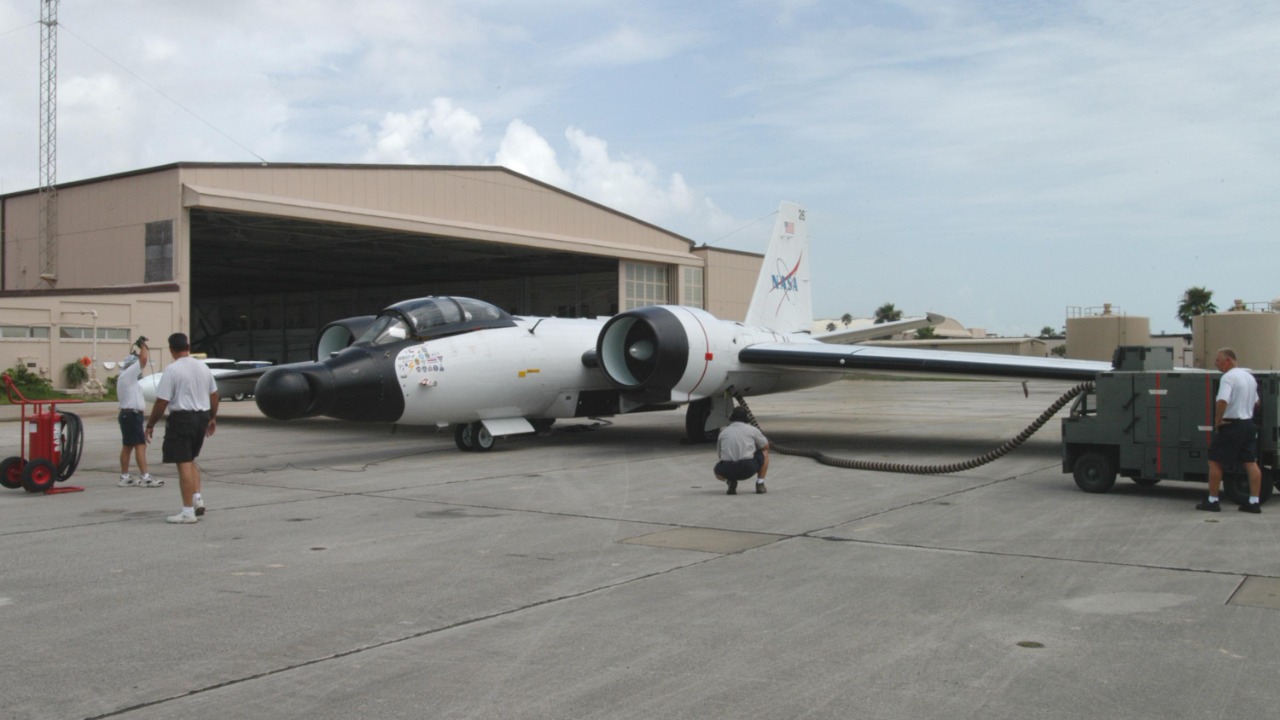
The WB-57 is not a common sight, even at research airfields, which is part of why this incident has drawn so much attention. NASA operates a small number of these high-altitude jets, which trace their lineage back to Cold War reconnaissance aircraft but have been extensively modified for scientific missions. A file description of the type shows a WB-57F aircraft taxiing at At Patrick Air Force Base in Cocoa Beach, Fla, before a test flight, underscoring the aircraft’s long service history and its role in specialized operations. That same file imagery, which labels the picture as FILE and notes the location At Patrick Air Force Base in Cocoa Beach, Fla, has been used to illustrate coverage of the Houston incident and to remind readers what the WB-57F looks like when it is not sliding on its belly at Ellington Field.
In the context of this emergency, the WB-57’s design likely helped protect the crew. The aircraft’s long wings and high-mounted engines kept critical components away from the runway surface as the fuselage absorbed the impact and friction of the landing. Aviation-focused coverage has highlighted that the NASA WB-57 research plane malfunctioned and had to touch down in Texas without landing gear, with close-up video showing the distinctive black nose of the aircraft scraping along the runway as it decelerated. Another detailed account refers to a NASA WB-57 research plane that malfunctioned and had to land at Ellington Field in Texas without its gear, again emphasizing the number 57 in connection with the model and pointing to the way the airframe’s shape influenced how it slid and finally stopped on the runway surface.
Investigation, safety record, and what comes next
NASA has already signaled that it will conduct a detailed investigation into the mechanical issue that left the WB-57 without working landing gear. One account of the incident notes that NASA will lead a thorough investigation, with officials stressing that understanding the root cause is essential before the aircraft returns to service. Aviation-focused reporting has described the event as a gear-up landing at Ellington Field in Houston, Texas, and has emphasized that all crew members were safe, quoting the figure 54 in connection with the broader context of aviation safety and NASA’s record. That same coverage, attributed to Jan and Pope in the byline and referencing UTC and Aviation Safety NASA, underscores that the agency treats even non-injury incidents as serious data points in its safety analysis.