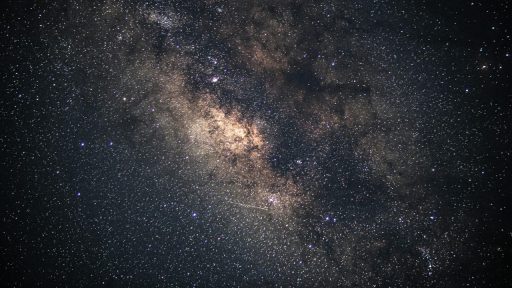
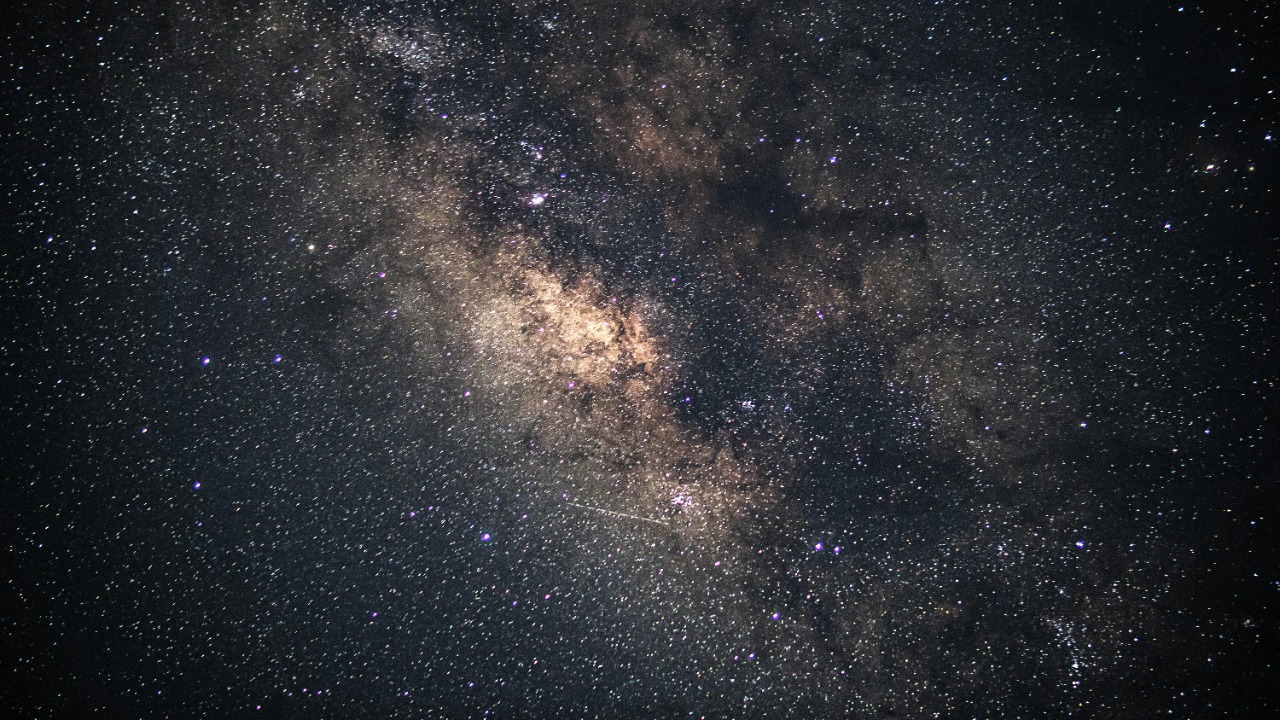

For more than two decades, astronomers have treated the compact object at the Milky Way’s center as a textbook supermassive black hole. Now a group of theorists argues that the same observations could be explained if our galaxy’s heart is instead a dense clump of dark matter shaped by quantum physics. If they are right, one of the most famous black holes in astronomy might not be a black hole at all, and our best laboratory for testing gravity would suddenly become a direct probe of dark matter itself.
The challenge is not that earlier measurements were wrong, but that they might be compatible with more than one kind of extreme object. The stars whipping around the Milky Way’s core, the glow of hot gas and even the silhouette seen by cutting edge telescopes all have to be rechecked against this alternative. The debate now unfolding is less about a single exotic object and more about whether dark matter can be pushed out of the shadows and into the bright center of our own galaxy.
From Sagittarius A* to a dark matter core
For years, the central object known as Sagittarius A*, often shortened to Sgr A*, has been modeled as a supermassive black hole with about four million times the Sun’s mass. That interpretation grew from painstaking tracking of stars that race around the Galactic Center at up to roughly 10 percent of the speed of light, motion that seemed to require an extremely compact and massive body. A new study argues that the same violent and rapid dance of stars could instead be governed by a tightly packed cluster of fermionic dark matter, a type of particle that would resist collapse in a way ordinary matter does not, yet still reproduce the measured orbits of the innermost stars according to one dark matter model.
Supporters of the dark matter interpretation point out that Sagittarius A* already sits inside a region where the galaxy’s invisible mass is expected to peak. In their scenario, an ultra dense concentration of these hypothetical particles would mimic the gravitational pull of a classic black hole, right down to the tight tracks of so called S stars that skim close to the center. Astronomers who favor this view argue that the Milky Way’s extreme core may therefore be a natural place to look for quantum supported dark matter structures, not just the empty spacetime pit predicted by general relativity.
Quantum pressure instead of an event horizon
The central technical claim of the new work is that quantum mechanics can hold a dark matter core together without forming an event horizon. In the proposed model, the Milky Way’s dark heart is made of fermionic particles whose quantum properties create a pressure that balances gravity at very high densities. That balance would allow an ultra compact configuration with nearly the same mass and size as a supermassive black hole, yet without the point of no return that defines a true black hole, according to an analysis of an ultra dense core.
Because this structure is supported by quantum pressure rather than a singularity, its interior physics would be radically different even if its external gravity looks almost identical. One report describes how the same quantum particles that shape the core could also influence the distribution of stars and gas around it, creating a footprint that resembles a black hole but is not quite the same. In that picture, the Milky Way’s center would become a test bed for both general relativity and particle physics, since the dark matter’s mass and spin would leave subtle signatures in the motions of nearby objects.
Matching the stars, gas and shadow
Any alternative to a black hole must clear a high observational bar, starting with the orbits of the closest stars. The new dark matter model claims to reproduce the full set of stellar tracks near Sagittarius A*, including the fastest stars that complete close in loops in just a few years. One account notes that this clump can match the observed speeds, which reach about 10 percent of light speed, while still remaining slightly more extended than a true event horizon, a detail that could eventually be teased out by more precise measurements of the Galactic Center.
The second hurdle is the behavior of hot gas and the silhouette captured by high resolution radio imaging. Earlier work showed that a compact object at the Milky Way’s core casts a shadow against its glowing surroundings that looks very much like the outline expected from a black hole. The new hypothesis responds that fermionic dark matter can also form a structure dense enough to create a similar shadow, as long as the mass and radius fall within a narrow range. One analysis stresses that any viable alternative must imitate a black hole’s shadow and that the proposed configuration is designed to do exactly that, extending earlier studies that hinted such a match was possible for a carefully tuned dark matter clump.
Why some astronomers are intrigued and others skeptical
The suggestion that the Milky Way’s central heavyweight might not be a black hole has split opinion among experts. Some astronomers see the idea as a creative way to connect two of the biggest unknowns in physics, dark matter and strong gravity, especially because the same dark matter core could in principle explain the extreme gravitational forces without introducing any new exotic fields. One report describes how some researchers now think the Milky Way’s center could be hiding something stranger than a supermassive black hole, a possibility that has motivated fresh simulations of how such a core would evolve and interact with surrounding Milky Way stars.
Others remain unconvinced, arguing that the conventional black hole picture already fits the data with fewer assumptions. Critics point to the clean agreement between general relativity and the observed stellar motions, as well as the success of models that reproduce the radio image of Sagittarius A* using standard accretion physics. They also stress that dark matter has never been detected directly, so replacing a well supported black hole with an unconfirmed particle cluster may not be justified. A summary of the debate notes that astronomers have always believed a supermassive black hole sits at the center of our galaxy and that current observations cannot yet clearly tell the difference between that scenario and a dark matter alternative, a tension highlighted in an overview of the competing views.
How we might finally tell what sits at the Milky Way’s heart
Settling the question will require more than clever theory; it will demand sharper data from the galaxy’s innermost light and matter. One line of attack is to watch the closest stars even more closely, looking for tiny deviations from the paths predicted by a pointlike black hole. The new dark matter model predicts small but measurable differences in how these stars precess and how fast they speed up near their closest approach, which could be tested as telescopes continue to track their orbits year after year according to several Galactic Center studies.
Another key front is high resolution imaging of the shadow and surrounding photon ring. Lupsasca, a theoretical physicist at Vanderbilt University in Nashville, is the project scientist for the Black Hole Explorer, a planned radio telescope in Earth orbit that aims to sharpen our view of black hole photon rings. That mission, described as a way to study the thin rings of light encircling black holes, could also probe whether Sagittarius A* behaves exactly like a black hole or shows subtle departures more consistent with a dark matter core according to technical plans for the Black Hole Explorer.