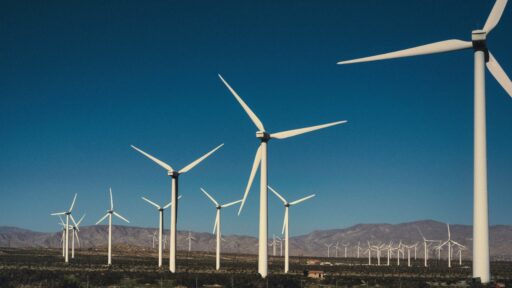
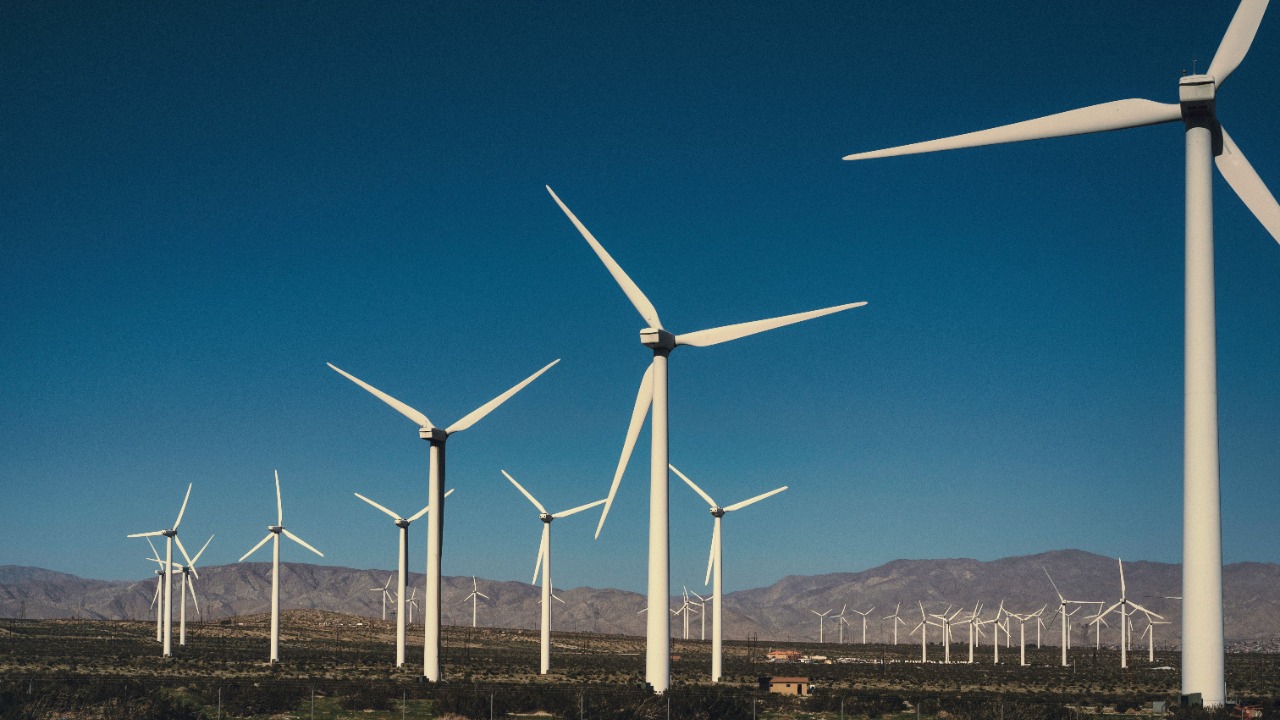

Drive through parts of Texas, Iowa or Oklahoma and wind turbines can stretch toward the horizon for miles. Yet counting turbines does not tell the whole story about how much electricity a state actually gets from wind.
A newer 3-megawatt turbine can produce far more electricity than an older machine rated below 1 megawatt. Wind conditions, turbine height, rotor size, downtime and grid constraints all influence actual production.
According to the latest state count available from the U.S. Wind Turbine Database, Texas, Iowa, Oklahoma, California and Kansas have the largest numbers of active utility-scale wind turbines in the United States. Texas alone had 19,175, more than Iowa, Oklahoma and California combined.
Nationally, wind generated roughly 464 billion kilowatt-hours of electricity in 2025, accounting for about 10.5% of U.S. utility-scale electricity production.
But which states have actually built the biggest turbine fleets, and how much power are those machines producing?
1. Texas — 19,175 Wind Turbines
Nothing else comes particularly close to Texas.
The state had approximately 19,175 active wind turbines in the latest U.S. Wind Turbine Database count.
That enormous fleet is spread primarily across West Texas, the Panhandle and other areas where open land and strong wind resources make large-scale projects economically attractive.
Texas also has something equally important: transmission.
Building thousands of turbines hundreds of miles from Dallas, Austin, Houston and other major electricity markets would be far less useful without the infrastructure needed to transport the electricity. Texas invested heavily in transmission projects connecting wind-rich western areas with population centers.
The result is extraordinary generation.
In May 2026 alone, Texas produced approximately 11.1 million megawatt-hours of wind electricity, representing roughly 27% of all U.S. wind generation that month.
For perspective, one megawatt-hour equals 1,000 kilowatt-hours.
That means Texas generated about 11.1 billion kilowatt-hours from wind in a single month.
The U.S. Energy Information Administration also identifies Texas as the country’s leading wind-electricity producer.
Texas demonstrates what happens when favorable geography, available land, large projects and major transmission investment all operate together.
2. Iowa — 6,475 Wind Turbines
Iowa has fewer than half as many wind turbines as Texas, but wind plays a much larger role in its own electricity system.
The state had approximately 6,475 active turbines.
During May 2026, those turbines generated around 3.65 million megawatt-hours of electricity.
The remarkable number, however, is not total production.
It is Iowa’s dependence on wind.
Wind supplied approximately 63.8% of all electricity generated within Iowa during May 2026, the highest share of any U.S. state in that month’s data.
That means wind is not merely a supplementary renewable resource in Iowa.
It is a central part of the state’s electricity system.
Iowa’s geography helps explain why. Large areas consist of relatively open agricultural land with strong wind resources and comparatively few obstacles.
Wind farms can also coexist with farming because turbines occupy only part of the land within a project area. Crops and livestock can remain around much of the infrastructure.
Anyone interested in the national relationship between wind resources and generation can explore the Department of Energy’s wind-energy resources, which notes that the U.S. now has more than 150 gigawatts of installed wind capacity.
3. Oklahoma — 5,564 Wind Turbines
Oklahoma ranks third with approximately 5,564 active wind turbines.
The state combines excellent Great Plains wind conditions with large areas of relatively low-density land, making it another natural location for utility-scale wind development.
Those turbines generated approximately 3.47 million megawatt-hours during May 2026.
That placed Oklahoma only slightly behind Iowa despite having around 900 fewer turbines.
Wind also accounted for approximately 46% of Oklahoma’s total electricity generation during the month.
That comparison demonstrates why simply counting turbines can be misleading.
Turbines differ significantly in output.
The Department of Energy reports that the average capacity of newly installed U.S. wind turbines had already reached 3.4 megawatts by 2023, dramatically higher than machines installed during the industry’s earlier years.
A state with a large population of newer turbines can therefore extract considerably more electricity from each machine than a state dominated by older equipment.
4. California — 5,510 Wind Turbines
California may be America’s solar-energy icon, but it also owns one of the country’s largest wind turbine fleets.
The state had approximately 5,510 active turbines, only slightly fewer than Oklahoma.
Yet its electricity production illustrates perfectly why turbine count and generation are not the same thing.
California generated approximately 1.52 million megawatt-hours of wind electricity in May 2026.
That is less than half Oklahoma’s output despite the two states having almost the same number of turbines.
Why?
California developed some of America’s earliest large wind farms.
Regions such as Altamont Pass, San Gorgonio Pass and Tehachapi became major wind-energy centers decades ago. Consequently, part of California’s fleet consists of older, smaller turbines installed during earlier generations of wind development.
The EIA’s explanation of U.S. wind resources specifically highlights Tehachapi, where strong seasonal winds are created partly by temperature differences between California’s desert interior and the Pacific region.
California proves that having thousands of turbines does not automatically make a state one of the largest current wind-electricity generators.
Age and size matter.
5. Kansas — 4,395 Wind Turbines
Kansas completes the top five with approximately 4,395 active turbines.
But Kansas punches far above that ranking when electricity output is considered.
During May 2026, Kansas generated approximately 2.60 million megawatt-hours from wind.
That was substantially more than California despite Kansas operating roughly 1,100 fewer turbines.
Wind supplied about 50.8% of all electricity generated in Kansas during the month.
The state’s strong performance is not unusual. EIA reports that Kansas ranked fourth nationally for total wind-powered generation in 2024 and had approximately 9,000 megawatts of installed wind capacity by the end of that year.
Its flat, open landscape sits within one of America’s strongest onshore wind-resource regions.
For Kansas, wind has moved well beyond the experimental stage.
It has become one of the foundations of the state’s power supply.
More Turbines Does Not Always Mean More Electricity
The comparison between California and Kansas makes this particularly clear.
California has around 5,510 turbines.
Kansas has roughly 4,395.
Yet Kansas produced about 2.60 million MWh of wind electricity during May 2026 compared with California’s 1.52 million MWh.
The reason is that turbine count says nothing about turbine capacity.
Older wind turbines may have capacities measured in hundreds of kilowatts.
Modern utility-scale machines commonly reach several megawatts.
Rotor diameter has increased too.
A larger rotor sweeps a much larger area, allowing the turbine to capture more energy from moving air.
Tower heights have also increased, allowing turbines to reach stronger and more consistent winds above the surface.
Modern wind farms can therefore generate enormous quantities of power using fewer machines than projects built decades earlier.
The States With the Most Turbines Aren’t Exactly the States Making the Most Wind Power
This creates one final twist.
The five states with the most turbines are Texas, Iowa, Oklahoma, California and Kansas.
But the five states producing the most wind electricity in 2025 were Texas, Iowa, Oklahoma, Kansas and Illinois.
California drops out.
Illinois moves in.
That is the clearest evidence that raw turbine numbers should never be confused with electricity output.
America’s wind fleet is a mixture of machines installed across several decades using dramatically different technologies.
Some states have enormous numbers of older turbines.
Others have fewer but much more powerful machines.
Texas manages to dominate both measurements.
With more than 19,000 active turbines and roughly 11.1 million MWh generated in May 2026 alone, it operates at a completely different scale from every other state.
But perhaps the more surprising stories are Iowa and Kansas.
They do not merely own thousands of turbines.
During May 2026, wind generated more than half of the electricity produced inside both states.
That shows how far American wind energy has moved.
Those towers scattered across the Great Plains are no longer just symbols of a future renewable grid.
In several states, they already are the grid’s dominant source of electricity.