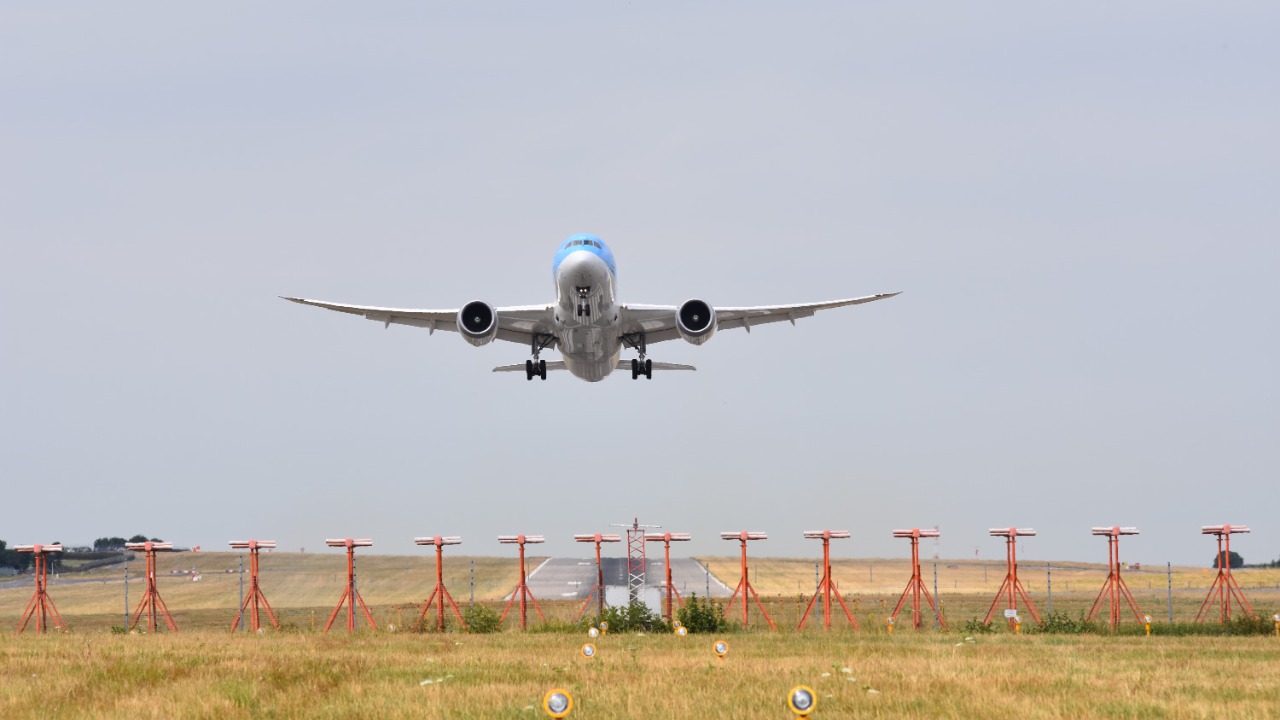

Air travelers already know that thunderstorms, snow and strong winds can delay a flight. A clear summer afternoon, however, rarely looks threatening from an airport window.
That could increasingly change.
Extreme heat can make it physically harder for an aircraft to take off safely. When temperatures climb high enough, airlines may need to remove cargo, carry less fuel, delay departure until conditions cool or even ask passengers to give up their seats. The Associated Press reported that these restrictions are becoming a more visible issue as extreme-heat days increase at major airports.
The reason is not an airline policy or an unusually cautious pilot.
It is basic aerodynamics.
Why Does Hot Weather Make Takeoff Harder?
Aircraft depend on air moving over their wings to create lift.
The problem is that hot air is less dense than cooler air. As temperature rises, the same volume of atmosphere contains fewer air molecules. A wing therefore has less dense air available to work with, while a jet engine also receives less mass of air for producing thrust.
The Federal Aviation Administration describes this through a concept known as density altitude. High temperatures increase density altitude, which means the aircraft effectively performs as though the airport were located at a higher elevation than it actually is. The FAA warns that higher density altitude produces longer takeoff distances and slower climb performance.
Its official density-altitude guidance explains that high, hot conditions can reduce aircraft performance enough that gross weight may need to be lowered for safe operation.
That can create a strange situation.
The runway is dry.
The sky is blue.
The aircraft is mechanically healthy.
Yet it may still be too heavy to leave safely.
Airlines Have to Make the Plane Lighter
Before departure, airlines calculate whether a particular aircraft can safely take off under the conditions at that airport.
Weight, temperature, runway length, airport elevation and aircraft performance all matter.
If the calculations show that the aircraft is too heavy, something has to change.
Airlines can remove cargo. They can reduce the amount of fuel carried and schedule a refueling stop later. They can wait for cooler temperatures. In some cases, they can ask passengers to voluntarily switch to a later flight.
That last possibility received attention in Las Vegas in July 2026.
American Airlines offered compensation to volunteers willing to leave a July 24 flight from Harry Reid International Airport after the temperature reached 114 degrees Fahrenheit, or about 47 degrees Celsius. The airline described reducing aircraft weight as a normal safety practice when hot-weather performance requires it.
Passengers may understandably find that frustrating.
But the alternative is not simply accepting a slower takeoff.
Aircraft performance has hard safety limits.
Higher Airports Face the Problem Earlier
Heat is particularly challenging when the airport is already located well above sea level.
Denver International Airport sits more than 5,000 feet above sea level. The air there is naturally thinner than at a coastal airport.
Add high temperatures and the density drops further.
That means an aircraft in Denver may experience serious performance restrictions at a temperature that would create fewer problems at an airport close to sea level.
The FAA’s Aircraft Performance handbook emphasizes that temperature and pressure altitude are central to calculating aircraft performance. Higher density altitude directly reduces takeoff and climb capability.
This explains why pilots often use the phrase “high, hot and heavy” with caution.
A high airport, a hot day and a heavily loaded airplane are exactly the combination aircraft performance calculations dislike.
Short Runways Create Another Limitation
Elevation is not the only problem.
Runway length can be equally important.
Because an aircraft may need more speed to generate sufficient lift in hot, thin air, it can require more runway before leaving the ground.
That makes airports with shorter runways potentially more vulnerable.
The AP identified New York’s LaGuardia Airport and Washington Reagan National Airport as examples where short runways can increase the likelihood of weight limitations during very hot weather.
A large airport with an extremely long runway gives operators more performance margin.
A constrained urban airport may not.
And no amount of passenger frustration can create another thousand feet of pavement.
There Is No Single Temperature Where Aircraft Stop Flying
It would be convenient if aviation had a universal rule saying planes cannot fly above a specific temperature.
It does not.
The FAA does not impose one maximum takeoff temperature for every aircraft. Limits vary according to aircraft type, weight, runway characteristics and airport altitude.
One airplane may be able to depart safely while another sitting nearby cannot.
A lighter aircraft may take off while a fully loaded version of the same model needs passengers or cargo removed.
Sometimes delaying the flight until evening is enough because cooler air improves performance.
The FAA even recommends considering cooler parts of the day when density-altitude conditions become problematic.
That could make early-morning flights increasingly attractive at extremely hot airports.
Climate Change Could Make Weight Restrictions More Common
The concern is not that hot-weather restrictions suddenly appeared in 2026.
Airlines have dealt with them for decades.
The concern is frequency.
A study involving researchers from Columbia University, NASA’s Goddard Institute for Space Studies and the Logistics Management Institute projected that, under continued warming, some airports could face weight restrictions on approximately 10% to 30% of departures during the hottest periods of the day by mid-century.
The NASA-hosted research explains the physical relationship clearly: increasing temperatures reduce air density, which reduces lift at a given airspeed and can force airlines to limit takeoff weight.
More recent research cited by the AP projected that aircraft operating from four European airports could eventually need to reduce loads by the equivalent of about 10 passengers per flight by 2065 under modeled warming conditions.
That does not mean every flight will start leaving ten people behind.
It means the margins airlines use when planning flights could become tighter more often.
Phoenix Shows How Quickly the Heat Problem Is Changing
Few airports demonstrate the trend better than Phoenix Sky Harbor.
According to an AP analysis of weather-station data, Phoenix Sky Harbor has averaged 43 days per year since 2020 with temperatures reaching at least 110 degrees Fahrenheit. That is more than three times the average seen during the middle of the 20th century.
Las Vegas has also experienced a significant increase.
Harry Reid International Airport averaged around 18 days per year at 110 degrees or hotter between 2020 and 2025, more than double the annual average recorded during the 1940s through the 1960s.
Palm Springs has experienced even more extreme conditions, averaging 55 days per year at 110 degrees or above during the 2020s, according to the AP analysis.
The issue is therefore not simply that aircraft dislike heat.
The number of days producing extreme performance conditions is changing.
Airports Themselves Can Be Heat Traps
Airports may also experience a particularly intense version of urban heat.
Think about their physical design.
Large airports contain enormous expanses of concrete and asphalt. There is relatively little shade or vegetation around runways and taxiways. Aircraft engines, ground vehicles and cooling equipment generate additional heat.
Those surfaces absorb solar energy throughout the day and release it back into the surrounding environment.
Climate researchers interviewed by the AP noted that airports can therefore be particularly vulnerable to the urban heat-island effect.
That creates another challenge for airport planners.
Future aviation infrastructure may need to be designed not only around passenger demand and larger aircraft but around increasingly severe environmental conditions.
The Biggest Change May Be What Passengers Consider “Bad Weather”
Aviation remains extraordinarily safe partly because airlines refuse to ignore physical limits.
Removing cargo or delaying a flight may be inconvenient.
Attempting a takeoff when aircraft-performance calculations say the margins are inadequate would be something much worse.
That is why extreme-heat disruptions should not be interpreted as aircraft becoming unsafe.
They show safety systems working.
What may change is how often those systems need to intervene.
For decades, travelers have looked through an airport window at clear skies and assumed the weather could not possibly be responsible for a delay.
As temperatures rise, that assumption may become increasingly outdated.
The future of weather-related flight disruption may not always arrive with dark clouds, lightning or snow covering the runway.
Sometimes it may arrive under completely blue skies, while the thermometer quietly climbs toward 110 degrees.