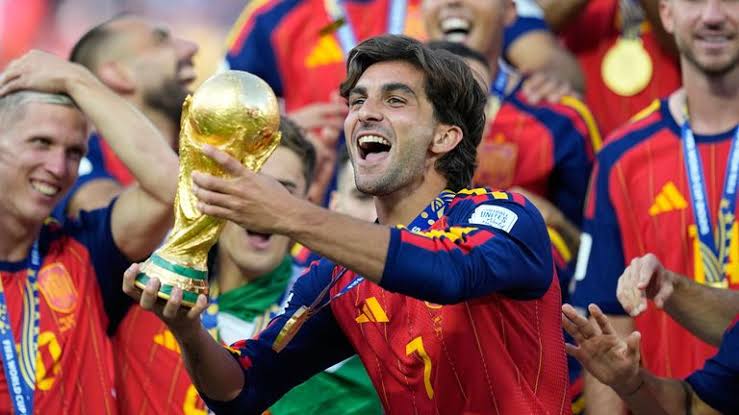

Spain secured their second FIFA World Cup title with a tense 1-0 extra-time victory over Argentina, as substitute Ferran Torres scored the decisive goal in the 106th minute.
The final at New York New Jersey Stadium remained scoreless throughout regulation time before Torres converted Spain’s sustained pressure into the match-winning moment. The result ended Argentina’s title defence and gave Spain their first men’s World Cup triumph since 2010. A complete match summary and official tournament coverage are available through the FIFA World Cup 2026 hub.
Spain controlled most of the contest but struggled to break down an Argentina side focused on defensive organisation. The defending champions remained compact, protected their penalty area and appeared increasingly determined to take the final to a penalty shootout.
That resistance eventually collapsed during extra time.
Ferran Torres Became Spain’s Unexpected Final Hero
Torres started the final on the bench, but his introduction gave Spain fresh movement and a more direct attacking threat.
In the 106th minute, the Barcelona forward reacted to a bouncing ball inside the penalty area and sent his finish beyond Emiliano Martínez. The goal was confirmed as the decisive moment in both the Reuters match report and the Associated Press final recap.
Torres had not been the central figure in Spain’s starting attack during the tournament, which made his impact even more dramatic. Spain had entered the final with greater attention focused on Lamine Yamal, Dani Olmo and Rodri, yet it was a substitute who ultimately delivered the country’s second star.
His goal also demonstrated the depth available to coach Luis de la Fuente. Spain could replace tired attackers without abandoning their technical identity or reducing the quality of their passing.
Spain Dominated Without Finding an Early Breakthrough
Spain controlled possession and territory for long periods, but the final did not develop into the open, attacking contest many expected.
Argentina defended deeply and attempted to deny Spain space between the defensive and midfield lines. Yamal was closely watched, while Spain’s central players repeatedly encountered a crowded area around the box.
Despite their control, Spain initially struggled to create a clear finishing opportunity. Martínez remained alert in goal, and Argentina’s defenders blocked passing lanes rather than chasing the ball unnecessarily.
The pressure was almost entirely one-sided. Reuters reported that Argentina failed to register a shot during regulation time, an unprecedented statistic for a team appearing in a World Cup final. The Reuters analysis of Spain’s victory described Argentina as offering virtually no attacking threat before extra time.
Spain therefore faced a difficult psychological challenge. They were controlling the game but remained one mistake away from allowing Argentina a decisive counterattack.
Enzo Fernández’s Red Card Shifted the Balance
Argentina’s resistance became even harder to maintain when Enzo Fernández was sent off during extra time.
The dismissal reduced Argentina to 10 players and gave Spain additional room to circulate the ball around the penalty area. Torres scored shortly afterward, taking advantage of a defence that was beginning to lose its shape and energy. The sequence is detailed in the Associated Press match account, which also notes that the winning goal arrived soon after Fernández’s red card.
Argentina had already spent most of the match without the ball. Playing with one fewer player during extra time made it increasingly difficult to close passing lanes and protect Martínez.
The goalkeeper still produced several important saves and prevented Spain from extending their lead. However, Argentina could not create a meaningful response at the other end.
Spain’s Defence Set a New Standard
Spain’s victory was built not only on possession and technical quality but also on an exceptional defensive record.
The champions conceded only one goal across eight tournament matches, according to the Associated Press tournament report. That became a new defensive record for a World Cup-winning side.
Spain’s defensive control began further forward than the back line. Their midfielders pressed quickly after losing possession, while the forwards worked to prevent opponents from building comfortable attacks.
Rodri played a central role in that structure by controlling space in front of the defence and helping Spain recover possession before opponents could counter.
The final provided the clearest example of that system. Argentina possessed elite attacking players, including Lionel Messi, but rarely progressed into positions where they could threaten Spain’s goal.
Lionel Messi’s Likely Final World Cup Ended in Defeat
The final may have marked Messi’s final appearance at a World Cup.
At 39, the Argentina captain was attempting to lead his country to consecutive titles after the 2022 triumph in Qatar. Argentina would have become the first nation since Brazil in 1962 to successfully defend the men’s trophy.
Spain prevented that achievement.
Messi struggled to find space against Spain’s organised midfield and defensive structure. Argentina’s lack of possession left him isolated for long periods, and he was unable to produce the decisive moment that had defined so many previous matches.
The Associated Press report described the defeat as an emotional ending for Messi, who left the field in tears after being denied another championship.
His presence had given the final a powerful generational narrative. Messi represented the most successful player of the previous era, while 19-year-old Yamal symbolised Spain’s future.
Neither scored, but the transition between generations remained one of the defining themes surrounding the match.
Luis de la Fuente’s Substitutions Decided the Final
De la Fuente deserves significant credit for the way he managed the closing stages.
Spain did not abandon their passing style when the opening goal failed to arrive. Instead, the coach introduced fresh attackers capable of increasing the tempo and stretching Argentina’s tired defensive line.
Torres brought direct running through the centre, while other substitutes helped Spain maintain width and pressure during extra time.
The winning goal validated that approach. Rather than depending entirely on the starting eleven, Spain used their squad depth to wear Argentina down.
De la Fuente has now guided this generation to two major international trophies after Spain also won the 2024 European Championship. Reuters noted that the World Cup victory extended Spain’s unbeaten sequence to 38 matches, strengthening their position as the dominant men’s international team of the period. The full tactical and match context can be read in the Reuters final analysis.
Spain Completed a Demanding Route to the Trophy
Spain’s knockout campaign required victories against several major European opponents.
They defeated Austria in the round of 32 before eliminating Portugal, Belgium and France on the way to the final. Argentina reached the title match after progressing past Cape Verde, Egypt, Switzerland and England.
The expanded 48-team World Cup included 104 matches and was staged across Canada, Mexico and the United States. A broader review of the tournament’s new structure and major storylines is available in the Associated Press World Cup retrospective.
Spain’s route demonstrated both attacking quality and defensive consistency. They defeated France 2-0 in the semifinal before shutting out Argentina in the final.
The champions conceded only once during the entire competition, despite facing several teams with elite attacking talent.
Spain Now Hold Both Men’s and Women’s World Titles
The victory created another historic achievement for Spanish football.
Spain became the first country to hold the men’s and women’s World Cup titles simultaneously. The women’s national team won its first global championship in 2023, and the men have now added the 2026 trophy.
The men’s latest triumph arrived 16 years after Andrés Iniesta scored the extra-time winner against the Netherlands in the 2010 final.
The parallels are difficult to ignore. Both Spanish World Cup titles were decided 1-0 after regulation time, and both featured a late goal from a player who became permanently associated with the country’s greatest football achievement.
Iniesta created the first star. Torres delivered the second.
The Final Confirmed Spain as Football’s Leading International Side
The final was not a classic in terms of entertainment. It contained long periods of cautious football, limited attacking action and few clear chances.
However, Spain’s performance reflected the qualities that made them champions.
They controlled the ball, prevented Argentina from counterattacking and trusted their substitutes to make the difference. Even when the match became frustrating, Spain remained patient rather than forcing risky passes.
Argentina came close to taking the contest to penalties, but their lack of attacking ambition eventually left them without a route back after Torres scored.
The 1-0 result may appear narrow, yet Spain’s control was much greater than the scoreline suggests. They produced the pressure, created the chances and found the only goal of the final.
Ferran Torres entered the match as a substitute and left as a national hero. His extra-time finish ended Argentina’s reign, closed what may have been Messi’s final World Cup chapter and confirmed Spain as champions of the world for the second time.