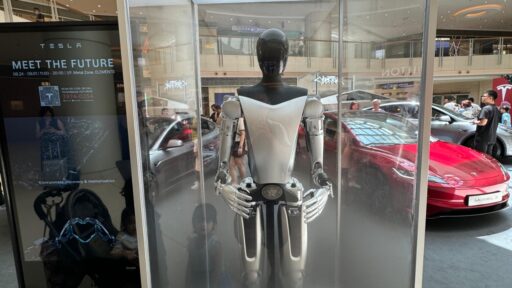
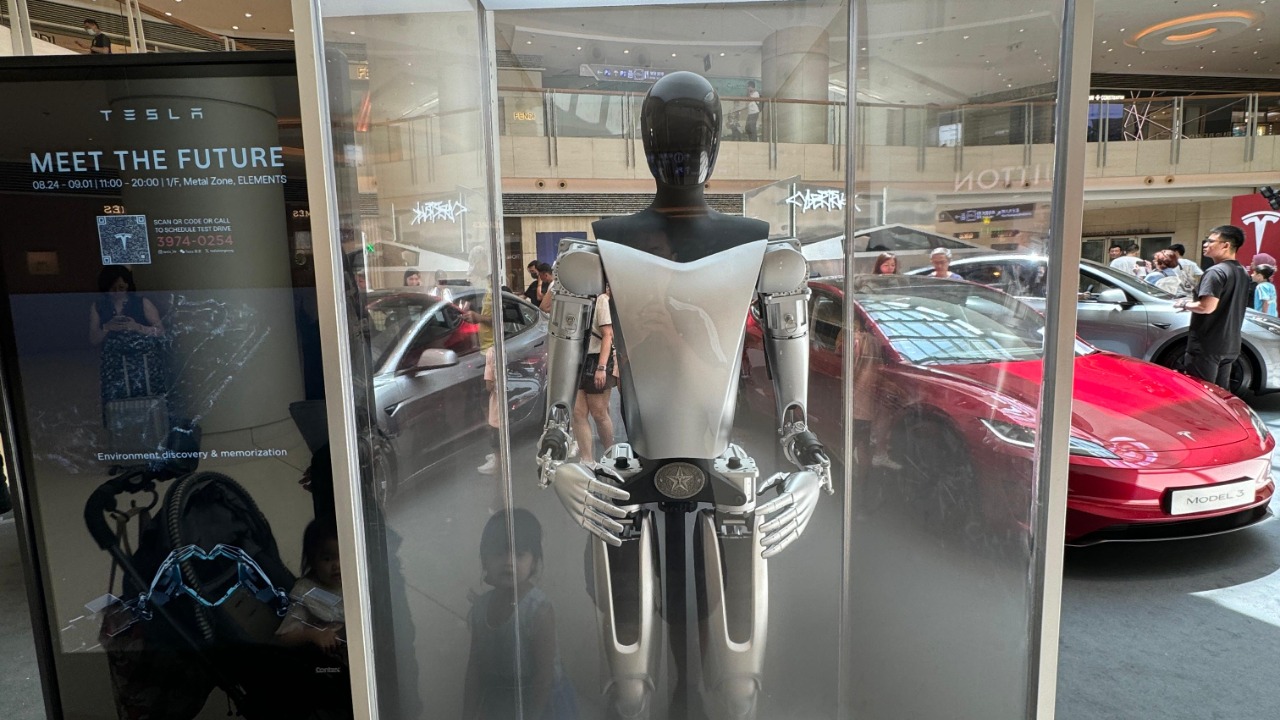

Tesla’s humanoid robot, Optimus, has quietly crossed an important threshold: it is now performing real work inside the company’s factories, yet it remains unavailable to customers who want to buy one. The shift from stage demos to production-floor tasks marks a new phase for both Tesla and the broader robotics sector, even as questions linger about how capable the system actually is and how far it can scale. For now, Optimus is a working prototype that doubles as a high-stakes bet on Tesla’s future business model.
How Optimus evolved from stage demo to factory worker
When Tesla first showed a humanoid robot concept, the project looked more like a science experiment than a product roadmap. Early descriptions framed Optimus as a general-purpose machine that could eventually handle repetitive or dangerous work that humans would rather avoid. Technical breakdowns of the project describe a bipedal robot roughly human-sized, designed to use Tesla’s existing expertise in batteries, actuators and computer vision, with the same kind of neural networks that power the company’s driver-assistance software feeding its perception and control stack, as detailed in technical overviews.
As the project matured, Tesla shifted from flashy event demos to more grounded engineering milestones. The company has highlighted improvements in Optimus’s walking stability, hand dexterity and ability to manipulate objects with two arms. According to coverage of Tesla’s internal plans, the robot is intended to share hardware and software platforms with the company’s vehicles so that improvements in one domain can transfer to the other, a strategy that aims to reduce costs and accelerate iteration. That convergence matters because it turns Optimus into a potential force multiplier for Tesla’s existing AI and manufacturing investments rather than a separate research project.
The most significant step came when Tesla began deploying Optimus units into its own production lines. Reporting on the company’s operations at the Fremont factory describes robots working on specific tasks around the Model S and Model X lines, with Tesla carving out a dedicated area of the facility for Optimus production and testing. Coverage of the Fremont build-out notes that the company is rearranging parts of the plant to support a small but growing number of humanoid units, as seen in reports on Optimus production. Taken together, those moves signal that, at least internally, Tesla believes the robot has moved from prototype-only status to something closer to an early operational tool.
Why Tesla is keeping Optimus in-house for now
Despite the factory deployment, Tesla has not opened Optimus to outside buyers or developers. The company has instead framed the robot as an internal productivity lever and a long-term product that will take years to mature. Analysts who follow Tesla’s financial moves have pointed to management decisions that prioritize Optimus and AI over some traditional automotive programs. Reporting on recent earnings discussions describes Tesla shelving certain vehicle variants in order to free up resources for humanoid robots and related AI infrastructure, with executives explicitly tying capital allocation to the promise of future Optimus revenue, as outlined in coverage of earnings decisions.
Keeping the robot in-house gives Tesla several advantages. It can test and refine Optimus in a controlled environment where safety, liability and uptime are managed by the same company that builds the hardware and software. The company can also tune the robot for very specific tasks such as parts handling, simple assembly steps or material movement, rather than promising a general-purpose assistant that must perform in unpredictable customer settings. In addition, Tesla can iterate the design rapidly without committing to long-term support contracts or regulatory filings that would come with commercial sales.
There is also a reputational dimension. Public commentary has been sharply divided on whether Optimus is a breakthrough or a marketing distraction. One widely shared critique argues that the robot is far from delivering on its ambitious promises and describes early demonstrations as a “total fiasco,” citing awkward movements and limited autonomy in staged videos, as recounted in a critical analysis of Optimus. By keeping the system away from paying customers, Tesla can avoid high-profile failures in uncontrolled environments while it works through technical and reliability issues on its own factory floors.
Competitive pressure also shapes the timing. The humanoid robotics field now includes multiple players, from industrial incumbents to startups building legged machines for logistics and inspection. Comparative reviews of the sector list Optimus alongside robots from companies that have spent years refining bipedal locomotion and manipulation for warehouse and research use, as seen in surveys of Optimus competitors. Many of those rivals are already running pilot programs or limited deployments with external customers, which raises the bar for what Tesla must deliver if it wants to enter the same market without undercutting its own narrative about superior AI and hardware.
Why Optimus in Tesla factories matters right now
Even if Optimus is not yet a product, its presence on Tesla’s production lines has immediate implications for both the company and the wider manufacturing sector. For Tesla, every task that a humanoid robot can handle inside a car plant offers a live test of whether the company’s AI-first approach can translate into tangible efficiency gains. If Optimus can reliably perform repetitive motions such as picking parts, loading fixtures or moving small assemblies between stations, Tesla can quantify labor savings, quality improvements or uptime gains and feed those metrics back into its long-term strategy.
Humanoid robots are particularly interesting in brownfield factories like Tesla’s because they can, in theory, operate in spaces built for humans without the need for extensive retooling. Unlike fixed industrial arms or custom conveyors, a bipedal robot with hands can walk through existing aisles, use tools and interact with equipment that was not designed around automation. That flexibility, if it proves real, could let Tesla automate tasks that were previously uneconomical to redesign around traditional robotics. It also gives the company a chance to demonstrate a concrete use case for general-purpose robots at scale, which has been a missing piece in the broader robotics story.
The internal deployment also matters for labor and policy debates. As Optimus takes on more factory work, questions arise about how Tesla will retrain or redeploy human workers, what safety protocols will govern close interaction between people and humanoid robots, and how regulators will evaluate incidents that involve AI-controlled machines. Unlike industrial arms that are caged or heavily fenced, humanoid robots are meant to share space with humans, which raises new challenges for collision avoidance, fail-safe behavior and ethical guidelines. Tesla’s factories could become early testbeds for those norms, for better or worse.
Beyond Tesla, the move signals to investors and competitors that humanoid robots are no longer confined to research labs and trade-show stages. When a large manufacturer begins using such systems in its own core operations, it validates the idea that general-purpose robots can have near-term economic value, even if they are not yet mass-market products. That perception can influence capital flows into robotics startups, partnerships between automakers and AI companies, and the priorities of component suppliers that build sensors, actuators and compute hardware tailored for bipedal machines.
What could come next for Optimus and factory humanoids
The next phase for Optimus will likely hinge on two questions: whether Tesla can prove consistent, measurable gains from its factory deployments, and whether the company decides to open the platform to external customers or developers. Technical analyses of the project suggest that Tesla envisions a future in which Optimus units are produced at high volume on automotive-style lines, potentially with price points that undercut existing industrial robots of similar capability, as described in broader coverage of the. To reach that stage, Tesla will need to standardize the hardware, stabilize the software and define clear service and safety frameworks.