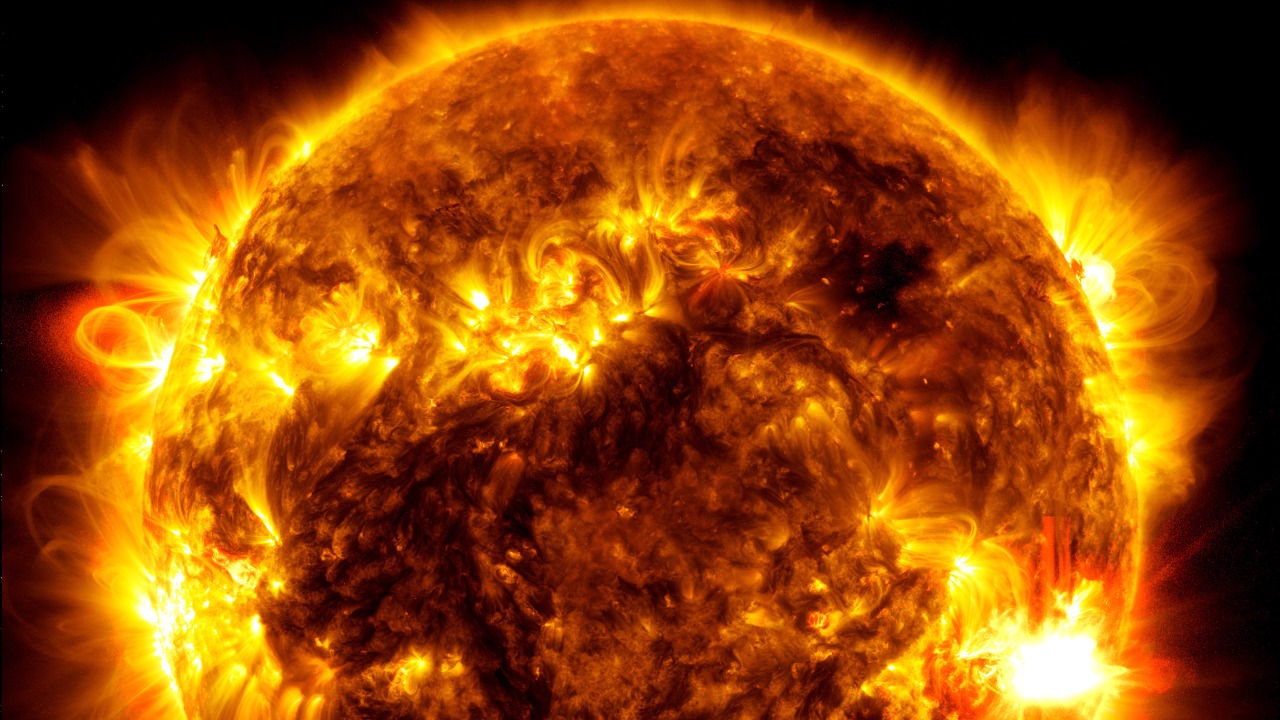

Starlink satellites are slipping out of orbit sooner than their designers expected, and the Sun is to blame. As solar activity ramps up toward the peak of its current cycle, intense storms are puffing up Earth’s upper atmosphere, increasing drag on low‑orbiting spacecraft and shortening their lifetimes.
This effect is already visible in daily reentries of Starlink hardware and in fresh modeling work suggesting that earlier forecasts underestimated how harsh this solar maximum would be. The result is a live stress test of the business model behind mega‑constellations and of the global rules meant to keep low Earth orbit usable.
How an active Sun is reshaping Starlink’s low orbits
Starlink’s design relies on operating thousands of satellites in very low Earth orbit, typically a few hundred kilometers up, where latency is low and failed units can naturally fall back into the atmosphere. That tradeoff depends on relatively stable atmospheric conditions. During strong solar activity, however, the Sun floods near‑Earth space with energetic particles and ultraviolet radiation that heat and expand the upper atmosphere.
As that expansion reaches Starlink altitudes, the satellites plow through denser air and experience more drag. Orbital decay speeds up, and spacecraft that once might have stayed aloft for several years can lose altitude much faster. Recent measurements of thermospheric density and satellite trajectories, combined in a detailed modeling study of solar cycle 25, show that the current upswing in activity is on the high side of earlier forecasts.
The elevated activity is now visible in the Starlink fleet’s behavior. Tracking data compiled by researchers and independent observers indicates that the constellation is experiencing more frequent and steeper orbital decay events than in the previous solar minimum. A report on satellites falling faster describes how increased drag is already cutting into the expected lifetimes of some units, forcing operators to perform more frequent orbit‑raising maneuvers or accept earlier reentry.
Solar storms do not affect every satellite equally. Newer Starlink generations carry improved propulsion and navigation systems, while older or partially failed spacecraft have less margin to fight drag. During particularly strong geomagnetic storms, operators sometimes preemptively raise orbits or tilt spacecraft to reduce cross‑section, but that consumes fuel and shortens the useful life of the satellite. The net result is a constellation that must work harder and burn more propellant just to hold its planned shells.
What has changed in the rate of Starlink reentries
The most visible symptom of this new environment is the pace at which Starlink satellites are now reentering the atmosphere. Earlier in the program, reentries were sporadic and often tied to deliberate deorbiting of failed units. Over the past year, however, independent skywatchers and professional trackers have logged a near‑continuous stream of Starlink objects returning to Earth.
Observers now estimate that roughly one to two Starlink satellites are reentering each day, a rate that aligns with analyses of daily reentries compiled from global tracking networks. Some of these are controlled deorbits at the end of a satellite’s planned life, but others are being nudged down more quickly by solar‑driven drag than original projections assumed. In a few cases, operators have had to accelerate retirement schedules for units that could no longer maintain their assigned altitude.
The scale of the Starlink system amplifies the impact of this trend. SpaceX has already launched thousands of spacecraft into orbit, with recent counts placing the active and drifting fleet at several thousand units, and total launches even higher. A recent breakdown of how many Starlink are currently in space highlights just how dense these shells have become compared with traditional communications constellations.
As more satellites are added, even a modest uptick in individual failure or decay rates translates into a steady stream of reentries. That flow is now shaped not only by engineering decisions but also by the timing and intensity of solar storms. A particularly strong geomagnetic event can increase drag across an entire shell at once, effectively shortening the operational life of hundreds of satellites by weeks or months.
Why the drag problem matters for safety, business and science
Faster orbital decay might sound like a built‑in cleanup mechanism, and in some respects it is. Regulators have pushed operators toward lower orbits precisely because atmospheric drag can remove dead satellites within a few years. The current situation, however, shows how an overactive Sun can turn that safety feature into an operational headache and a potential risk factor.
From a safety perspective, increased drag complicates collision avoidance. Starlink satellites already perform frequent automated maneuvers to steer clear of other spacecraft and debris. When the atmosphere thickens unevenly during a storm, predicted trajectories become less reliable and operators must update models more frequently. That raises the chance of close approaches and coordination errors, especially in crowded altitude bands that also host crewed missions and scientific observatories.
There is also the question of what happens as these satellites burn up. Current assessments suggest that most Starlink hardware disintegrates high in the atmosphere, but the sheer volume of reentries is prompting new scrutiny of cumulative effects. A growing body of research is examining how repeated reentry of satellite materials might affect upper atmospheric chemistry and long‑term climate trends, although many of those findings remain preliminary and, in several cases, unverified based on available sources.
For SpaceX, the drag problem hits the business model directly. Shorter lifetimes mean more frequent replacement launches to maintain coverage and capacity. That raises costs and increases launch cadence pressure, even as the company continues to expand into new markets. A detailed overview of Starlink’s deployment notes that the constellation is still in an aggressive growth phase, with new generations and orbital shells planned. If solar activity keeps whittling down lifetimes, the balance between growth and replacement becomes harder to manage.
The impact extends to astronomy and space science. Starlink satellites already contribute to streaks in astronomical images and to radio interference in sensitive bands. Faster orbital decay might reduce the long‑term presence of any given satellite, but the higher launch tempo needed to compensate can increase the number of bright objects in the sky at any given moment. Astronomers therefore face a moving target, shaped both by corporate deployment plans and by the Sun’s mood.
What a harsher solar maximum means for future mega‑constellations
The current solar cycle is now a real‑world experiment for every company that wants to operate hundreds or thousands of satellites in low orbit. The detailed modeling of accelerated decay and the broader analysis of solar cycle 25 both point toward a key lesson: design margins that look comfortable during a quiet Sun can erode quickly when activity ramps up.
Future constellations are likely to respond in several ways. Engineers can harden satellites against drag by increasing propulsion capacity, improving attitude control, and refining autonomous station‑keeping algorithms that account for real‑time space weather data. Operators might also adjust target altitudes, trading slightly higher latency for orbits that are less sensitive to atmospheric expansion during storms.
Regulators are also watching. Agencies that oversee orbital debris and spectrum use are already grappling with how to manage mega‑constellations. The emerging picture of faster‑than‑expected decay may influence rules on disposal orbits, end‑of‑life timelines, and required fuel reserves. If solar activity can shave years off a satellite’s life, policies that assumed a predictable five‑year decay window may need revision.
Finally, the episode is sharpening interest in better space weather forecasting. Operators now have strong financial incentives to anticipate geomagnetic storms days in advance, so they can raise orbits or adjust spacecraft orientation in time. Improved forecasts would not eliminate drag, but they could smooth out some of the worst spikes in orbital decay and reduce the risk of sudden, constellation‑wide disruptions.
Starlink’s current struggles with solar‑driven drag are therefore more than a technical footnote. They offer an early glimpse of how a crowded low Earth orbit will behave under a restless Sun, and a warning that the economics and safety assumptions behind satellite mega‑constellations depend on forces no company can control.