
NASA is tearing up its original Artemis playbook and racing to field a leaner, faster path back to the lunar surface. The agency is trading an early, high‑risk moon landing for a stepped sequence of test flights that it hopes will echo the pace and focus of Apollo while still building a long‑term presence in deep space. The reboot keeps the promise of astronauts returning to the moon alive, but it also concedes that the first plan was too fragile to survive real‑world engineering and budget pressure.
Rather than a single heroic leap, Artemis is now structured as a campaign that spreads risk across multiple missions and years. The reset delays the first landing but also adds new flights, simplifies hardware, and gives crews more chances to shake down the Space Launch System rocket and Orion spacecraft before anyone tries to descend to the lunar surface again.
From ambitious sprint to staged campaign
The original Artemis roadmap tried to jump rapidly from an uncrewed test around the moon to a crewed landing at the south pole, compressing complex work on landers, suits, and life support into a tight window. That vision has now been replaced with a slower, more methodical campaign that NASA officials say is modeled in spirit on the way Apollo pivoted from early test flights to a landing within about three years. Reporting on the revamp describes how NASA is explicitly looking back to Apollo as a template for a faster but still disciplined push to put astronauts on the surface again, with one analysis noting that NASA is reshaping Artemis by modeling it after the “speedy” Apollo approach described by Marcia Dunn and a related poll of public attitudes toward the program.
Central to the reset is a decision to stop treating the first landing as a near‑term deadline and instead use early crewed missions as orbital testbeds. Universe Today reports that Earlier NASA updates increased the cadence of flights under the Artemis Pro gram and added an extra mission focused on docking maneuvers in low Earth orbit. That shift, combined with a delayed landing timeline, turns Artemis into a multi‑step proving ground rather than a single shot at glory.
Artemis II and the hardware learning curve
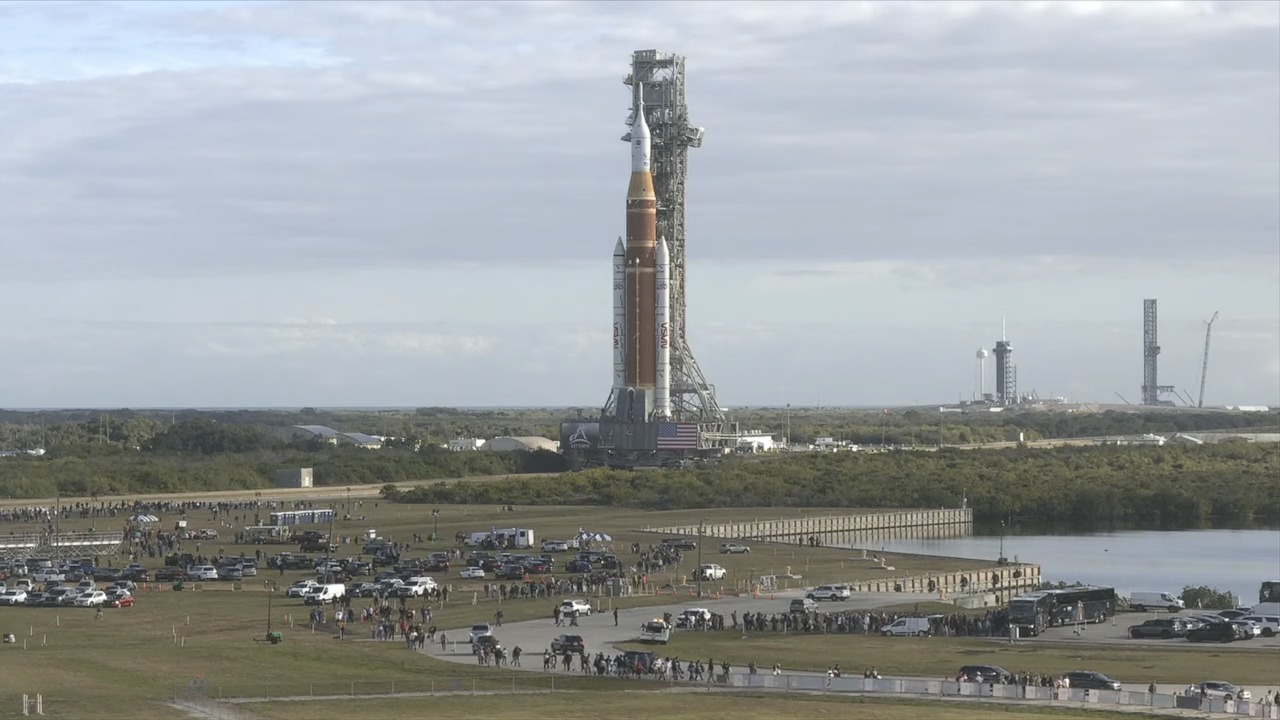
The next big milestone in this new architecture remains Artemis II, a crewed lunar fly‑around that will be the first time astronauts ride the Space Launch System and Orion together. NASA imagery shows crawler‑transporter 2 hauling the Artemis II SLS rocket with the Orion spacecraft atop it at Kennedy Space Center, a scene captured in a NASA news release that also confirms the mission’s role as a test flight. Another report describes the same mobile launcher carrying the Artemis II Space Launch System rocket and Orion spacecraft as it arrives at the Vehicle Assembly Buil ding, underscoring how much heavy infrastructure is involved before a single astronaut can strap in.
Artemis II has already absorbed delays as engineers work through hydrogen leaks and other rocket problems, with one local report noting that the lunar fly‑around by four astronauts is now off until at least April and that the launch window remains uncertain. A separate update from Kennedy Space Center explains that those hoping to watch the NASA Space Launch System SLS Artemis II launch from the Kennedy Space Center Visitor Complex must plan around a revised schedule, confirming that NASA schedule changes have already pushed back Artemis II’s first launch attempt. These setbacks are exactly why NASA now wants more test flights before committing to a landing.
Artemis III loses its first landing and gains a new role
The most dramatic change in the reboot is the fate of Artemis III, which had been billed as the mission that would return astronauts to the lunar surface. That plan is now off the table. Multiple reports state that the Artemis III mission, which had been expected to land astronauts near the moon’s south pole in 2028, will instead be redefined as an orbital flight. One detailed account explains that Artemis III is changing from a crewed mission to the lunar surface to an Earth orbit rendezvous of NASA’s Orion spacecraft, describing how the crew will practice docking in Earth orbit rather than attempting a landing and linking this shift directly to Artemis mission changes.
In a separate briefing, Jared Isaacman announced that the Artemis III mission, which was set to land astronauts on the moon in 2028, will no longer shoot for that target, calling the previous plan “just not the right pathway forward” and arguing that NASA needs to set Artemis up for long‑term success. The same report describes how Isaacman framed the decision as part of a broader overhaul and noted that the crew will still fly but will not attempt a landing. Online discussion threads, including one titled NASA’s Artemis Program Updates and Discussion Thread 6, have dissected this change in real time as fans parse the implications of Artemis Program Updates posts that confirm Artemis III’s reclassification.
A new mission, a delayed landing, and a simpler rocket
To fill the gap left by the lost landing, NASA has added a new mission to the Artemis lunar program and updated its architecture accordingly. A formal announcement from Kennedy Space Center details how NASA is inserting an extra flight into the sequence so that crews can rehearse docking and other operations in orbit before committing to a descent, a decision laid out in the Artemis architecture update. Universe Today adds that NASA is increasing the cadence of missions to meet its objectives under the Artemis Pro gram, but that the first lunar landing has been delayed to a later flight that will follow this new orbital rehearsal.
The rocket that will carry these missions is also changing. SpaceNews reports that NASA has revised plans for future Artemis missions and canceled upgrades to the Space Launch System that would have used a Boeing developed Exploration Upper Stage, effectively freezing SLS at its current configuration for the foreseeable future. Another analysis from LiveScience explains that in the updated plan NASA is targeting a 2028 landing and a 2027 in orbit docking flight, while also walking away from the more powerful upper stage that was supposed to debut on later SLS variants, a decision that is detailed in coverage of sweeping Artemis changes. By simplifying the rocket, NASA hopes to reduce technical risk, even if that means relying more heavily on orbital refueling and commercial landers later on.
Inside NASA’s “back to basics” strategy
Behind all these structural tweaks is a philosophical shift inside NASA leadership. In a detailed briefing, agency officials described the need to “get back to basics” and focus on flying what is ready instead of chasing an ever more complex stack of upgrades and add ons. Spaceflight Now recounts how launch had been planned for early February but was delayed to repair a hydrogen leak and to give engineers time to address other concerns, and how NASA now aims for one moonshot per year thereafter under the new plan. A separate Universe Today summary notes that NASA has increased the mission cadence while still delaying the first landing, illustrating how the agency is trying to balance ambition with realism in its major overhaul.
Public communication is a key part of that strategy. NASA maintains an official Artemis blog that tracks mission milestones, hardware rollouts, and policy shifts in near real time, providing a running narrative of how the program is evolving. The blog, accessible through the Artemis blog portal, has chronicled everything from the uncrewed Launch of Artemis 1 (which finally lifted off after being delayed four times and reached space in the early hours of a Wednesday) to the current debate over how to sequence Artemis II and Artemis III. By foregrounding both setbacks and progress, NASA is trying to show that the reboot is not a retreat from the moon but a recalibration meant to avoid the kind of overreach that could stall human deep space exploration for another generation.