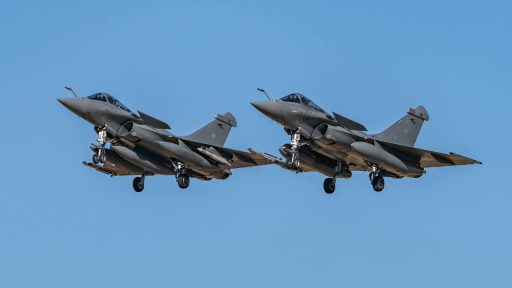
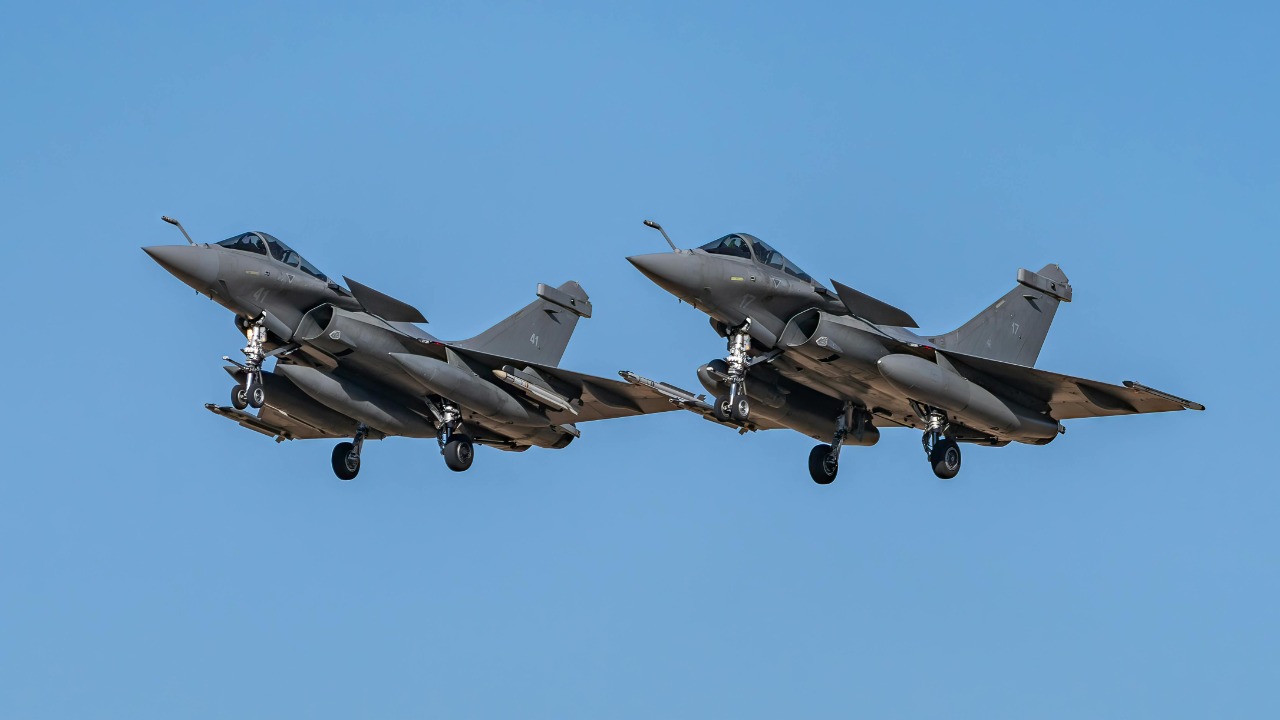

French combat aviation is pushing deeper into the Nordic theater, with two Rafale fighters operating from Sweden in a focused test of agile, cold weather operations. The deployment is small in numbers but large in strategic meaning, signaling how Paris and Stockholm intend to fight if Europe’s northern flank ever turns from deterrence to defense.
Rafale jets touch down in Uppsala
The current deployment centers on two Dassault Rafale fighters from the French Air and Space Force that have shifted from their home bases to Uppsala, a key Swedish air hub north of Stockholm. Operating in Sweden in the heart of winter allows the French crews to validate how the Rafale, its support teams, and its logistics chain perform when exposed to freezing temperatures, snow, and limited daylight, conditions that would define any real conflict in the High North. The mission is framed as part of a broader France–Agile Combat Employment effort, which is designed to prove that frontline aircraft can disperse quickly, sustain operations away from large permanent bases, and still generate credible combat power.
The activity in Uppsala is scheduled across several days, from Jan 19 to Jan 23, with the two French jets integrated into Swedish airspace and ground support routines. By flying from a Swedish base rather than a French one, the Rafale detachment is forced to rely on host-nation infrastructure, procedures, and weather services, which is exactly the kind of friction that planners want to expose in peacetime. The presence of the French fighters at Uppsala in Sweden is also a visible signal to any observer watching Nordic air activity that France is prepared to operate far from its own territory in support of regional security.
Agile Combat Employment meets Arctic winter
What France is testing in Sweden is not just whether the Rafale can handle icy runways, but whether its entire concept of Agile Combat Employment can survive in a harsh northern climate. Agile Combat Employment, often shortened to ACE, is built on the idea that modern fighters should be able to disperse rapidly to multiple smaller airfields, complicating an adversary’s targeting and allowing air forces to keep flying even if major bases are hit. By sending two Dassault Rafale aircraft from the French Air and Space Force into Swedish winter conditions, planners are examining how quickly ground crews can refuel, rearm, and turn jets around when they are operating from a partner’s base with limited organic support.
The cold weather layer makes this more than a routine cross-border visit. Hydraulic systems, avionics, and munitions all behave differently in sub-zero temperatures, and the tempo of operations must adapt to snow clearance, de-icing cycles, and the safety constraints of working on frozen ramps. French officials have framed the current activity in Sweden as part of a broader push to refine agile combat employment in realistic conditions, with the two Rafale fighters in Sweden for cold weather testing described as a deliberate step in that direction. Reporting on the deployment of the French Rafale jets to Sweden for agile operations underscores that this is about validating a concept of operations as much as it is about flying sorties.
Nordic partnerships under rising Arctic pressure
The decision to send French fighters into Sweden’s winter skies is also rooted in a broader political and strategic calculation. Nordic governments have been explicit that their security environment is deteriorating, particularly around the Arctic and the North Atlantic, where military activity and geopolitical competition are both intensifying. French leaders have responded by deepening cooperation with Nordic partners, presenting this as a shared responsibility to manage instability in Europe’s northern approaches and to protect critical sea lanes, energy infrastructure, and undersea cables that run through the region.
Officials in the region have stressed that, in a time of growing uncertainty in the surrounding world, it is crucial to keep developing cooperation with allies who share both values and responsibility for collective security. That logic is directly reflected in the way France is strengthening its military partnership with the Nordics amid rising Arctic tensions, including more frequent exercises, port calls, and air deployments. The Rafale presence in Sweden fits squarely into this pattern, giving French crews practical experience with Nordic geography and procedures while reassuring local populations that they are not facing these pressures alone. The emphasis on shared responsibility for security, highlighted in reporting on Nordic cooperation, helps explain why a two-jet deployment can carry outsized political weight.
From Jade drills to Swedish runways
The Rafale detachment in Sweden does not come out of nowhere. Earlier training cycles have already pushed French Air and Space Force units to practice dispersal and forward operations under the banner of the Jade drills, which focused on moving aircraft away from their home bases to alternative airfields. In those exercises, planners explicitly linked their approach to the Agile Combat Employment playbook and to the United States Marines’ Expeditionary Advanced Base Operations, both of which emphasize small, mobile, and resilient footprints. The experience gained in the Jade drills, where the French Air and Space Force trained to disperse aircraft from their home bases to other locations, laid the conceptual groundwork for sending Rafale fighters into a partner’s territory for real-world cold weather testing.
By shifting from controlled national drills to operations on Swedish soil, France is effectively stress testing the same ideas under more complex political and logistical conditions. Host-nation support arrangements, airspace coordination, and communications interoperability all become part of the experiment, not just the technical performance of the aircraft. The fact that earlier training explicitly referenced ACE and the Marines’ EABO playbooks shows that French planners are thinking in terms of a wider allied doctrine, not a purely national approach. Reporting on how, in the Jade drills, the French Air and trained to project power forward helps connect those earlier experiments to the current deployment in Sweden, which is essentially the next iteration of the same playbook.
What a two-jet deployment really signals
On paper, two Rafale fighters are a modest force, but in strategic signaling, scale is not the only metric that matters. By choosing to send a small, agile detachment rather than a large exercise package, France is underscoring the very concept it is trying to prove: that high-end combat aircraft can be moved quickly, integrated with allied infrastructure, and sustained in demanding environments without a massive footprint. For Sweden, hosting the jets at Uppsala provides a live test of how its own bases, command structures, and logistics can support allied aircraft in a crisis, from runway capacity and fuel stocks to security procedures and maintenance support.
I see this kind of deployment as a rehearsal for the first days of any future emergency in the Nordic region, when speed, flexibility, and political will would matter more than raw numbers. The Rafale’s presence in Sweden for agile cold weather testing shows that Paris is willing to put real assets into that rehearsal, not just issue communiqués. It also gives both sides a chance to identify friction points, whether in communications, rules of engagement, or technical compatibility, while there is still time to fix them. In that sense, the two jets at Uppsala are less a token gesture and more a flying laboratory for how France and Sweden intend to fight together if deterrence ever fails.