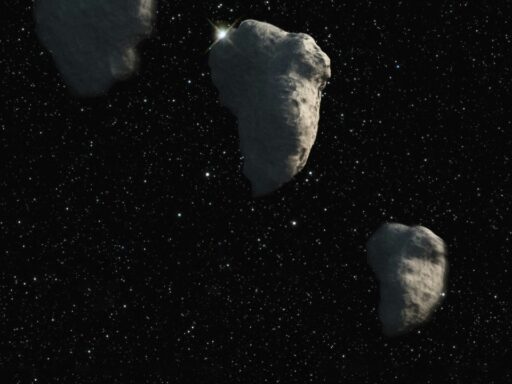

A dead star in our galactic neighborhood has been caught in the act of tearing apart the frozen remnant of a planetary system, a Pluto-scale body that once orbited a Sun-like star. The discovery turns a distant white dwarf into a kind of forensic lab, letting astronomers read the chemical fingerprints of a shattered world and reconstruct how it formed and where it came from. It is also a rare, vivid preview of the long future of our own Solar System, when the Sun will shrink into a white dwarf and start feeding on whatever icy debris survives.
At the center of this drama is the white dwarf WD 1647+375, a stellar corpse compact enough to pack roughly the Sun’s mass into a body the size of Earth, yet close enough, at about 260 light-years away, to study in detail. As fragments from an icy, Pluto-like object spiral into its intense gravity, they leave telltale traces in the star’s light, revealing a composition rich in nitrogen and water ice that is strikingly similar to Pluto and other Kuiper Belt objects.
The dead star and its icy victim
The white dwarf at the heart of this story, WD 1647+375, is what remains after a Sun-like star exhausted its nuclear fuel and shed its outer layers, leaving behind a dense, cooling core. In a nearby corner of our galactic neighborhood, roughly 260 light-years away, this compact star is now surrounded by a disk of debris that betrays a violent recent encounter with a large icy body. Observations show that the material falling into the star is not just rocky dust but includes volatile-rich fragments that point to a Pluto-class object rather than a typical asteroid.
A key clue is the way heavy elements appear in the white dwarf’s atmosphere, where they should quickly sink out of sight unless they are being continually replenished by infalling material. Spectra reveal an unusual abundance of nitrogen, along with signatures of water-bearing compounds, indicating that WD 1647+375 is actively accreting the remains of a frozen world. The system’s distance and basic properties have been pinned down through detailed analysis of the star’s light, with reports describing WD 1647+375 as a white dwarf located about 260 light-years away and identified by its full designation that includes the number 375.
How Hubble exposed a cosmic crime scene
The breakthrough came when astronomers turned the Hubble Space Telescope toward WD 1647+375 and dissected its light with high-resolution spectroscopy. By spreading the star’s ultraviolet and optical light into a spectrum, they could see narrow absorption lines carved out by specific elements in the white dwarf’s atmosphere. Those lines revealed an unexpected surplus of nitrogen, oxygen, carbon, and other volatiles that do not belong in a bare stellar remnant, pointing instead to ongoing pollution by planetary debris. The precision of Hubble’s instruments allowed researchers to distinguish this pattern from the more rock-dominated signatures seen in many other white dwarfs.
From that spectral fingerprint, the team inferred that the accreted body must have had a high ice content and a bulk composition similar to Pluto and other distant dwarf planets. The nitrogen-rich mix, combined with the estimated mass of the disrupted object and its volatile inventory, suggests an ice-to-rock ratio of 2.5, significantly higher than typical inner-system asteroids. That ratio, together with the detection of abundant water ice, marks the debris as the remains of a frozen, Pluto-like world that once orbited far from its star before being perturbed inward and torn apart.
Reconstructing a Pluto-like world from stellar crumbs
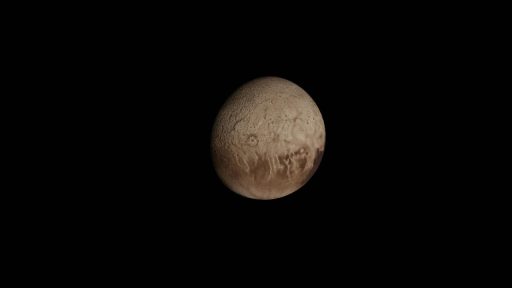
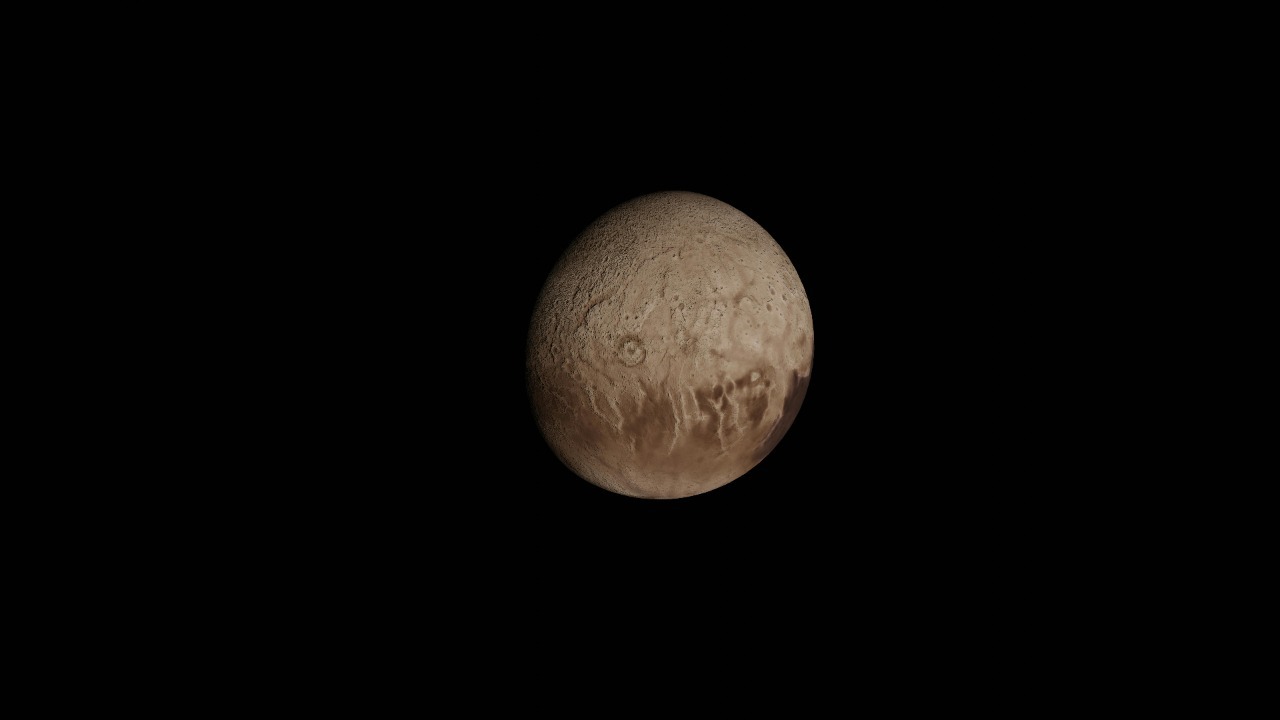
Piecing together the nature of the destroyed object is a bit like reconstructing a crime victim from trace evidence, and the chemistry points strongly to a Pluto analog. Pluto itself is known to be rich in nitrogen ice, with a surface dominated by frozen nitrogen, methane, and carbon monoxide, and a bulk composition that mixes rock and ice. The debris now contaminating WD 1647+375 shows a similar nitrogen-heavy profile, along with signs of carbon and oxygen that are consistent with a body loaded with volatile ices. That combination is difficult to produce in the warmer inner regions of a planetary system, which is why astronomers argue the shattered world must have formed in a distant, cold reservoir.
In our own Solar System, that reservoir is the Kuiper Belt, a broad ring of icy objects beyond Neptune that includes Pluto and many smaller bodies. The evidence from WD 1647+375 suggests its planetary system once hosted a comparable belt of frozen debris, and that the destroyed object came from that outer region before gravitational interactions nudged it inward. Researchers describe the accreted body as a close match to Pluto in both size and composition, and note that the inferred ice content and nitrogen abundance are hard to reconcile with anything other than a distant, Kuiper Belt style origin. The analogy is strengthened by the way the debris appears to have been scattered inward from a region similar to The Pluto neighborhood in our own Solar System, the Kuiper Belt that encircles the outer planets.
What WD 1647+375 reveals about planetary system afterlives
For astronomers, WD 1647+375 is more than a curiosity; it is a test case for how planetary systems survive and evolve after their stars die. White dwarfs are the end state for the vast majority of stars, including the Sun, and many of them show signs of being polluted by planetary debris. In most cases, that debris looks rocky and dry, consistent with the breakup of asteroids or inner planets. The icy, Pluto-like composition at WD 1647+375 proves that even distant, volatile-rich worlds can be dragged into the destructive reach of a white dwarf long after the star’s red giant phase has ended.
This has direct implications for the long-term fate of our own outer Solar System. When the Sun becomes a white dwarf, its gravity will still dominate the Kuiper Belt, and interactions with surviving planets could scatter objects like Pluto inward, where they might be tidally disrupted and accreted. The detection of a nitrogen-rich, ice-dominated body at WD 1647+375 shows that such a scenario is not just theoretical. Detailed modeling of the system, supported by high quality Hubble data, indicates that the disrupted object likely originated in a distant icy belt and was perturbed onto a star-grazing orbit, turning the white dwarf into a kind of cosmic recycling center for its planetary leftovers.
A new window on exoplanet chemistry and future missions
Beyond the drama of a star eating a frozen world, WD 1647+375 opens a rare window on the detailed chemistry of exoplanetary material. Directly measuring the composition of small, distant worlds is extraordinarily difficult, but when a white dwarf digests one of its planets or planetesimals, the elements are effectively smeared across the star’s surface where they can be read spectroscopically. In this case, the nitrogen-rich, water-laden signature provides a benchmark for what a Pluto-like body looks like when reduced to its elemental ingredients. That, in turn, helps refine models of how volatile-rich worlds form and migrate in planetary systems beyond our own.
The discovery also sets the stage for future observatories that will extend this kind of stellar forensics. Missions such as the Nancy Grace Roman Space Telescope and other planned facilities will be able to survey many more white dwarfs for similar pollution patterns, building a statistical picture of how common icy, Pluto-class bodies are in the galaxy. Current work with Hubble and complementary facilities has already shown that WD 1647+375 is not an isolated curiosity, but part of a broader population of dead stars still interacting with their planetary debris. Researchers have described the system as a kind of cosmic crime scene, highlighted in outreach material that frames the event as a White Dwarf Star Like Object and a dramatic example of how Astronomers can use stellar remnants to probe planetary chemistry. Public-facing summaries have even described the event as a Hungry white dwarf consuming a Pluto like world, a vivid shorthand for a process that, in the distant future, may play out in our own backyard.