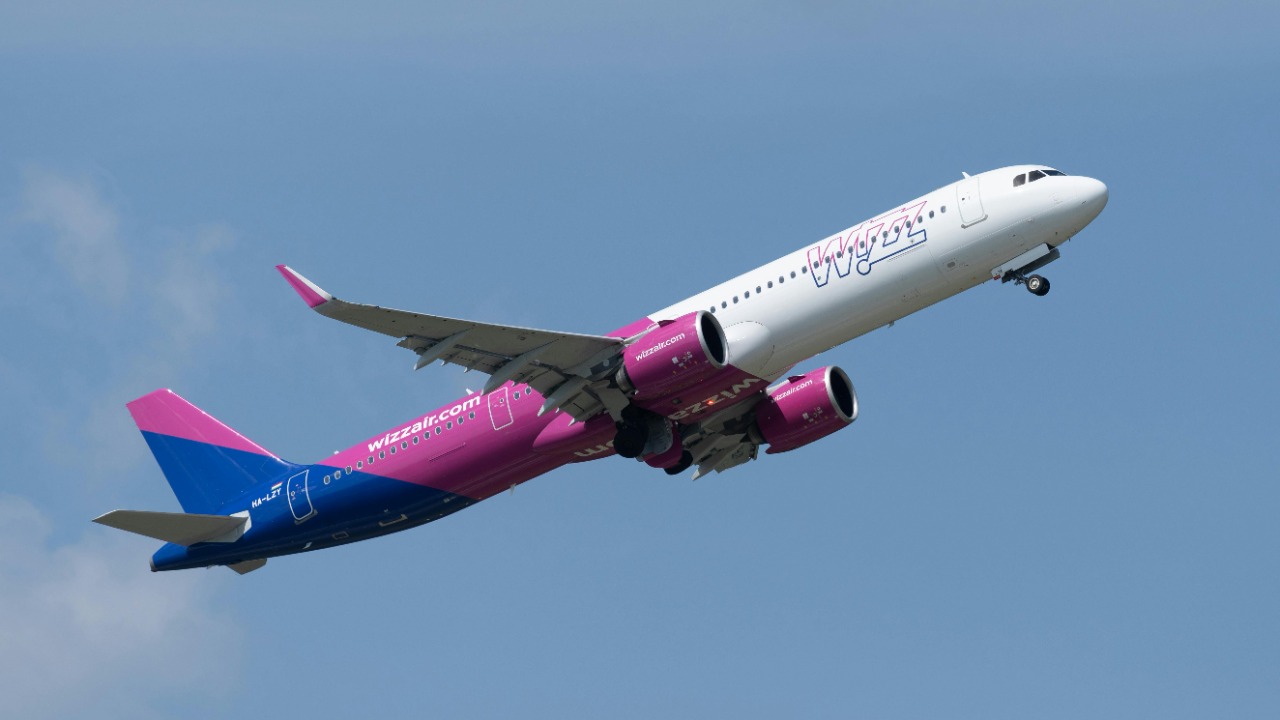

In just 22 years, Wizz Air has gone from a regional upstart to a carrier that has flown 500 M people, a scale that puts it firmly among Europe’s biggest low cost brands. The Budapest based airline is marking the half billion milestone as proof that its stripped back model and aggressive growth strategy have reshaped how Central and Eastern Europeans travel. I see this moment less as a finish line and more as a stress test of whether the formula that got Wizz Air here can keep working in a tougher aviation cycle.
The long climb to 500 M passengers
Wizz Air’s story is, at its core, about speed. The company says it needed 11 years to carry its first 100 m passengers, then only four more years to double that figure, a sign of how quickly demand accelerated once its network reached critical mass across Europe. According to Wizz Air, that early phase laid the foundation for the surge that followed, as new bases and aircraft allowed the airline to densify routes that had previously been underserved or priced out of reach for many travelers.
The result is the headline figure that Wizz Air is now celebrating, 500 M passengers flown in 22 Years since its launch. Company statements describe this as a “historic milestone” for a carrier that started with a handful of aircraft and now presents itself as one of Europe’s leading low cost airlines. The scale of that achievement is underlined in material that highlights how Wizz Air Marks 500 M Million Passengers in 22 Years, a trajectory that would have been hard to imagine when low cost flying was still a novelty in much of Central and Eastern Europe.
From regional challenger to European fixture
What makes this growth more striking is the competitive backdrop. While many of the airlines founded in the early 2000s have since disappeared, Wizz Air has become one of Europe’s leading discount carriers, using its cost base and network choices to survive where others failed. Reporting on the anniversary notes that While peers fell away, Wizz Air leaned into secondary airports, point to point routes, and a relentless focus on utilization, turning its Eastern European roots into an advantage rather than a constraint.
The Budapest based company, Wizz Air is also keen to frame the milestone as a national and regional success story, pointing out that a carrier launched in Hungary now ranks among the most recognizable airlines in Europe. Coverage of the celebrations stresses that The Budapest based group has helped open up travel for millions of people who previously relied on long distance buses or trains, particularly on routes linking Central and Eastern Europe with Western hubs and holiday destinations.
A low cost model under pressure and evolution
Hitting 500 M passengers does not mean the business is without strain. Earlier this winter, Wizz Air highlighted a fleet milestone that underlined its rapid expansion, even as it quietly shelved a previously promised push into what it called the world’s most populous country. In that same context, the airline acknowledged that its market value had fallen to about a fifth of its 2021 level, a reminder that investors are scrutinizing whether the growth can translate into durable returns, as noted in a report on the Fleet milestone and strategy reset.
At the same time, Wizz Air is tweaking its product to capture more revenue from passengers who are willing to pay extra for comfort without abandoning the low cost framework. The airline has unveiled WIZZ Class, described as a low cost alternative to business class on selected routes, with the initial rollout focused on flights from Budapest to London Gatwick and Rome Fiumicino. The company presents WIZZ Class as a way to tap higher yielding customers while keeping the core cabin dense and affordable, a balancing act that will be central to its next phase.
Network expansion and traffic momentum
Despite the financial volatility, Wizz Air’s operational metrics show a carrier still in expansion mode. Traffic statistics released from Geneva by Wizz Air Holdings Plc describe strong December 2025 growth and emphasize that the airline is pushing ahead with product enhancing and regional densification strategies. The statement from Wizz Air Holdings underlines that the company sees its future in flying more often between existing city pairs and layering on ancillary services, rather than chasing every new geography that becomes available.
That strategy is visible in the latest route announcements. For the summer 2026 season, Wizz Air is adding five new routes, including Two additional routes from Bulgaria that will launch on 7 June 2026, linking Sofia with Corfu and expanding leisure options for travelers heading to the Greek islands. The airline frames these new flights as part of a broader effort to deepen connectivity from its Bulgarian and Italian bases, with Bulgaria, Sofia, Corfu and other markets benefiting from more direct links to sun destinations that fit the low cost holiday template.
How Wizz Air stacks up in Europe’s low cost race
To understand the significance of the half billion passenger mark, it helps to place Wizz Air alongside its closest rivals. Passenger data for December shows that Ryanair and Wizz Air get 7% and 16% growth in passengers respectively, with Wizz Air’s load factor rising to 91.0% from 90.7%. Those figures, reported under the banner of Ryanair and Wizz in an ALLIANCE news item, suggest that even in a crowded market, Wizz Air is still finding incremental passengers and filling a slightly higher share of its seats.
Company leaders are keen to frame this as validation of their long term strategy. In comments marking the milestone, executives argued that Wizz Air has risen to become one of Europe’s most recognizable airlines, with half a billion passengers travelling with the low cost carrier since launch. They also stressed that this performance gives the group “tremendous confidence” to keep investing in its fleet and network, a sentiment captured in material noting that This performance is seen internally as proof that the model can scale further.