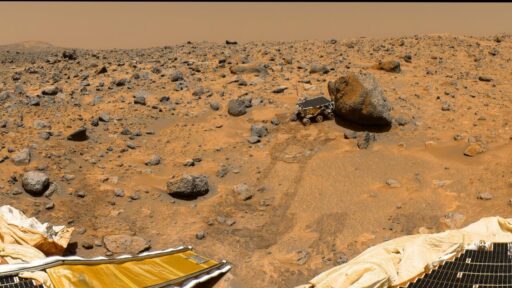

The most intriguing new sound in the solar system is not coming from a distant pulsar or a hidden black hole, but from the thin air of Mars. NASA has logged an electrical signal on the red planet that behaves unlike anything previously recorded there, forcing scientists to rethink how active and complex the Martian environment really is.
What began as a routine weather check by the Perseverance rover has turned into a rare kind of planetary detective story. I see this signal as a pivot point, linking the physics of Martian storms with the chemistry of ancient riverbeds where rocks already hint that life might once have taken hold.
The strange Martian crackle that should not exist
The signal at the heart of this story is an electrical crackle, a kind of atmospheric static that cuts through the thin Martian air with the sharpness of a snapped wire. Instruments on NASA’s Perseverance rover picked it up while listening to dust devils and passing storms, capturing audio that researchers later identified as the sound of lightning-like discharges in the planet’s atmosphere. In a study published in Nature, scientists describe how the rover’s microphones and sensors recorded these bursts as a new class of Martian noise, distinct from the mechanical sounds of the rover itself or the low rumble of the wind, revealing an atmospheric electrical phenomenon that had never been directly heard on the planet before.
What makes this signal so striking is that it offers direct evidence of a form of lightning on Mars, something that had long been debated but never conclusively observed. Researchers report that the pattern and timing of the discharges match what they would expect from charged dust swirling inside convective vortices, turning common dust devils into natural generators. In their account, published in Nature, they describe this as a chance discovery that finally confirms that the Martian sky can spark, a finding that transforms lightning from a theoretical possibility into a measured reality on Mars lightning.
From mini sonic booms to leopard-spotted rocks
The newly logged signal does not stand alone, it joins a growing catalog of Martian sounds that are reshaping how I think about the planet’s weather. After launching in 2020, Perseverance made a 200-day, 300-million-mile journey to reach Mars’ Jezero Crater in February 2021, and once there, its microphones began to pick up electric discharges that scientists likened to “mini-sonic booms” inside dust devils. These sharp pops, layered over the hiss of wind, show that even a thin atmosphere can host energetic events, with charged grains colliding and separating until the air itself breaks down in tiny bolts of plasma.
That same rover is also transforming the picture of what lies underfoot. In a region of the crater carved by ancient water, Perseverance drilled into a rock called Cheyava Falls and pulled out a core sample named Sapphire Canyon, a speckled, leopard-spotted piece of stone that immediately stood out. Early analysis suggests that the chemistry of this sample could have supported microbial metabolisms, making the Sapphire Canyon core from Cheyava Falls inside the Bright Angel area one of the most tantalizing pieces of Martian geology yet collected.
NASA has gone further, describing the same Cheyava Falls rock as a potential biosignature site. The agency notes that the sample, called Sapphire Canyon, was Taken from a rock named “Cheyava Falls” last year and is now central to a paper in Nature that argues its layered textures and organic chemistry could be consistent with past biology, even if non-biological alternatives still need to be ruled out. In that account, the potential biosignature is not a fossil or a microbe, but a pattern of minerals and carbon-bearing compounds that might record how ancient Martian water interacted with rock.
A planet that crackles, glows and maybe once lived
When I put the electrical signal together with the rock record, Mars starts to look less like a dead world and more like a planet that still hums with subtle activity. NASA itself has described a recent rover finding as a discovery “unlike anything we have seen before,” underscoring how quickly the mission’s data is rewriting expectations about the red planet. That phrase was used to capture the sense that the rover’s latest measurements, from atmospheric electricity to unusual rock chemistry, are pushing into territory that earlier missions never reached, a shift reflected in coverage of a NASA Mars rover discovery that lit up public debate.
The stakes are clearest in a quiet Martian riverbed, where layered stone now appears to hold the strongest hints yet of past life. New data from a rock in that ancient channel show complex organic signatures that some researchers argue are best explained by biology, even as they stress that non-biological alternatives must be ruled out. One analysis describes this as the strongest sign so far that Mars might once have been inhabited, framing the find as a key step toward answering whether the possible signs of life in that riverbed are truly biological or the product of exotic Martian chemistry.
These Martian signals also echo a broader pattern in space science, where strange emissions are forcing astronomers to revisit basic assumptions. Observers have recently reported a mysterious deep space object that emits radio bursts in a pattern unlike known pulsars or magnetars, with the nature of the signals still unexplained, a reminder that even in our own galaxy, some strange signals defy easy classification. Against that backdrop, the crackle of Martian lightning and the chemistry of a single rock core become part of a larger story about how little we still know. It is no coincidence that a detailed explainer on a speckled Martian rock, described as the clearest sign of life that we have ever seen on the planet, has drawn wide attention to how signs of life on Mars are being interpreted, and why each new signal, whether electrical or chemical, matters so much to the search.