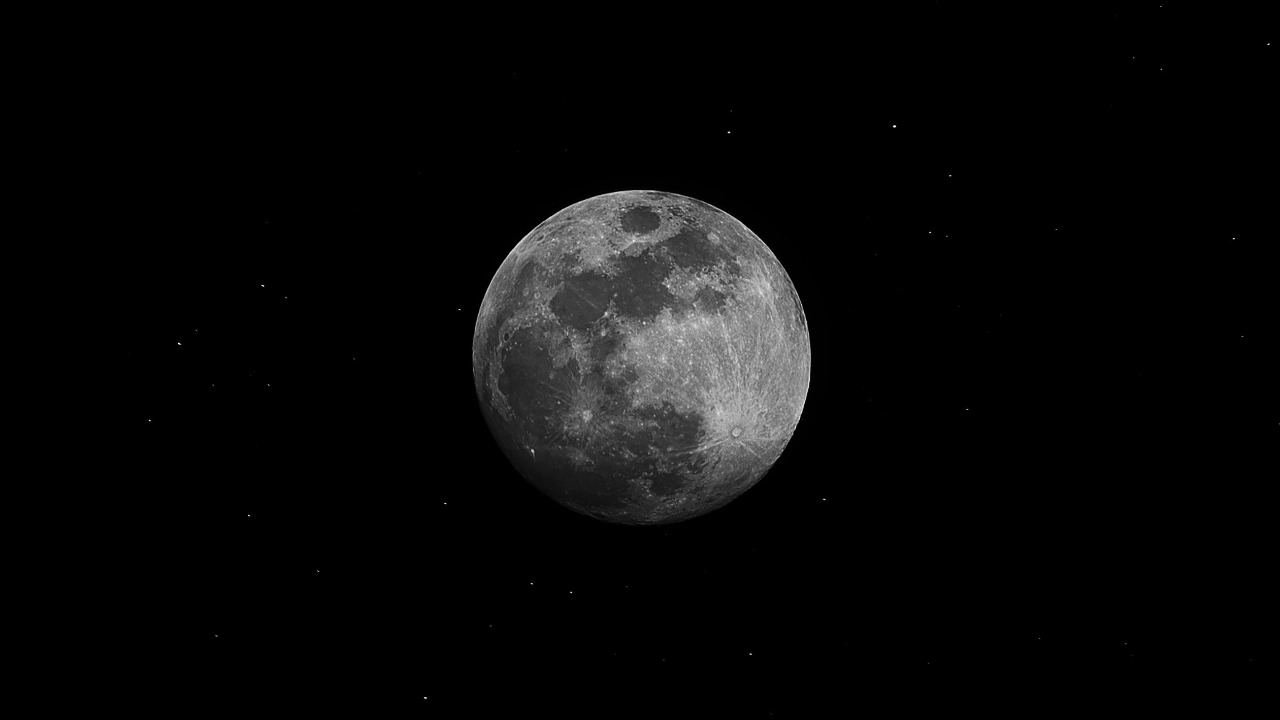

The Moon is quietly slipping away from us, centimeter by centimeter, and that slow-motion breakup will reshape life on Earth long before the two worlds ever risk a true separation. Over deep time, this retreat will stretch our days, soften our tides, and subtly rewrite the conditions that helped complex life flourish. I want to unpack what scientists actually expect to happen, and why the long-term story is less about cosmic abandonment and more about a gradual rebalancing of the Earth–Moon partnership.
How and why the Moon is drifting away
The starting point is simple but profound: tidal friction is transferring energy from Earth’s rotation into the Moon’s orbit, pushing our satellite outward while slowing our spin. Laser measurements show that The Earth’s companion is receding by a few centimeters each year, with one widely cited figure putting The Earth–Moon gap on a steady increase. In practical terms, that means The Moon’s orbit, already about 384,400 kilometers in radius, is slowly expanding inside the region where Earth’s Hill sphere keeps it gravitationally bound, a domain that remains vast compared with the current distance.
Different measurements and models converge on similar numbers for the pace of this retreat. One detailed analysis describes The Moon as moving away from Earth at a Rate Of About 3.8 Centimeters Per Year, while an Ask Astro explainer frames it as roughly 1.5 inches, or 1.5 centimeters, annually for The Moon’s outward drift. The apparent discrepancy reflects that the rate has varied over geological history and is often averaged over different timescales, but the direction is unambiguous. Theoretically, as one overview of lunar distance notes, Earth and Moon will keep adjusting until they become tidally locked to each other, somewhat like Pluto and Charo, long before the end of the Solar System’s lifetime.
Longer days, gentler tides, and a calmer planet
Because angular momentum is conserved, the Moon’s outward migration is paid for by Earth’s slowing rotation, which means our days are gradually lengthening. A detailed study cited by Scientists in NEW DELHI suggests that the familiar 24-hour day on Earth could eventually extend to 25 hours as the Moon drifts away, a change that would unfold so slowly that no single generation would notice. A companion analysis on Why Earth might see days that Could last 25 hours focuses on What scientists are saying about this long arc, tying it directly to the ongoing exchange of energy between Earth and Moon.
Over even longer spans, the separation will reshape the balance of forces that drive our tides and climate. As the distance grows, the gravitational pull that raises ocean bulges will weaken, leading to smaller tidal ranges and a quieter coastal environment. One educational text on About the Moon’s influence notes that it is pretty straightforward that if the Moon moved far enough away, tides would diminish significantly, although the Sun would still raise a residual tide until it, too, evolves in approximately 5 billion years. A separate look at how Researchers at the University of Wisconsin, Madison frame the issue stresses that it is not just about gaining an extra hour, since in 200 million years, if the Moon keeps receding, people who surf, fish, or sail would experience very different coastal dynamics.
Climate stability is another quiet casualty of a more distant Moon. The planet’s axial tilt, which governs the severity of seasons, is currently buffered by the Moon’s gravitational torque. Without that stabilizing effect, Earth’s tilt could swing far more wildly, a scenario dramatized in a Jun video that imagines what would happen to Earth if the Moon got away and the tilt oscillated between 0 and 85 degrees. A more technical discussion of Earth and Moon evolution in the Precambrian era uses visual and statistical tools to reconstruct how this stabilizing partnership has changed over billions of years, underscoring that the current configuration is not guaranteed forever.
Will the Moon ever truly leave, and what would that world feel like?
For anyone picturing the Moon simply slipping out of orbit and vanishing into space, the current science is reassuringly conservative. A comprehensive look at the Future of Earth concludes that the distance to the Moon will increase by about 1.5 Earth radii during the same period that the Sun brightens, and Based on computer models, the presence of the Moon will continue to influence tides and rotation for as long as 10 million years and far beyond. Another synthesis of how As for the Moon’s fate explains that it will not retreat from the Earth forever, instead approaching a configuration where one hemisphere of each body always faces the other and the far side is never seen from the other.
Speculative scenarios about a Moonless Earth help clarify what is at stake, even if they are unlikely to occur naturally. One detailed piece on Why Is the Distance Between the Earth and Moon Increasing walks through what would happen Before the Moon drifted so far that tides weakened, nights grew darker, and predators that rely on moonlight to locate prey could no longer do so easily. Another analysis of Colder oceans and Oceanic circulation warns that without the Moon to stabilize Earth’s tilt, the climate could swing between extremes that would be hostile to many forms of life, as deeper water currently pulled into bays at high tide would behave very differently.
Even in the nearer term, the gradual retreat is already leaving fingerprints on our planet that scientists can read. A focused Q&A on What Happens as the Moon Moves Away from Earth notes that laser ranging has confirmed the outward motion and that the Question of long-term consequences now centers on how ecosystems and human societies adapt to subtle shifts in tides and day length. For now, the key takeaway is that the Moon is not about to desert us, but its slow drift is already reshaping the clock, the coasts, and the climate that define life on this planet.