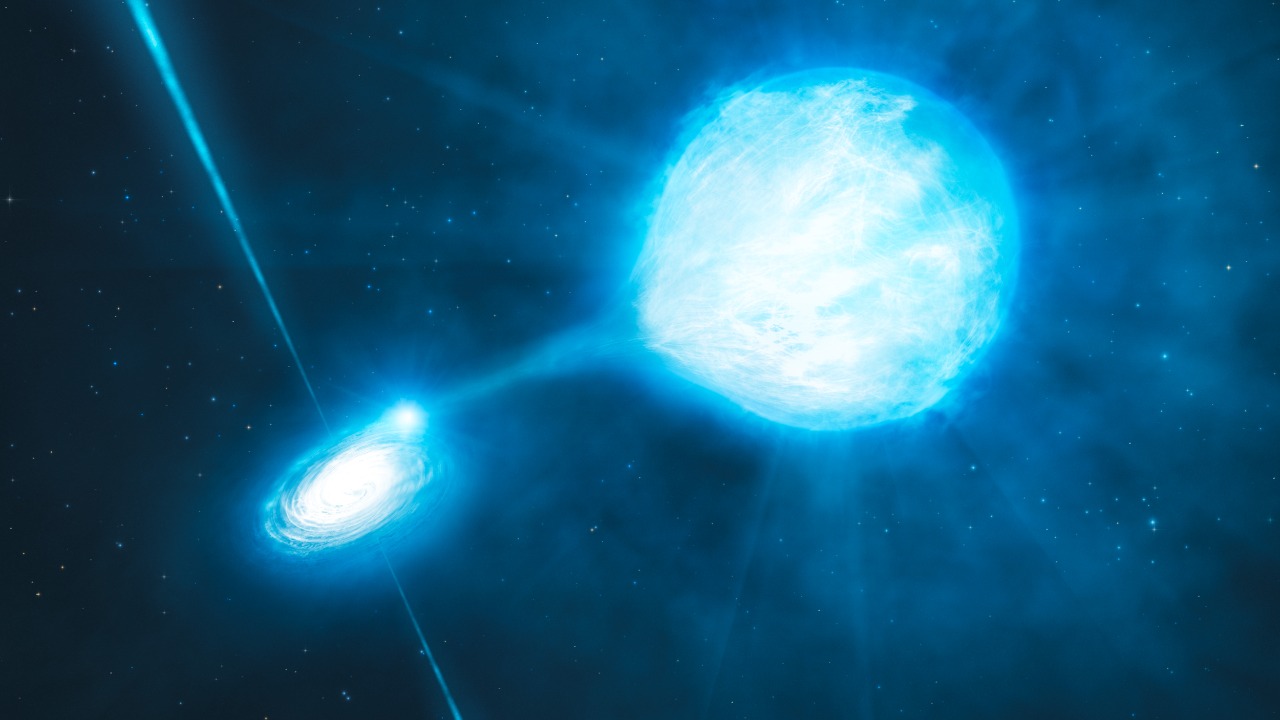

Astronomers have finally watched a black hole actively twisting the fabric of spacetime, turning a century‑old prediction from Einstein into a vivid, unfolding event. Instead of a static snapshot, telescopes captured matter wobbling and precessing as it spiraled toward oblivion, letting researchers track the distortion almost as it happened. I see this as a turning point, where black holes stop being abstract monsters in equations and start behaving like laboratories for gravity itself.
Einstein’s frame dragging, written in X‑rays
The core idea behind this breakthrough is deceptively simple: if mass bends spacetime, then a spinning mass should also drag it around as it rotates. Dec described how Einstein argued that a rotating object would twist the geometry of the universe around it, a phenomenon now known as frame dragging, with a spinning black hole expected to produce the most extreme version of this effect. In the new observations, material in the inner accretion disk did not follow a clean, flat orbit but instead traced out a slow, lopsided wobble, a pattern that matches the way a warped spacetime should steer particles near a fast rotating singularity.
Earlier tests of this idea had to rely on far subtler signals. Around our own Earth, the mission known as Gravity Probe measured frame dragging as a tiny shift in gyroscopes, only 42 milliarc‑seconds per year, barely enough to tease out from noise. By contrast, near a supermassive black hole the same physics becomes violent, with spacetime vortices strong enough to torque entire streams of gas. When Dec and other researchers point to this new wobble as a direct imprint of a spinning black hole, they are effectively watching Einstein’s equations come alive in X‑ray light.
A feasting black hole turns spacetime into a whirlpool
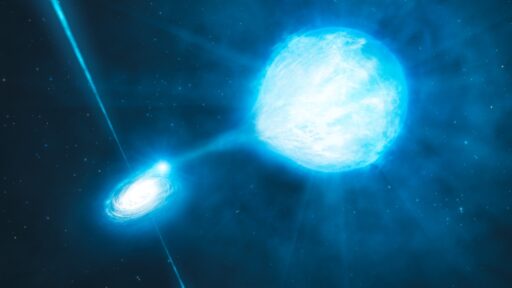
The spectacle began when a distant supermassive black hole suddenly brightened as it tore apart an unlucky star, a process astronomers classify as a tidal disruption event. Astronomers call these flares tidal disruption events, or TDEs, and Astronomers note that They unfold over months or years, giving observers time to watch black hole physics evolve in what amounts to real time. As the shredded star formed a disk, X‑rays revealed a steady inner glow that flickered in a pattern best explained by spacetime itself being dragged around, with the inner regions precessing while other light formed farther out.
In parallel, high‑energy monitoring showed that this particular black hole is spinning at nearly the speed of light, a key ingredient for such an extreme effect. Reporting on the same system, one team emphasized that Einstein‘s theory confirmed by a black hole required a rotation rate close to that cosmic speed limit, which dramatically amplifies the frame dragging. Another analysis described how This effect translates to a wobble in the orbit of matter in the accretion disk around the supermassive black hole, turning the entire feeding process into a slow, graceful precession that instruments can track.
What makes this episode so striking is how clearly it lines up with the theoretical picture. One group summarized that, for the first time, For the first time, scientists have watched a black hole twist spacetime itself, with the dragging causing nearby paths to wobble instead of forming neat ellipses. A complementary analysis stressed that the same team had directly observed material orbiting a fast spinning black hole, tying the observed precession to the object’s rapid rotation. When I look at these converging lines of evidence, the case that we are seeing spacetime itself dragged into a whirlpool feels remarkably solid.
From a quiet galaxy to a live‑action gravity lab
This is not the first time astronomers have watched a black hole switch on, but it is the first time the awakening has doubled as a precision test of relativity. Earlier work followed a dormant giant about 360 m light years from Earth that suddenly flared as it began feeding again, with observers noting that a black hole 360 m light years away from Earth suddenly begun shining brighter and consuming material within its host galaxy. That event showed that supermassive black holes can transform on humanly accessible timescales, but the new observations go further by turning such a flare into a controlled experiment on gravity.
In the latest campaign, Scientists coordinated a whole series of measurements to capture the twisting effect from multiple angles. One report highlighted that Scientists have directly observed a black hole dragging and twisting spacetime, confirming that the inner disk’s motion matches a rotation close to the speed of light. Another account described how Laura, who holds a Master’s in Experimental Neuroscience and a Bachelor in Biology, helped explain the data as evidence of spacetime vortices forming while the black hole killed a star, underscoring how interdisciplinary expertise is now part of decoding these extreme events. When I connect these threads with the statement that Einstein said a spinning mass should twist the universe as it spins, the narrative is clear: what began as a quiet galaxy has become a live‑action gravity lab, and the universe is performing Einstein’s thought experiments on our behalf.