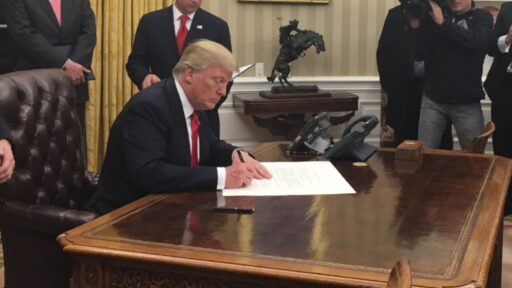
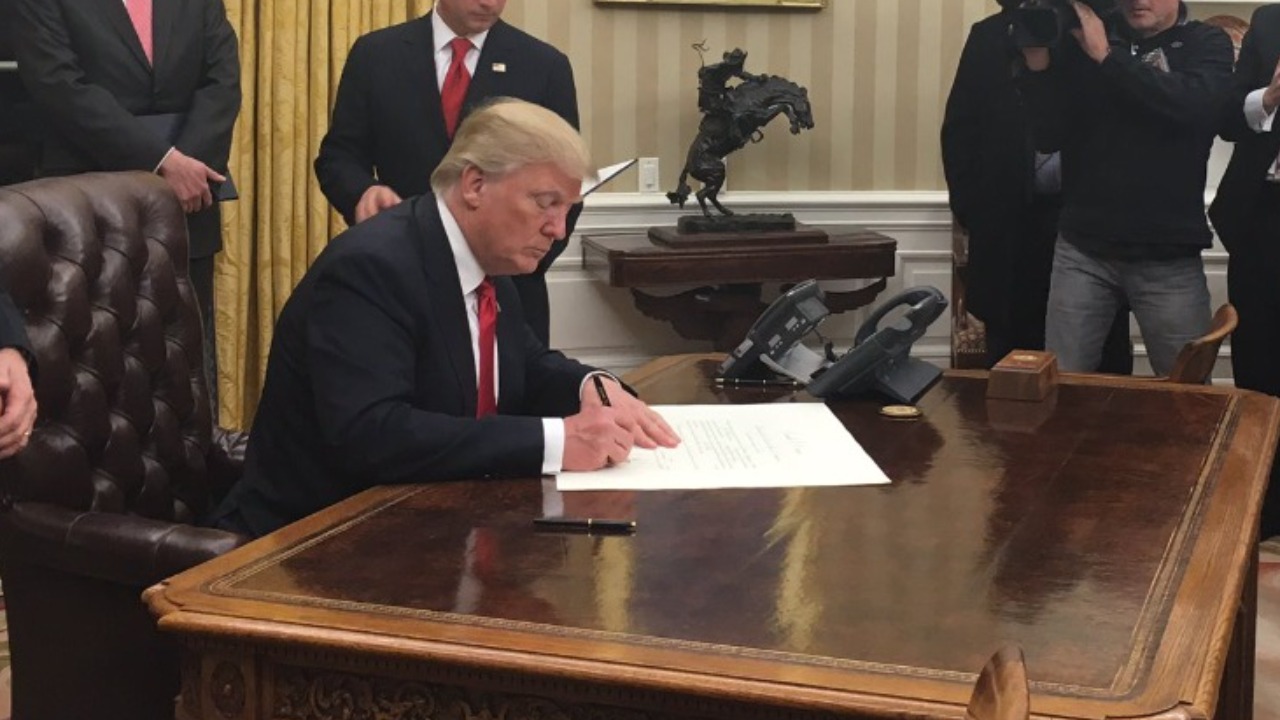

On December 11, 2025, President Donald Trump signed an executive order aimed at preventing US states from enforcing their own regulations on artificial intelligence, centralizing federal oversight to streamline national AI development. The move targets what the administration describes as “excessive” state-level rules that could hinder innovation, immediately drawing criticism from state officials and advocacy groups concerned about fragmented protections. The order represents a significant shift from prior decentralized approaches to AI governance, potentially affecting ongoing state initiatives in areas like data privacy and algorithmic bias.
Details of the Executive Order
The new executive order establishes sweeping federal preemption over artificial intelligence policy, instructing agencies to block individual US states from enforcing their own AI rules in favor of a single national framework. According to reporting that describes how the White House intends to avoid a patchwork of local mandates, the directive explicitly seeks to prevent “individual US states from enforcing AI rules” that diverge from federal standards, framing uniformity as essential for companies that deploy machine learning models across state lines and operate services such as autonomous vehicles, generative AI chatbots, and automated hiring tools by blocking individual US states from enforcing AI rules. In practice, this means state legislatures and regulators would be barred from imposing or maintaining AI-specific obligations that go beyond what federal agencies prescribe, a change that could immediately reshape compliance strategies for large technology platforms and smaller startups alike.
The Trump administration’s rationale, as described in coverage of the order, is that state-level AI rules have become a barrier to national competitiveness and a drag on investment in emerging technologies. Officials argue that companies building advanced systems for sectors such as healthcare diagnostics, financial risk scoring, and industrial automation face costly and conflicting requirements when states adopt their own standards, and they present the executive order as a way to remove what they characterize as “excessive” local constraints on data use, model training, and deployment by blocking states from regulating their own AI rules. By shifting authority firmly to Washington, the order is designed to promote uniformity across the country, but it also raises the stakes for how quickly federal agencies can craft detailed safeguards that match or exceed protections some states had already begun to enforce.
Immediate Backlash from Stakeholders
The announcement has already sparked fierce backlash from state officials, particularly attorneys general who see the order as a direct assault on their ability to protect residents from AI-related harms. Reporting on the reaction describes how several Democratic and Republican state law enforcement leaders quickly warned that stripping states of enforcement power over algorithmic systems could weaken oversight of high-risk uses such as predictive policing tools, automated welfare eligibility checks, and AI-driven credit scoring as the order to block state-level AI regulations sparked fierce backlash. For these officials, the stakes are concrete: they have been investigating and, in some cases, suing companies over opaque algorithms that allegedly discriminate against tenants, job applicants, or borrowers, and they now face uncertainty about whether those cases can proceed under a new federal-first regime.
Civil rights organizations and digital rights advocates have also condemned the order, arguing that it undermines state efforts to address AI-driven discrimination and privacy risks that federal law has not yet fully covered. Groups focused on racial justice, workers’ rights, and consumer protection warn that state legislatures have often moved faster than Congress or federal agencies to regulate facial recognition in public spaces, biometric surveillance in workplaces, and automated decision systems in housing and employment, and they fear those initiatives will be frozen or invalidated under the new preemption policy after Trump signed an executive order blocking US states from enforcing AI rules. Their criticism highlights a broader concern that, without strong and enforceable national standards, the order could leave communities exposed to biased or intrusive AI systems while removing one of the most responsive layers of government from the regulatory equation.
Impact on State AI Initiatives
The executive order immediately collides with a wave of state AI initiatives that had begun to set detailed rules for transparency, accountability, and risk management in automated systems. Coverage of the policy shift notes that the order halts enforcement of existing state AI regulations, including measures in California and New York that focus on transparency in AI decision-making and require companies to disclose when algorithms are used in areas such as hiring, lending, and public services by blocking states from enforcing their own regulations around AI. Those state laws, which often mandated impact assessments or independent audits of high-risk models, had been seen as early templates for responsible AI governance, and their suspension could delay or derail ongoing efforts to refine them in response to real-world deployment problems.
The shift from state-led innovation protections to a federal-only model also threatens to slow the development of local AI ethics frameworks that were tailored to specific regional concerns. Reporting on the order explains that state task forces and commissions, some of which were convened to study algorithmic bias in policing or to set guardrails for AI use in public schools, may now find their recommendations sidelined as agencies in Washington take the lead on rulemaking under Trump’s executive order to block state AI regulations. For residents of states that had invested heavily in participatory processes, including public hearings and consultations with affected communities, the loss of local authority could mean less opportunity to influence how AI is governed in contexts such as tenant screening, social services eligibility, or language-access tools for immigrants.
Broader Federal AI Policy Shifts
The executive order fits squarely within President Trump’s broader agenda to accelerate AI deployment by reducing what the administration views as regulatory friction, particularly from state governments. Reporting on the policy notes that the White House is seeking to align federal agencies around a pro-innovation stance that prioritizes rapid scaling of AI in sectors like defense, logistics, and financial services, while limiting the ability of states to impose additional constraints on data collection, model training, or deployment through an order to block “excessive” state AI regulations. This approach contrasts with Biden-era allowances for state experimentation, which had treated states as laboratories for AI governance and encouraged them to pilot rules on algorithmic transparency, risk assessments, and public-sector AI procurement that could later inform national standards.
The implications for the national AI strategy are significant, both for industry and for public oversight. On one hand, companies that operate across all 50 states may welcome the prospect of a single federal rulebook, expecting that it will reduce compliance costs and make it easier to roll out products such as AI-powered medical diagnostics, automated customer service systems, or large language models without navigating dozens of different state regimes as the order aligns with a push to avoid fragmented AI rules. On the other hand, critics warn that concentrating authority in Washington without clear timelines or mandates for robust safeguards could lead to uneven oversight, where some high-risk applications receive close scrutiny while others slip through regulatory gaps, leaving workers, consumers, and marginalized communities to bear the brunt of any failures or abuses.
Legal and Political Fights Ahead
Even before the ink on the executive order had dried, Democratic-led states were signaling that they would challenge the policy in court, arguing that it represents an unconstitutional overreach into traditional areas of state police power. Reporting on the early response notes that governors and attorneys general in several states that had passed or proposed AI-specific laws are preparing legal strategies that could invoke the Tenth Amendment, long-standing consumer protection statutes, and precedents on federal preemption to contest the administration’s attempt to nullify their rules after Trump signed an order blocking states from enforcing their own AI rules. These legal battles will determine not only the fate of existing AI regulations in places like California, New York, and Colorado, but also the broader balance of power between Washington and the states in setting technology policy.
The political ramifications are just as far-reaching, with the order already emerging as a flashpoint in debates over how aggressively the United States should regulate artificial intelligence. Lawmakers who support the president’s approach argue that a strong federal hand is necessary to keep pace with rivals such as China and the European Union, which are moving ahead with their own AI strategies, while opponents contend that sidelining states will weaken democratic accountability and slow the development of safeguards against algorithmic discrimination and privacy violations as the backlash to the state-level AI regulations ban intensifies. As the courts weigh the challenges and federal agencies begin translating the executive order into concrete rules, the outcome will shape how power, responsibility, and risk are distributed across the country’s rapidly expanding AI landscape.