
The Winter Olympics in Milan and Cortina are opening under a glare that has little to do with snow conditions or medal counts. President Donald Trump’s foreign policy choices and culture-war directives are shaping how the world sees the United States, and those tensions are now colliding with the Olympic ideal of neutral ground. Athletes are stepping into an arena where every cheer or boo risks becoming a referendum on Washington.
Instead of a respite from politics, these Games are emerging as a live test of how far geopolitical rifts can seep into sport. From protests over immigration enforcement to anger about military withdrawals and gender policies, the Olympic stage is being asked to absorb disputes that began in the Situation Room and on the campaign trail.
Trump’s foreign policy shadow over Milan
Well before the opening ceremony, diplomats and sports officials were already bracing for a chillier reception for the American delegation. Analysts have warned that this winter’s Olympic competition in Milan will unfold under a “cloud of geopolitical tension,” with existing friction between major powers likely to be visible in everything from security arrangements to crowd behavior, and that the Games may not ease that strain but instead amplify it. In that context, President Donald Trump’s assertive approach abroad, framed by his team as a defense of American financial and security interests, has become part of the Olympic backdrop rather than something separate from it.
Trump’s recent decisions, including a sharp reordering of alliances and a more transactional posture toward partners, are now being discussed in the same breath as medal prospects. Reporting on the run-up to Milan has noted that his aggressive moves in the foreign policy arena are “hanging over” Team USA, with officials and athletes aware that their presence is being read through the prism of Washington’s stance on issues like Ukraine and broader American financial and. The result is a delegation that carries not only national colors but also the weight of contested policy choices.
A darker global image for Team USA
Inside Olympic circles, there is open acknowledgment that the United States is arriving with a more complicated reputation than in past Winter Games. In conversations around the International Olympic Committee, officials have even discussed the possibility that the U.S. delegation could face boos and jeers, a reaction tied to anger over Trump’s decision to pull back military support from Ukraine and broader unease about Washington’s reliability as a partner, according to reporting on International Olympic Committee press briefings. That kind of reception would mark a sharp departure from the post–Cold War norm, when American athletes were more likely to be seen as symbols of pop culture than of hard power.
The shift is visible not only in speculation about crowd noise but also in the way foreign lawmakers are using the Games to send messages. Italian Lawmaker Riccardo Magi, for example, has been photographed holding a placard demanding that Immigration and Customs Enforcement agents not be allowed into Olympic venues, a protest that links U.S. domestic enforcement to the international event and underscores how dramatically the mood has changed, as documented in coverage of Riccardo Magi. When lawmakers in the host country are staging anti-U.S. demonstrations tied directly to Trump-era agencies, it signals that the American flag on a tracksuit now carries a more contested meaning.
ICE, protests and the politics of presence
Immigration and Customs Enforcement has become one of the most visible flashpoints where Trump’s domestic agenda collides with Olympic optics. Anti-ICE protests swept across the United States earlier this year, and that anger has spilled into Italy after U.S. officials announced that ICE agents would be part of the security footprint around American hospitality spaces, prompting demonstrations that forced organizers to rethink branding and logistics, according to accounts of the Anti ICE backlash in Italy. The controversy has turned what is usually a low-profile corporate pavilion into a symbol of contested U.S. power.
Critics argue that the Trump administration has ensured that debate over Immigration and Customs Enforcement will follow Team USA to Milan, pointing to decisions that elevated ICE’s visibility abroad and made its presence a political statement rather than a routine security measure, as detailed in commentary on how The Trump administration handled the agency. Many of the signs and chants at protests near Olympic-related events have explicitly linked ICE to recent controversies inside the United States, arguing that the agency’s reputation raises questions that go beyond operational concerns, a dynamic captured in reporting that noted how Many of the demonstrators framed their objections.
Culture wars on the Olympic stage
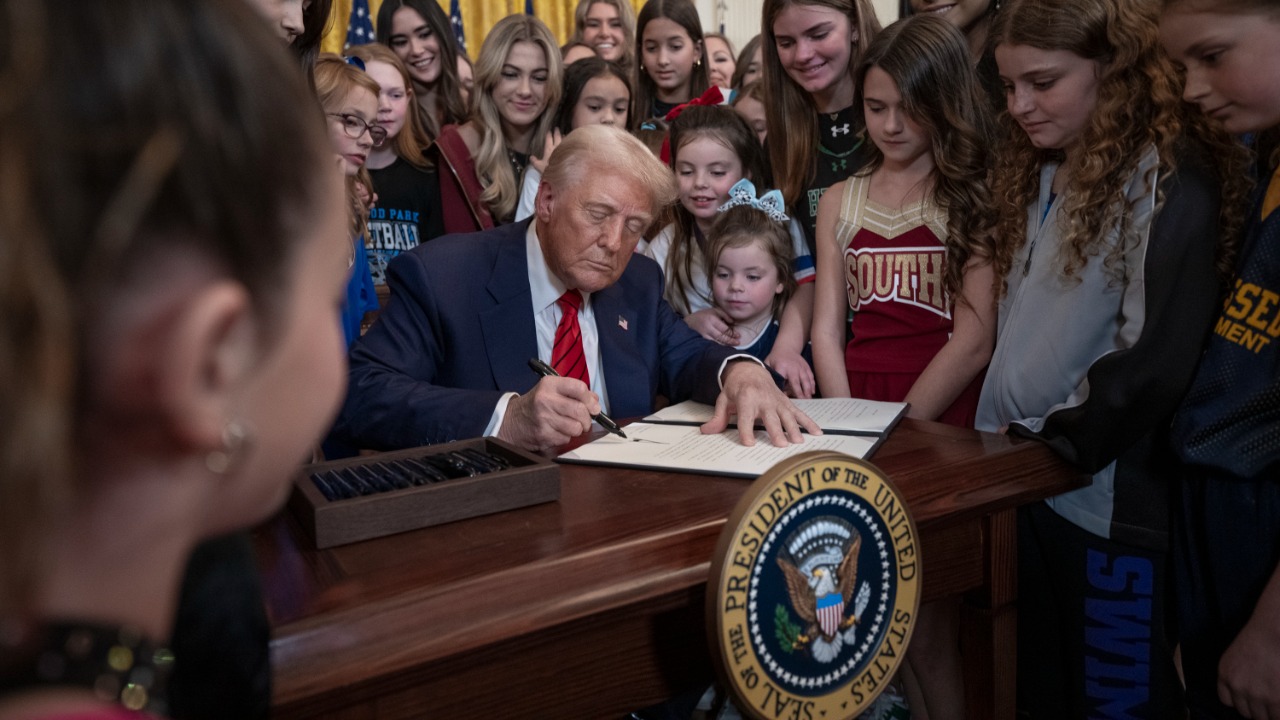
Trump’s imprint on the Games is not limited to foreign policy and immigration. His directives on gender and sport have also reached into Olympic governance, most notably through an order that led the U.S. Olympic & Paralympic Committee to ban transgender biological men from women’s events, a move that officials implemented following the president’s instruction, as described in a social media post noting that the Just in decision followed his order. Supporters frame the policy as a matter of fairness in competition, while critics see it as an extension of domestic culture wars into an arena that is supposed to be governed by international consensus and scientific criteria.
That tension is playing out as Olympic officials already grapple with how to harmonize different national rules on transgender participation. By tying the U.S. position so directly to a presidential directive, the administration has made American athletes and officials the face of a polarizing debate that other countries, from Canada to Venezuela, are handling through their own sports federations rather than executive orders. The result is another layer of scrutiny on Team USA, which now finds itself navigating not only geopolitical disputes but also the front lines of global arguments over identity and inclusion.
Athletes caught between diplomacy and unity
For the competitors themselves, the political noise is both inescapable and largely beyond their control. Lawmakers back home have warned that Trump’s policies could make it harder for U.S. athletes to compete overseas, citing concerns about visa access, retaliatory measures and the broader diplomatic climate, as laid out in a report where Lawmakers raised alarms about these obstacles. Those warnings underscore how decisions taken in Washington can shape everything from training schedules to who ultimately makes it to the start line.
At the same time, senior figures around the Games are trying to emphasize continuity and shared purpose. Casey Wasserman, Chairman of the Los Angeles Organizing Committee for the 2028 Olympic and Paralympic Games, has spoken about the need for the United States to show that it can still be a constructive partner in the Olympic movement, a message delivered as he addressed the IOC alongside teams from Denmark and Canada. His argument is that whatever the current tensions, the long-term success of both Milan and Los Angeles depends on preserving some sense of shared rules and mutual respect.