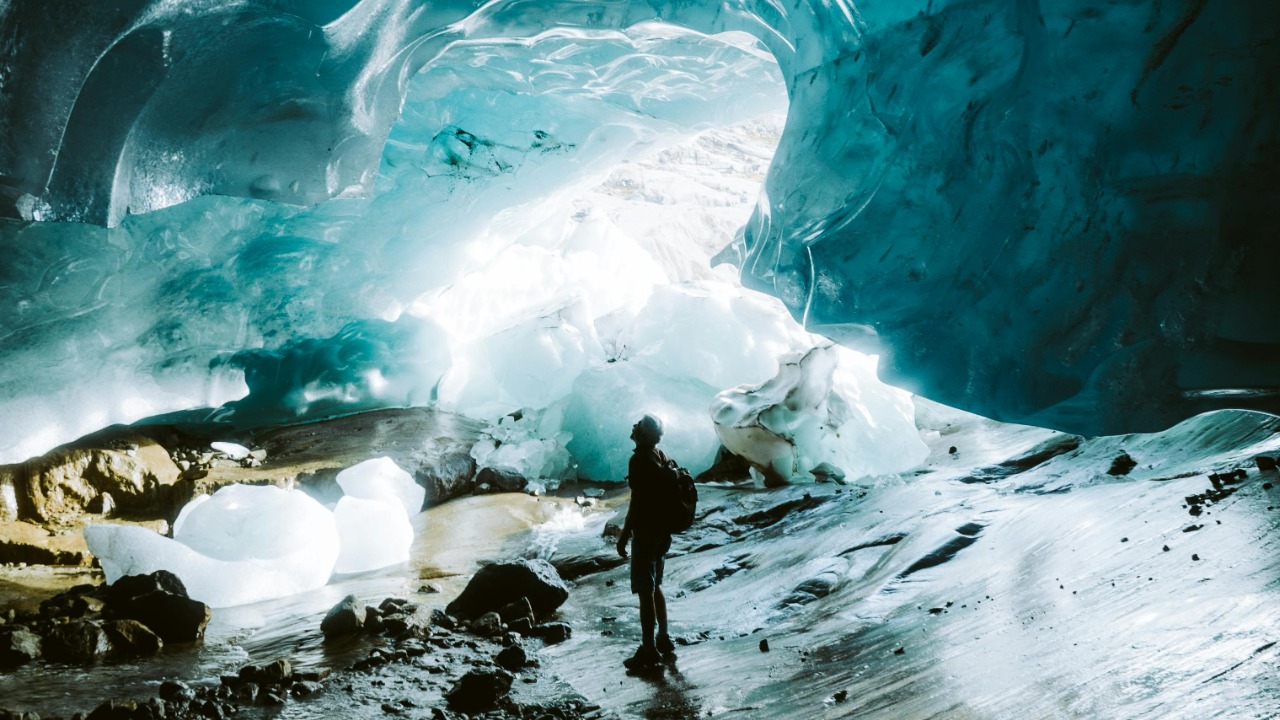

In the high desert of western New Mexico, a short walk across black lava suddenly ends at a railing that overlooks a glowing green pit of ice. Locals have long treated this frozen pool as a curiosity, a natural refrigerator tucked into a volcanic landscape that bakes in summer sun. Recent attention has revived a bolder claim, that this desert ice cave has somehow stayed frozen for more than 3,000 years, turning it into a kind of time capsule beneath the pines.
The science is more cautious than the legend. Researchers and site managers agree that the cave floor holds perennial ice and that the temperature inside never rises above freezing, but the exact age of that ice, and whether it has remained continuously frozen for millennia, is not yet firmly established. What is clear is that the Bandera Volcano Ice Cave, also known as the Zuni Ice Cave, is one of New Mexico’s strangest places, where geology, climate and tourism collide in a single chilly chamber.
Where the desert hides its ice
The frozen chamber sits within a lava tube on the flank of Bandera Volcano, part of a rugged volcanic field in western New Mexico. The feature is formally known as the Bandera Volcano Ice, a collapsed section of tube that exposes a steep stairway down to a permanent ice floor. The broader volcanic complex, including the cinder cone of Bandera Volcano, rises from forested high desert that otherwise sees hot, dry summers and cold but often snow‑starved winters.
Visitors today reach the site through a family‑run attraction that markets the surrounding landscape as the Ice Cave and Bandera Volcano, complete with a rustic trading post. The ICE CAVES property includes short trails over jagged lava, interpretive signs and a stop at the Ice Caves Trading Post, which sells local Native American jewelry, pottery, rugs and other art. That mix of commerce and geology has helped keep the cave on the map for generations of travelers driving the lonely highways west of Albuquerque.
How a lava tube becomes a freezer
The cave’s ability to stay cold in a warm region starts with its volcanic architecture. Lava tubes form when the surface of a flowing lava stream cools and hardens while molten rock continues to move inside, eventually draining away and leaving a hollow tunnel. In the case of the Zuni Ice Cave, part of that tube collapsed near its entrance, creating a vertical opening that traps dense cold air. The remaining tunnel extends back into the hillside, where thick rock and limited airflow insulate the interior from surface heat.
Site managers say the temperature in the chamber never rises above 31 degrees Fahrenheit, even when summer temperatures outside soar. As rainwater and snowmelt seep through cracks in the lava, that water drips into the cave and freezes on contact with the chilled floor, gradually building a thick, layered mass of ice. The same process, in a very different setting, shapes the unstable blocks of the Khumbu Icefall on Mount Everest, where gravitational forces, topography and temperature variations constantly rearrange frozen towers. In New Mexico, the forces are gentler, but the principle is similar: ice persists where cold air pools and rock shields it from the sun.
Has the cave really stayed frozen for 3,400 years?
The boldest claim attached to the site is that the ice has remained below freezing for roughly 3,400 years, a figure that has circulated widely in recent coverage. That number suggests an unbroken stretch of freezing conditions stretching back to the late Bronze Age, an extraordinary span for a small cave in a relatively warm region. However, the detailed material from the site’s own operators focuses on present‑day conditions and on how water from rain and snowmelt accumulates and freezes, without providing a specific age for the oldest ice layers. On that point, the precise longevity of the frozen mass remains unverified based on available sources.
What can be said with confidence is that the cave has held ice for a very long time and that people have known about it for centuries. The family that runs the attraction notes that their ancestors have lived near the Ice Cave and Volcano for over, a span that predates European contact and hints at deep Indigenous familiarity with the site. Oral histories and archaeological evidence could eventually help constrain how long the cave has been used as a cold storage space, but tying that directly to a continuous 3,000‑plus‑year freeze would require careful scientific dating of the ice itself. Until such work is published, the 3,400‑year figure should be treated as an intriguing hypothesis rather than a settled fact.
A natural laboratory in a warming world
Even without a precise age, the cave’s stable chill has clear scientific value. A frozen floor that never exceeds 31 degrees Fahrenheit acts as a natural archive of past precipitation, trapping layers of frozen rain and snowmelt that could, in principle, be sampled for chemical clues about historical climate. Similar ice bodies in caves and lava tubes elsewhere have yielded records of past droughts and atmospheric pollution. In New Mexico, the combination of a small, accessible chamber and a well‑documented temperature regime makes the Bandera Volcano Ice Cave a promising candidate for such work, even if detailed ice‑core studies have not yet been widely reported.
The cave also offers a stark contrast between microclimate and regional trend. The Ice Cave and Bandera Volcano sit along the North American Continental, where snowpack and groundwater recharge are critical to downstream water supplies. As the broader Southwest warms and dries, a pocket of ice that survives only because of a delicate balance of shade, airflow and rock insulation becomes a kind of warning light. If regional temperatures continue to rise, even a cave that feels timeless could start to lose mass, just as the Khumbu Icefall responds to subtle shifts in temperature and gravitational stress. For scientists, that makes the New Mexico cave not just a curiosity but a sensitive indicator of change.
Tourism, tradition and the strange appeal of cold
For most people who descend the wooden stairs, the draw is less climate science than the visceral shock of stepping from desert heat into a natural freezer. Travel videos show visitors arriving around 9:45 a.m. to beat the wind, then walking past roadside signs that urge them to Contine down the trail. Another clip, titled as a visit to one of New Mexico‘s strangest places, captures the moment when the temperature suddenly drops and the green‑tinted ice comes into view. The effect is theatrical, a carefully maintained path that still delivers a genuine sense of discovery.
The operators lean into that experience with a mix of education and spectacle. The Ice Caves Trading Post, sometimes branded simply as Trading, anchors the site with exhibits and locally made crafts, while signage along the trail explains how You can walk from a volcanic crater to a frozen cavern in a single short hike. The official trail guide, available by CLICKING through the site, highlights how Bandera Volcano exploded in volcanic fury and left behind the lava flows that now shelter the ice. That narrative, of fire creating a permanent pocket of cold, is part of what keeps the cave lodged in the state’s travel imagination.