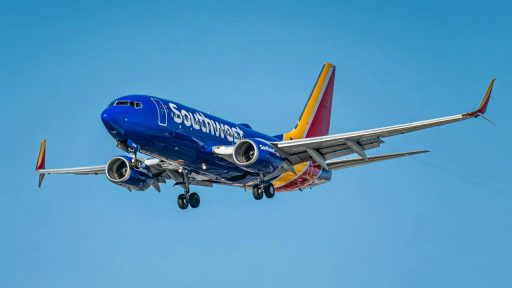
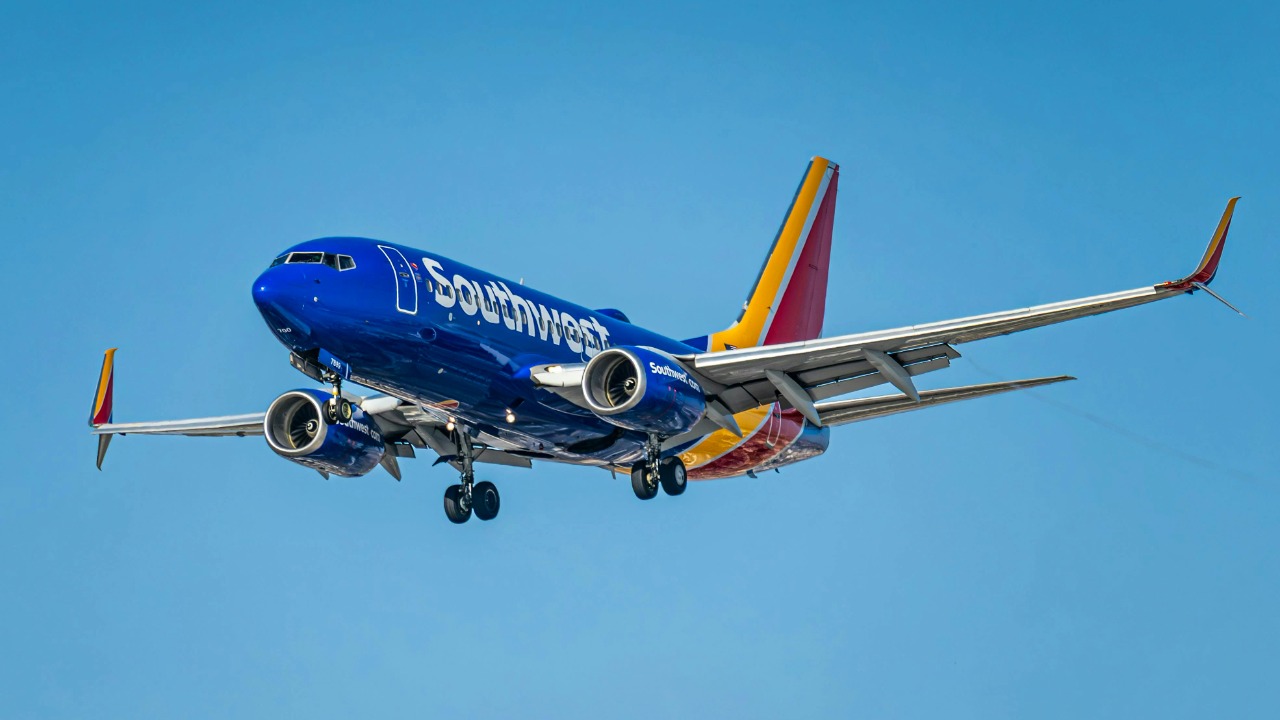

Southwest Airlines has jolted back into the market’s good graces, with its share price surging after the carrier sharply lifted its earnings per share guidance. The move reflects a dramatic reset in expectations as management leans into controversial revenue changes and improved operations to convince investors that the low-cost model can still deliver premium returns.
The stock’s rally, powered by a quadrupling of profit guidance, now puts fresh pressure on Southwest to prove that higher fees and a more segmented cabin will not erode its brand. I see the reaction as a turning point: investors are rewarding a bolder, more commercial Southwest, but they are also signaling that execution risks from here will be judged quarter by quarter.
Guidance shock and a historic stock surge
The immediate catalyst for the rally was Southwest Airlines’ decision to multiply its earnings per share outlook, a shift big enough to reset how Wall Street values the company. After the airline reported stronger operational performance for the Full Year and its latest quarter, the stock jumped about 17 percent in a single session, a move that underscored how deeply investors had discounted the carrier before the update. That kind of one-day repricing is rare for a mature airline and signals that the market had not fully appreciated the earnings power embedded in the new plan until management put hard numbers behind it.
The scale of the move is even more striking when set against the company’s long history as a relatively steady, low-cost operator. According to one account, Southwest Airlines stock just logged its biggest percentage gain since the late 1970s, a period when deregulation was reshaping the entire U.S. airline industry and Southwest was still proving out the low-cost airline model. I read that historical comparison as more than trivia: it suggests investors see the current strategy shift as a structural break, not just a cyclical bounce tied to fuel prices or a single strong travel season.
Bag fees, seating changes, and a new revenue playbook
Behind the upgraded guidance is a willingness by Southwest to rethink some of the sacred cows that once defined its brand. The company is introducing bag fees and altering its seating approach, moves that have sparked vocal pushback from parts of its customer base but promise a step change in revenue per passenger. Management has framed these changes as essential to funding fleet investments and technology upgrades while still keeping base fares competitive, effectively asking loyal flyers to accept a more à la carte experience in exchange for a stronger, more reliable airline.
Investors appear to be siding with the spreadsheets rather than the social media backlash. One market recap noted that, Despite the early friction from travelers, Southwest shares around the time of the announcement were trading near $41.34, with a modest move of 0.01% on that particular quote, as investors digested the idea that bag fees and seating changes could help quadruple profit over time. I see that as a clear signal that the market believes the incremental revenue from these unpopular changes will outweigh any demand hit, at least in the near term, especially if Southwest can maintain its reputation for friendly service and operational reliability.
Analyst reactions: cautious upgrades and diverging views
The stock’s surge and the new guidance have forced Wall Street analysts to revisit their models, but the reactions are far from uniform. Some see the new fee structure and operational improvements as enough to justify a higher valuation, while others remain skeptical that Southwest can fully offset cost pressures and competitive threats. The result is a split tape of price targets and ratings that, in my view, reflects genuine uncertainty about how durable this profit inflection will be once the initial excitement fades.
On the more cautious side, Bank of America has raised its price target on Southwest from $37 to $42 but kept an “underperform” rating, implying that even after the guidance hike, the firm still expects the stock to lag peers from the company’s previous close. That combination of a higher target with a negative rating tells me the bank acknowledges the earnings upgrade but questions whether the current share price already discounts most of the upside. By contrast, Morgan Stanley has taken a more optimistic stance, lifting its target to $55 and assigning an “overweight” rating that points to about a 13.6% upside from the stock’s previous close. I interpret that as a vote of confidence that Southwest can not only deliver on the new guidance but also sustain a higher earnings base as its new revenue initiatives mature.
What the rally says about the low-cost model
Beyond the day-to-day stock moves, I see this episode as a referendum on whether the classic low-cost airline model can still thrive in a world of higher labor costs, volatile fuel prices, and increasingly demanding customers. Southwest built its identity on simplicity, with open seating, no bag fees, and a relatively uniform fleet that kept operations lean. The decision to introduce more complex pricing and seating structures suggests that even the standard-bearer of low-cost flying now believes it must extract more revenue from each seat to stay competitive, especially as legacy carriers push deeper into basic economy and ultra-low-cost rivals crowd the bottom of the market.
The market’s enthusiastic response to the quadrupled earnings guidance indicates that investors are comfortable with a more hybrid Southwest, one that blends its low-cost roots with revenue tactics long used by competitors. The key risk, in my view, is whether the airline can execute these changes without undermining the trust and goodwill that have historically differentiated it. If customers perceive the new bag fees and seating rules as nickel-and-diming rather than fair value, the short-term profit boost could be offset by weaker loyalty and more price-sensitive behavior, particularly on routes where travelers can easily switch to another carrier.
What investors should watch next
For shareholders and prospective buyers, the next phase is less about the headline of quadrupled guidance and more about the details that will determine whether those numbers hold. I would focus on three metrics in upcoming quarters: unit revenue growth as the new fees and seating changes roll through the system, cost per available seat mile excluding fuel to see whether operational gains are sustainable, and load factors that reveal whether customer demand is holding up in the face of higher all-in trip costs. Any slippage in these areas could quickly challenge the bullish narrative that has driven the recent 17 percent jump.
It is also worth remembering that airline stocks are inherently volatile and sensitive to macro shocks, from fuel price spikes to demand swings tied to economic growth. Tools like Google Finance can help investors track real-time price moves and historical performance, but they cannot substitute for a clear thesis about how Southwest’s strategy will play out over a full cycle. In my view, the current setup rewards investors who are willing to accept some turbulence in exchange for the possibility that a more commercially aggressive Southwest can deliver structurally higher earnings, while those who doubt the durability of the low-cost model’s evolution may prefer to treat the recent surge as an opportunity to take profits rather than a new baseline.