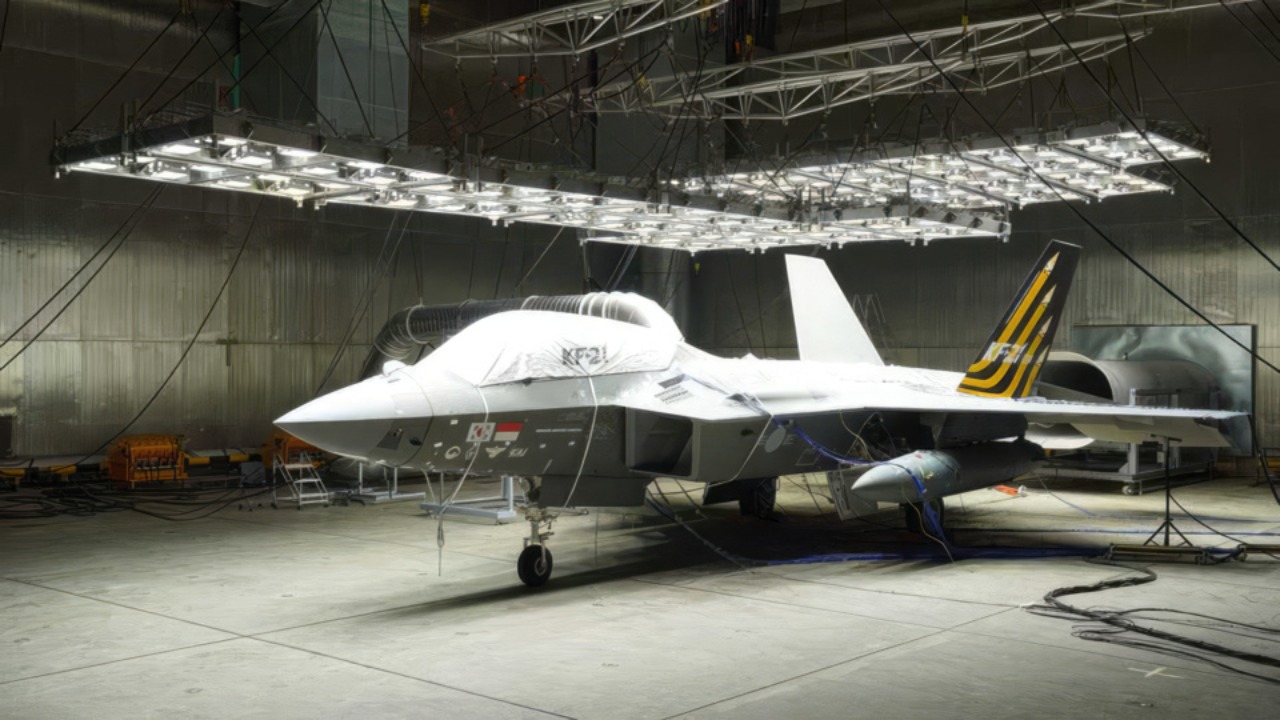

South Korea’s Korea Aerospace Industries has moved the KF-21 Boramae program into serial production, with the first fighters now scheduled for delivery to the South Korean Air Force in 2026. After years of development and shifting projections, the program has a firm handover timeline for initial production aircraft, turning a once-uncertain schedule into a concrete plan. With a unit price set at 65 million dollars, these indigenous 4.5-generation multirole jets are positioned to start strengthening the country’s air combat capabilities next year.
Establishing the Delivery Timeline
The delivery of the first production KF-21 Boramae fighter to the South Korean Air Force now has a set date in 2026, replacing earlier ambiguity about when the aircraft would formally enter service. According to reporting that details how the delivery of the first production KF-21 Boramae fighter to the South Korean Air Force now has a set date, officials have locked in the initial handover window, signaling that development and testing milestones have progressed to a point where planners can commit to a specific year. For the Air Force, that clarity is critical, because it allows operational units to align pilot conversion courses, maintenance training, and base infrastructure upgrades with a predictable arrival of the new jets.
The confirmation that the first KF-21 will be delivered in 2026 also marks a material change from earlier projections that treated the transition from prototypes to frontline aircraft as a moving target. By fixing the schedule for the first production aircraft to reach operational units, the program reduces uncertainty for defense planners who must phase out older platforms and integrate the KF-21 into existing command, control, and logistics systems. I see this as a pivotal shift from a development-centric mindset to one focused on fielding, which raises the stakes for meeting performance, reliability, and supportability benchmarks on time.
Progress in Serial Production
Korea Aerospace Industries has advanced the KF-21 Boramae from limited prototype builds into serial production specifically to meet the 2026 delivery target for the South Korean Air Force. Reporting on how KAI advances serial production of KF-21 fighters to be delivered to the South Korean Air Force in 2026 underscores that the manufacturing line is now oriented around producing operational aircraft rather than test airframes. That shift implies that supply chains for key subsystems, from avionics to engines, are being stabilized at production scale, which is essential for delivering multiple aircraft on a tight schedule and for sustaining the fleet once it enters service.
The move into serial production also reflects an emphasis on accelerated manufacturing processes to ensure readiness for the inaugural batch of fighters. By committing to a production tempo that supports the 2026 handover, KAI is effectively binding its industrial planning to the Air Force’s modernization calendar, which raises both opportunities and risks for stakeholders. If the production system performs as planned, the Air Force gains a steady flow of new-generation aircraft that can be integrated into squadrons without major gaps; if bottlenecks emerge, the knock-on effects could delay retirements of older jets and complicate training pipelines. In my view, the decision to advance serial production at this stage shows confidence in the design and test results, but it also heightens scrutiny on quality control and schedule discipline.
Pricing and Contract Details
South Korea has set the KF-21 Boramae price at 65 million dollars per unit, a figure that aligns with domestic procurement needs and positions the aircraft competitively within the 4.5-generation fighter segment. Coverage explaining that South Korea sets KF-21 price and plans first deliveries from 2026 notes that this pricing framework underpins the initial production contracts and guides budget planning for the Air Force. A clearly defined unit cost allows defense officials to map out how many aircraft can be acquired within medium-term spending plans, and it also shapes potential export discussions by signaling where the KF-21 sits relative to alternatives such as upgraded F-16s or other regional fighters.
The first deliveries of these 65 million dollar KF-21 Boramae fighters are planned starting in 2026, formalizing the financial structure that supports the program’s transition into service. By tying the price point directly to a near-term delivery schedule, the government and KAI are effectively committing to a cost and capability package that must hold up under operational scrutiny once the jets reach frontline units. For the South Korean Air Force, this arrangement means that long-term sustainment costs, training investments, and potential follow-on orders can be modeled with greater precision, which is vital for balancing the KF-21 against other priorities such as missile defense, surveillance assets, and unmanned systems. From my perspective, locking in both price and delivery timing strengthens the program’s credibility but also leaves less room to absorb overruns without political and budgetary consequences.
Impact on South Korean Air Force Modernization
The 2026 arrival of KF-21 Boramae fighters will equip the South Korean Air Force with advanced indigenous platforms that are intended to replace aging fleets and reinforce deterrence on the Korean Peninsula. Reporting that South Korea is to deliver the first KF-21 Boramae fighters in 2026 highlights how the new jets are expected to serve as multirole workhorses, capable of air-to-air and air-to-ground missions while integrating more modern sensors and weapons than many of the aircraft they will succeed. For pilots and planners, the shift to a domestically developed 4.5-generation platform offers not only performance gains but also greater flexibility in upgrading systems without being constrained by foreign export controls.
This development represents a pivotal upgrade for the force structure, because the set delivery date enables integrated planning for training, deployment, and eventual squadron-level operations. With a firm 2026 timeline, the Air Force can schedule conversion courses, simulator acquisitions, and maintenance training so that personnel are ready when the first jets arrive, rather than reacting to uncertain timelines. I see this as particularly important in a regional environment where neighboring air forces are also modernizing, since the KF-21’s entry into service will influence how South Korea coordinates with allies, manages its legacy fleets, and signals its technological ambitions. By anchoring modernization plans to a concrete delivery year, the service can better synchronize the KF-21 with other capabilities, from airborne early warning aircraft to precision-guided munitions, and ensure that the new fighter is integrated as a central element of its future airpower strategy.