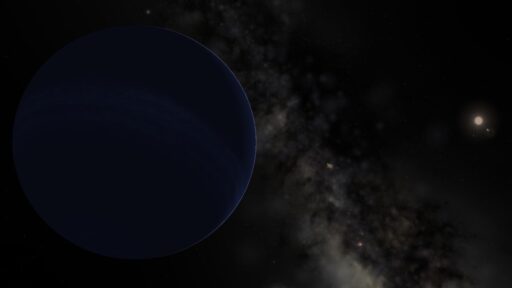
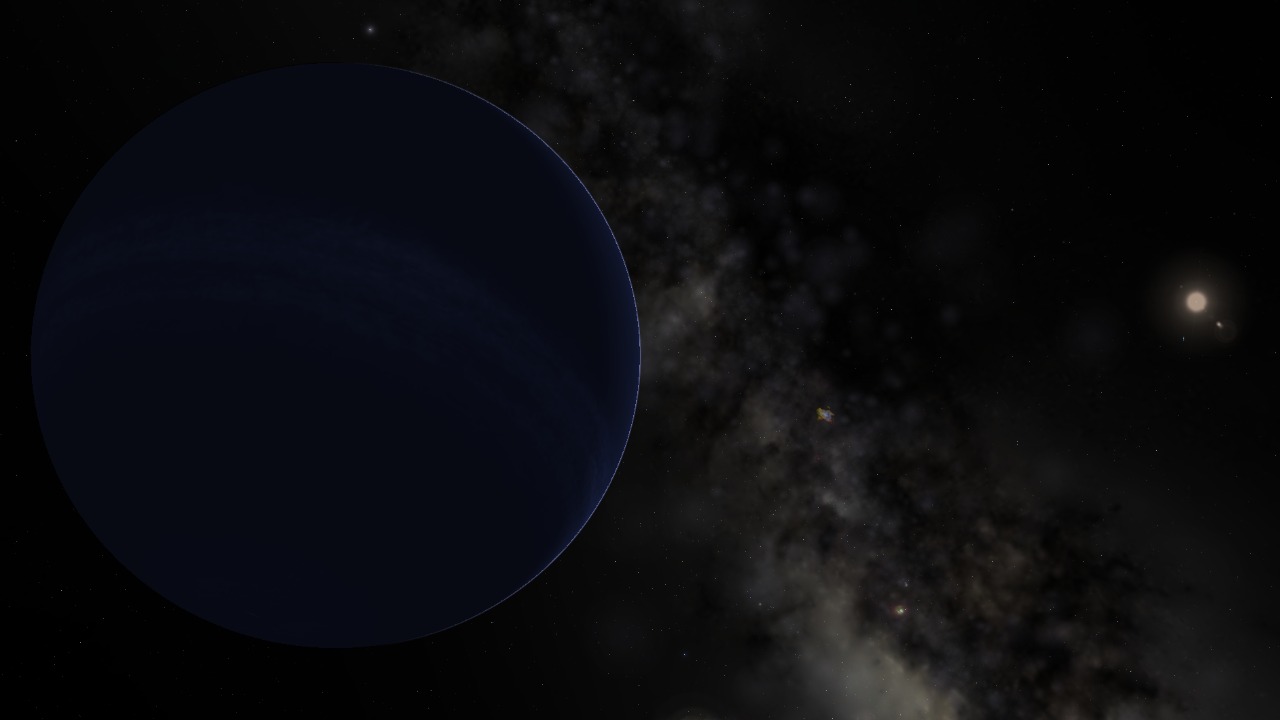

Planet 9 remains a ghost at the edge of the solar system, unseen by any telescope yet stubbornly present in the equations that describe how distant worlds move. The idea that an unseen giant is sculpting the orbits of icy debris far beyond Neptune has survived a decade of scrutiny, revisions, and false alarms. I see a pattern in the latest evidence: the more precisely astronomers measure the outer solar system, the harder it becomes to dismiss a hidden planet outright.
The math that refuses to back down
The modern hunt for Planet 9 began when Caltech researchers noticed that a cluster of small, icy bodies beyond Neptune seemed to share strangely aligned orbits that gravity alone could not easily explain. Those Caltech researchers argued that a massive planet on a stretched, highly elongated path in the outer solar system could herd these objects into their observed configuration, and they described a world so distant that it would take thousands of years to complete a full orbit around the sun, a case laid out in detail by Caltech. I find that this original argument still underpins almost every new claim about Planet 9, because it ties a specific, testable orbit to the observed sky.
Since that first proposal, Astronomers have expanded the catalog of distant objects and refined the statistics, yet the gravitational oddities have not gone away. New work described how Astronomers find evidence suggesting that Our solar system has nine planets again, with the orbits of remote bodies in the icy belt showing patterns that are easier to reproduce if a massive planet is tugging on them, a point underscored when Astronomers, Joseph and Our are all cited together. In video explainers, Dec and other presenters have stressed that Planet 9 has never been seen, but scientists say the math is clear that something massive is shaping these orbits, a framing captured in a widely shared discussion of how Planet 9 has never been seen. When I weigh these arguments, I see less a single smoking gun and more a growing pile of circumstantial evidence that keeps pointing in the same direction.
Clues in the data, but still no clear image
Even with persuasive orbital patterns, Planet 9 will remain hypothetical until someone actually spots it, and that has proved far harder than many expected. Earlier work showed that Scientists accumulate circumstantial evidence, but no telescope has yet spotted it, with Planet Nine still a blank spot in direct imaging surveys despite years of targeted searches, a reality summarized in a detailed look at how Scientists accumulate circumstantial evidence. More recently, Researchers at the California Institute of Technology, or Caltech, have reported new evidence that further suggests there is a huge ninth planet whose gravity can explain why some icy bodies never cross Neptune’s path, a scenario they describe when Researchers at the California Institute of Technology outline how these orbits behave. I read these updates as a sign that the theoretical picture is tightening even as the observational picture remains stubbornly blank.
On the observational front, survey archives have become a gold mine for Planet 9 hunters who hope the planet has already drifted through someone’s field of view. One analysis of sky surveys taken 23 years apart reported evidence of controversial Planet 9 uncovered in infrared data, noting that this is not the first time that a candidate for Planet Nine has been found in such archives and that astronomer Micha has been involved in earlier searches that eventually ruled out false positives, a history recounted when Planet Nine and Micha are discussed together. In the latest round of scrutiny, one team reported that In the end, they detected a single potential finding that ticked many boxes but sat tens of billions of kilometers farther out than expected, a caveat that led them to stress that if this pans out it would be extraordinary, or it could still be a more mundane object, a tension captured in a careful breakdown of how In the end, they detected a single potential finding. I see these archival hints less as near misses and more as proof that the search volume is finally converging on the right patch of sky.
New instruments promise to sharpen that focus even further. While the planet itself, Planet Nine, remains undiscovered, Live Science writer Harry Baker has reported that scientists expect the powerful Vera C. Rubin Observatory to be a game changer in 2025, with While the survey’s repeated scans of the sky designed to catch exactly the kind of slow moving, faint object Planet 9 would be, a prospect laid out when While the planet itself ( Planet Nine ) remains undiscovered, Live Science, Harry Baker are mentioned together. Other Astronomers have argued that it is very possible that Planet Nine will be found within months once next generation surveys concentrate on objects closer to home, a forecast that appears in a discussion of how Planet Nine Astronomers could discover the elusive world. Even popular explainers have joined in, with Jul narrations reminding viewers that no, not Pluto, we are talking about something lurking on the outskirts of the solar system, a distinction that is spelled out in a widely viewed segment that asks whether you have heard about Planet 9 and clarifies that Pluto is not the target, as seen in have you heard about planet 9. no not Pluto. When I put these strands together, I see a field that is running out of places for a giant planet to hide, yet still finds the numbers pointing insistently toward a world we have not quite managed to see.