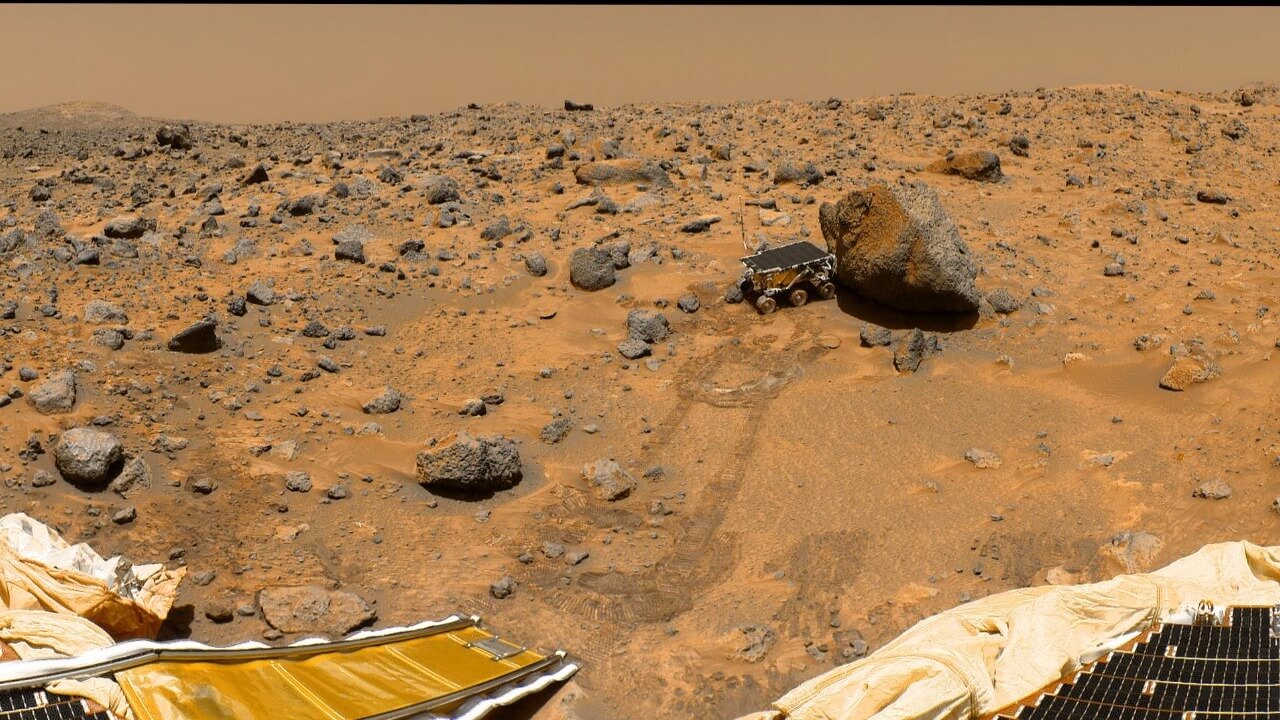

NASA’s Perseverance rover, after four years of exploration on the Martian surface, has spotted a mysterious 31-inches wide rock described as a “visitor from outer space” that does not belong on the Red Planet. Scientists are stunned by its odd-looking appearance, which appears totally alien to Mars’ geology and unlike the native rocks that have dominated previous mission updates. Captured in recent rover images, the unusual find suggests it may have originated elsewhere in the solar system, marking a significant shift from prior discoveries of clearly Martian material.
Perseverance Rover’s Detection
The discovery emerged from Perseverance’s routine imaging of the Jezero Crater region, a campaign that has unfolded over four years of driving, drilling and sampling across the Martian surface. According to reporting that describes the object as a mysterious “visitor from outer space,” the rover’s cameras picked out the 31-inches wide rock sitting in terrain that mission scientists thought they already understood, turning a standard survey into a headline-grabbing anomaly linked to the search for ancient life and habitable environments after four years. That shift from expected geology to something that appears imported from beyond Mars immediately raised the scientific stakes for a mission already tasked with decoding the planet’s past.
Mission updates describe the rock as having been flagged in images taken during Perseverance’s ongoing traverse of the crater floor, where the rover has been cataloging sedimentary layers and volcanic outcrops that record Mars’ environmental history. The announcement of the find around November 18, 2025, built directly on earlier analyses of local rocks that consistently pointed to native Martian origins, so the sudden appearance of an object that “didn’t belong there” reframed the narrative from incremental mapping to a rare example of apparent extraterrestrial debris. For NASA and its partners, that timing matters, because it injects a fresh line of inquiry into a mission that was beginning to settle into a predictable rhythm of core sample collection and terrain characterization.
Physical Characteristics of the Rock
Reports describe the object as an “unusual 31-inches wide rock” that stands out sharply from the surrounding debris field, both in size and in shape, which helps explain why scientists quickly concluded it did not match expectations for Jezero Crater’s surface composition. Coverage of the find notes that the boulder-like fragment appears irregular and isolated, with a profile that contrasts with the smaller, more weathered stones that typically litter the rover’s path, reinforcing the assessment that it “didn’t belong there” based on what geologists anticipated for this part of Mars as an unusual 31-inches wide rock. That physical prominence makes the rock not just a curiosity but a prime target for detailed follow-up, since any compositional outlier of that scale could carry a long record of its journey through space.
Visual assessments from Perseverance’s cameras, as described in multiple accounts, emphasize that the rock’s textures and colors look “totally alien to the Red Planet,” with surfaces that do not resemble the volcanic and sedimentary units the rover has cataloged so far. One report characterizes the object as an “odd-looking rock on Mars” whose appearance diverges from the muted reds and browns of typical Martian outcrops, suggesting a different mineral mix and possibly a different origin environment altogether that is totally alien to the Red Planet. For planetary scientists, those visual cues are not just aesthetic details, they are early hints that the rock may preserve a chemical fingerprint of another world or of a parent body that formed under very different conditions from Mars.
Scientific Implications and Reactions
NASA’s working assessment, reflected across several outlets, is that the rock is likely a “visitor from outer space,” probably delivered to the Martian surface as part of an asteroid or meteorite impact that originated elsewhere in the solar system. One account notes that scientists were “stunned” by the discovery and quickly framed it as a rock that “shouldn’t be there,” language that underscores how sharply it departs from the catalog of native Martian samples Perseverance has built up over four years of operations as a rock that shouldn’t be there. That reaction signals more than surprise, it highlights the potential for this single object to illuminate the broader process by which material from distant regions of the solar system is scattered across planetary surfaces.
Earlier mission updates had consistently described Perseverance’s drilled cores and abraded targets as Martian in origin, tied to local lava flows, lakebed sediments and impact deposits that fit established models of Jezero Crater’s history. The new reports, by contrast, stress that this rock appears to be an outlier, prompting fresh questions about how often Mars is peppered with material that formed far from its orbit and what that imported debris might reveal about the diversity of planetary building blocks. Coverage that labels the object a “visitor from outer space” and a rock that “does not belong on Mars’ surface” frames it as a test case for understanding cosmic transport mechanisms, from high velocity impacts to long term orbital evolution, that can redistribute material between worlds that does not belong on Mars’ surface. For researchers studying planetary bombardment and the exchange of rocks between planets, the find offers a rare, well documented example that can be tied directly to high resolution imagery and in situ measurements.
Future Analysis and Mission Impact
Mission planners are already outlining a closer examination campaign that would bring Perseverance’s full instrument suite to bear on the rock, with particular attention to spectroscopy that can confirm whether its composition truly differs from the Martian baseline. Reports indicate that the rover’s ability to perform detailed chemical and mineralogical scans will be central to testing the “visitor from outer space” hypothesis, since a clear mismatch with local geology would strengthen the case for an origin in an asteroid belt fragment or another planetary crust that doesn’t belong there. For NASA’s Mars program, that kind of targeted analysis is not just about solving a single mystery, it is about refining the criteria that future missions will use to flag and prioritize non native materials.
The discovery is also feeding directly into discussions about Mars Sample Return and how to balance the scientific value of local sediments against the potential insights locked in extraterrestrial contaminants. Coverage that highlights the rock as an “alien visitor on Mars” suggests that stakeholders are already considering whether similar objects should be elevated in future collection strategies, since they might carry information about distant regions of the solar system that would otherwise be inaccessible to direct sampling as a rock that shouldn’t be there. Even as Perseverance continues to pursue its core objectives of characterizing ancient habitable environments and caching Martian cores, the appearance of this 31-inches wide anomaly is accelerating research into Mars’ bombardment history and the broader traffic of rocks between worlds, adding a new dimension to a mission that was already central to plans for bringing pieces of Mars back to Earth.
How the Discovery Reshapes the Mars Narrative
For the public and for many researchers, Perseverance’s work had settled into a familiar storyline of careful drilling, sample caching and incremental mapping of Jezero Crater’s layered history. The sudden emergence of a rock described as an “alien visitor on Mars” and a “mysterious ‘visitor from outer space’ rock on Mars surface after 4 years” disrupts that narrative by introducing a tangible reminder that Mars is not a closed system, but a world continually influenced by material arriving from beyond its skies on Mars surface after four years. That shift in perspective matters for how scientists interpret the planet’s geological record, because it underscores the need to distinguish between rocks that formed in place and those that were imported, each carrying different clues about planetary evolution.
Media coverage that calls the object an “odd-looking rock on Mars” and emphasizes that it is “totally alien to the Red Planet” has also broadened public engagement with a mission that can otherwise seem dominated by technical updates and incremental findings. By highlighting a single, visually striking anomaly that “didn’t belong there,” outlets have drawn attention to the dynamic processes that shape not only Mars but the entire inner solar system, from asteroid impacts to the slow exchange of material between planetary neighbors as an odd-looking rock on Mars. In my view, that renewed focus on the unexpected reinforces a central lesson of planetary exploration: even after four years of methodical work by a sophisticated rover, a single strange rock can still rewrite assumptions about what kinds of stories are preserved in the dust and stones of another world.