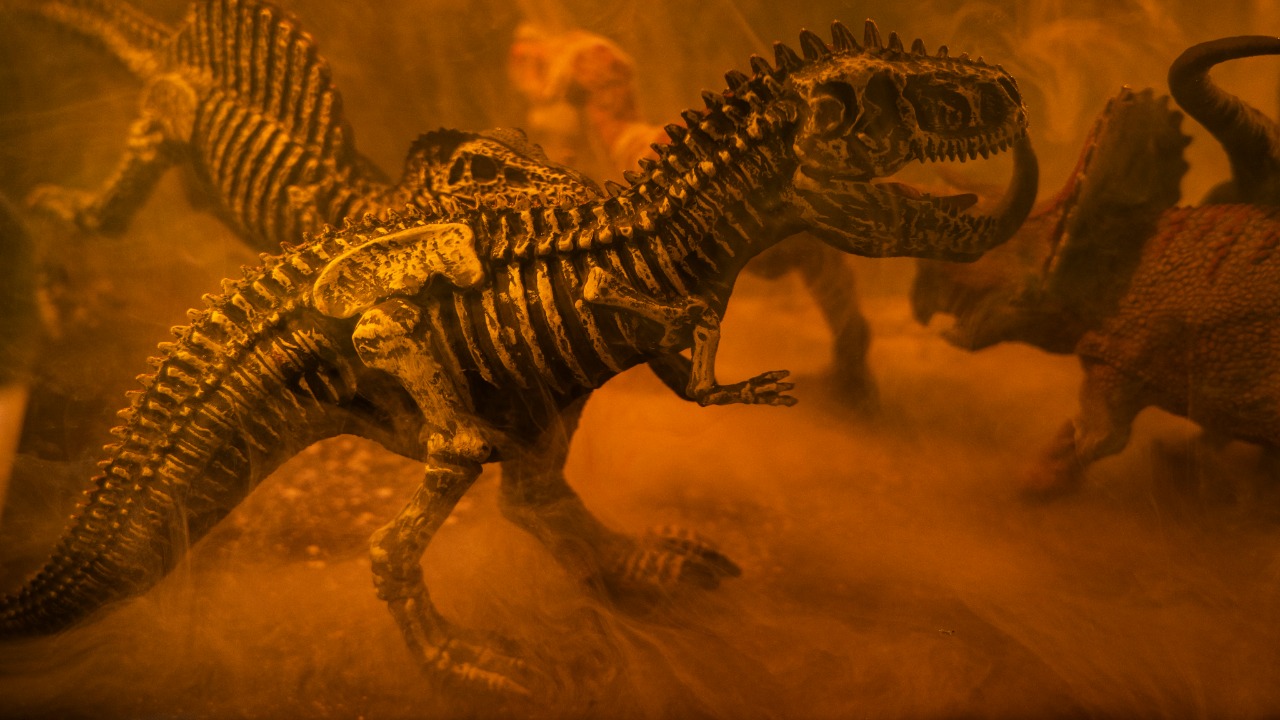

The asteroid impact that ended the age of dinosaurs is usually framed as a story of loss, but the fossil record now shows it also triggered one of the fastest bursts of innovation life has ever seen. Within a geological blink, ecosystems rebuilt themselves, new species appeared and surviving lineages, including our own, began evolving at accelerated rates. In effect, the catastrophe cleared the ecological slate and turned up the speed on evolution’s engine.
From microscopic plankton in the oceans to early mammals on land, multiple lines of evidence point to a world that did not just recover, but rapidly diversified into new forms and lifestyles. I see that pattern as a warning as much as a wonder: mass extinctions can unleash creativity in evolution, yet they do so by first pushing existing worlds to the brink.
The day the dinosaurs died, and why it mattered for evolution
When a massive asteroid slammed into Earth roughly 66 m years ago, it vaporized rock, ignited global wildfires and plunged the planet into a dark, cooling shroud that toppled food webs from the top down. Large dinosaurs on land and many marine reptiles vanished, along with countless plants and smaller creatures that depended on them. That sudden removal of dominant species created what evolutionary biologists call ecological release, a rare moment when surviving lineages suddenly had access to space, food and niches that had been locked up for tens of millions of years, as highlighted in work on Cretaceous and Paleogene recovery.
In evolutionary terms, that kind of disruption is like lifting a long-standing cap on experimentation. Traits that were once liabilities, such as larger body size in mammals that would have made them easy dinosaur prey, could suddenly become advantages. Studies of post impact fossil assemblages describe an extraordinary rebound in biodiversity that suggests natural selection was working with a suddenly expanded design space.
Plankton’s “ridiculously fast” comeback in the oceans
The first hints that evolution hit the accelerator after the impact come from the smallest survivors. In deep sea drill cores, researchers have traced the appearance of a new plankton species, Parvularugoglobigerina eugubina, across multiple sites. Their work shows that this species evolved between 3,500 and 11,000 years after the asteroid, an interval that is vanishingly short on geological timescales. The same team reported that, based on this analysis, P. eugubina appeared an average of 6,400 years after the impact across six global sites, a pace they described as “ridiculously fast.”
That rapid appearance was not a trivial footnote, it marked the rebuilding of the base of the marine food web. Microscopic foraminifera like Parvularugoglobigerina are key players in carbon cycling and energy transfer in the oceans, and their quick diversification helped kick start the rejuvenation of global biodiversity. One analysis of these microfossils argues that evolving plankton may have effectively kicked off life’s comeback after the asteroid, with tiny organisms setting the stage for larger animals to return.
From “raccoon size” mammals to a threefold boom
On land, the story is just as dramatic. In the immediate aftermath of the impact, most surviving mammals were small, often compared to rats or shrews, but they did not stay that way for long. By roughly 100,000 years after the extinction, fossil evidence indicates that mammal species richness had roughly doubled and typical body sizes had climbed to something like raccoon scale, a clear sign that these animals were moving into new ecological roles as mid sized omnivores and predators.
Further into the Paleocene, new fossil discoveries from sites that preserve an exceptional continental record show that flowering plant diversity was once again at a level similar to what it had been before the impact and that Mammalian diversity had increased threefold. About seven hundred thousand years after the event, entire communities had largely recovered, albeit with new species and a huge increase in body mass among mammals compared with their pre impact ancestors.
Mammals put “brawn over brains” in the new world
As mammals expanded into the ecological space left vacant by dinosaurs, they did not all evolve in the same way. Detailed work on skulls and skeletons from early Paleocene species shows that many lineages initially prioritized getting bigger and more robust rather than immediately evolving larger brains. One study of the Cranium of the Paleocene predator Arctocyon primaevus, for example, found that after the dinosaurs, Mammals Put Brawn Over Brains, with body mass and jaw strength increasing faster than cranial capacity, a pattern documented using advanced imaging and statistical analysis methods by researchers at AMNH.
That emphasis on size makes evolutionary sense in a landscape where new plant growth and prey species were proliferating. Larger bodies can travel farther, exploit tougher food and fend off rivals, and in the absence of giant reptiles, the risks of growing big were reduced. Analyses of continental fossil sequences describe this as an Exceptional record of biotic recovery, with mammal body sizes trending upward as forests and other habitats re established.
Our own ancestors evolved three times faster
For the lineage that would eventually give rise to humans, the post dinosaur world was not just a time of expansion, it was a period of accelerated change. Genetic and fossil based reconstructions indicate that Our ancestors evolved three times faster in the 10 million years after the extinction of the dinosaurs than in the previous 80 million years, a striking shift that researchers at Jun and colleagues linked to the opening of new ecological opportunities.
That acceleration did not just affect primates. The same work found that many placental mammal groups, including those that would become modern pangolins, shrews and hedgehogs, were diversifying rapidly in the early Paleogene. A separate analysis of mammal fossils concluded that Mammal diversity exploded immediately after dinosaur extinction, with a burst of evolution into new forms followed by specialization that finally produced the familiar modern groups, a pattern documented in Mammal focused research at UCL.
Rebuilding forests, birds and fish in a transformed biosphere
The evolutionary surge was not limited to mammals and plankton. As forests regrew and climates stabilized, birds and fish experienced similarly rapid recovery and radiation, with many other organisms, including snakes, tuna and swordfish, butterflies and bees, diversifying at the same time. Syntheses of multiple extinction events argue that this pattern of recovery and radiation has repeated after earlier crises, such as the end Devonian extinction, suggesting that mass die offs can, over long spans, make life on Earth more diverse, a point underscored in work on Birds and other groups.
On land, the return of dense vegetation reshaped habitats and food sources, which in turn drove new evolutionary experiments. Analyses of post impact plant fossils show that Flowering plant diversity rebounded quickly, providing new fruits, seeds and leaves that mammals, birds and insects could exploit. In the oceans, the swift rebound of plankton communities, documented by paleoceanographers such as Chris Lowery at the University of Texas at Austin, helped stabilize marine ecosystems that would later support modern fish lineages.
How fast is “fast” in deep time, and what the debate reveals
Calling this evolutionary burst a “turbo boost” is not without controversy. Some researchers who accept the fossil and genetic data still question whether the apparent speed reflects real biological change or artifacts of how we date and interpret the record. Critics have pointed to the reliance on Bayesian dating methods in some studies of placental mammal evolution, arguing, as one analysis framed it, that claims about faster evolution after the extinction may depend heavily on model assumptions, a concern raised in discussions of Science Daily style reports.
Even among scientists who agree that evolution sped up, there is still work to do in pinning down the exact mechanisms. A comprehensive review of mammal fossils and molecular data noted that, while the rapid expansion of species is clear, understanding the selective forces behind that increase is Still lacking, with questions remaining about the roles of climate, competition and chance in shaping outcomes, as summarized in a major Still synthesis.