
The latest flight trials of Airbus Hteaming with a H225M helicopter and a Flexrotor UAS over Singapore have moved crewed‑uncrewed cooperation from concept to operational reality. By proving that a frontline helicopter crew can task, control, and exploit a drone’s sensors in real time, the campaign has been hailed as a gamechanger for modern tactical operations. The results point to a future in which helicopters no longer fly alone into danger but work as the hub of a distributed, digital team.
From concept to live mission over Singapore
Airbus and Singapore have now completed a pioneering series of HTeaming flight trials that put a H225M transport helicopter in charge of a Flexrotor uncrewed aircraft in realistic scenarios. In partnership with Singapore’s Defence Science and Technology Agency, or DSTA, the campaign validated that a crewed platform can direct an uncrewed asset, receive its sensor feeds, and fold that information into time‑critical decisions in the same mission window, according to Airbus and Singapore. For a city‑state that relies heavily on air power for deterrence and rapid response, proving that a single helicopter can orchestrate its own mini‑constellation of drones is strategically significant.
The work in Singapore did not happen in isolation, it was structured as a joint technology push between Airbus and the Defence Science and Technology Agency to harden the system for real operations. DSTA, which supports the Republic of Singapore Air Force, treated the flights as an operational experiment rather than a demo, stressing how manned‑unmanned teaming could reduce aircrew exposure in high‑risk environments and improve the odds of success in complex rescue or surveillance missions, as detailed in the agency’s account of the Succesfull flight trials. That framing matters, because it shows the technology is being judged on whether it changes outcomes in real‑world scenarios, not just on whether it works in a lab.
How HTeaming actually works in the cockpit
At the heart of HTeaming is a modular architecture that lets helicopter crews task and control different types of uncrewed aircraft systems from their existing cockpit environment. Airbus Helicopters describes the solution as a way of Empowering crews to focus on their primary mission while the system handles data flows, autonomy levels, and communications with the UAS. In practice, that means the H225M crew can designate an area of interest, assign the Flexrotor to investigate, and then receive processed imagery and tracks on their own displays without juggling extra laptops or ad‑hoc radios.
To make that possible, Airbus and Singapore integrated specialised data‑link architectures and secure communications into the helicopter so that the Flexrotor’s feeds could be piped directly into the mission system. The partners highlight that the helicopter crew were able to receive and process real‑time data from the Flexrotor while maintaining direct command of the uncrewed aircraft, a capability underpinned by specialised data‑link technologies. Another Airbus description of the trials notes that this integration enabled the helicopter to act as a secure airborne node, using advanced encryption and networking technologies to support operations where information dominance and protection are as critical as kinetic effects.
From unveiling to operational validation
HTeaming did not appear overnight in Singapore’s skies, it is the product of a deliberate roadmap that Airbus Helicopters has been sketching out for several years. When the company first publicly detailed the concept, it framed HTeaming as a modular crewed‑uncrewed teaming system that builds on its experience as both a helicopter and UAS manufacturer and on its know‑how as a system integrator, describing how it was Building a bridge between legacy rotorcraft and a new generation of tactical uncrewed aerial system offering. That early messaging stressed modularity, the idea that operators should be able to plug HTeaming into different helicopter types and connect it to a variety of drones without bespoke redesigns each time.
Company representatives have since underlined that ambition in more concrete terms. Gerin Roze, speaking about the system, said HTeaming can be integrated onto any type of helicopter and control any type of UAS, and that it will be available across the Airbus Helicopters product range, according to Gerin Roze. Another description of the solution emphasises that HTeaming has been developed to be easily integrated on any type of helicopter and to take control of any type of UAS, including transport helicopters from Airbus Helicopters, a point reiterated in a Jun briefing. The Singapore trials therefore serve as a proof‑of‑concept that this modular promise holds up when a real air force plugs the system into its own platforms and procedures.
Why the H225M–Flexrotor pairing matters
The specific combination of a H225M helicopter and a Flexrotor UAS is not incidental, it illustrates how HTeaming can pair a heavy, long‑range transport asset with a nimble, persistent scout. Airbus and Singapore have highlighted that the H225M, a workhorse for tactical transport and special operations, was able to direct the Flexrotor to extend its surveillance reach and provide targeting and situational awareness beyond the helicopter’s own sensors, as described in coverage of Airbus and Singapore hailing the success. For the Republic of Singapore Air Force, which operates in crowded airspace and must manage both maritime and urban threats, that kind of organic reach is a force multiplier.
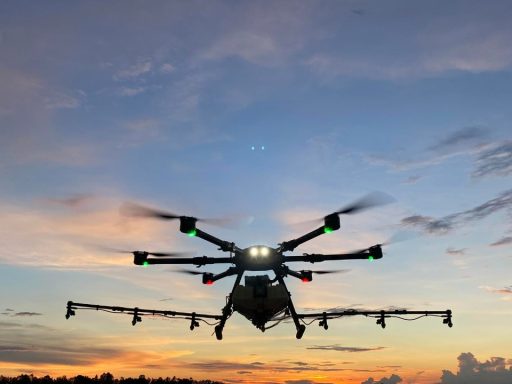
The Flexrotor UAS itself is a small, runway‑independent system that can loiter for extended periods, making it an ideal forward sensor for a helicopter that may need to stay masked behind terrain or outside an air defence envelope. In the Singapore campaign, the Defence Science and Technology Agency and the Republic of Singapore Air Force used the pairing to rehearse rescue missions where the uncrewed aircraft could scout landing zones, identify threats, and reduce crew exposure before the H225M committed to a landing, according to the Succesfull rescue mission account. A separate social media summary of the event captured the broader sentiment, describing how the Airbus Hteaming trial with the H225M helicopter and Flexrotor UAS proved a Airbus Hteaming breakthrough for modern tactical operations.
What this signals for future airpower
For Airbus Helicopters, HTeaming is part of a broader vision in which helicopters become command posts for mixed formations of crewed and uncrewed assets. The company has described the concept as the future of crewed‑uncrewed teaming, with HTeaming representing an important leap forward in helicopter‑drone collaboration that uses dedicated antennae and mission systems for helicopter installation, as set out in its Airbus Helicopters narrative. That vision aligns with a wider shift in airpower thinking, where survivability and effectiveness increasingly depend on dispersing sensors and effectors across a network rather than concentrating them in a single platform.
The Singapore trials also carry industrial and strategic implications beyond Southeast Asia. Financial analysts have already noted that the campaign validated the ability of a piloted helicopter to access real‑time data from an uncrewed aircraft and reduce crew exposure to high‑risk environments, framing the outcome as Successful Integration and time data sharing. For defence customers, that translates into a clearer business case for investing in upgrades to existing fleets rather than waiting for entirely new aircraft. And for Airbus and Singapore, the joint work cements a partnership in which the city‑state’s Defence Science and Technology Agency and the Republic of Singapore Air Force help shape how HTeaming evolves, while Airbus refines a product it can now market as combat‑tested in one of the world’s most demanding operational environments.