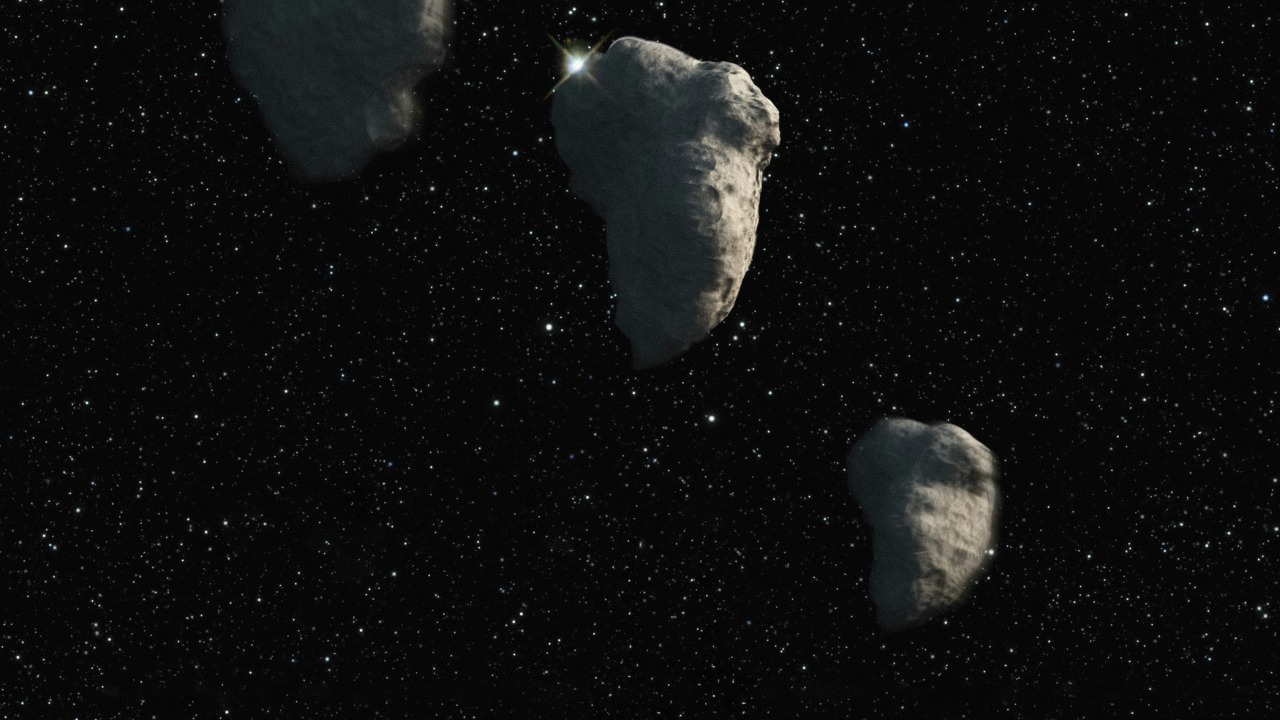

The Vera C. Rubin Observatory has spotted asteroid 2025 MN45, a massive body in the main asteroid belt that is spinning faster than any large asteroid ever recorded. Detected during the facility’s first seven nights of pre-survey observations with the world’s largest digital camera, the object is roughly the size of eight football fields yet completes a full rotation in a fraction of the time typical for such big space rocks. The discovery showcases how Rubin’s early test runs are already uncovering extreme, record-breaking objects that challenge long-held assumptions about asteroid physics.
Early Detection in Pre-Survey Phase
The NSF–DOE Vera C. Rubin Observatory identified asteroid 2025 MN45 during its initial commissioning campaign, before the Legacy Survey of Space and Time formally begins, turning what was meant to be a systems check into a headline discovery. According to an official account of how the facility’s test scans unfolded, the object emerged in the first seven nights of pre-survey imaging as analysts sifted through streams of fresh data and flagged an unusually bright, fast-varying point of light that did not match any known catalog entry, a pattern that immediately suggested a rapidly rotating asteroid rather than an instrumental glitch. That such a distinctive target surfaced so quickly underscores how Rubin’s combination of a wide field of view and rapid cadence is already reshaping expectations for what commissioning data can deliver, especially for dynamic solar system science.
Engineers and scientists were using the observatory’s 3.2 gigapixel imager primarily to validate focus, tracking, and data pipelines, yet the system’s ability to capture repeated snapshots of the same patch of sky in quick succession made it ideal for catching fast movers like 2025 MN45. As described in a detailed rundown of the find, the camera’s real-time alert stream highlighted the asteroid’s changing brightness within a single night, allowing follow-up analysis to begin almost immediately rather than waiting for slower, manual review cycles that constrained earlier surveys. For planetary scientists and mission planners, this kind of rapid, automated detection in a pre-survey phase signals a shift away from the limitations of older telescopes and toward an era in which potentially important objects are recognized and characterized within hours of first light, not months later.
Asteroid 2025 MN45’s Physical Profile
Asteroid 2025 MN45 stands out not only for how fast it spins but also for how big it is, with multiple reports describing it as comparable in length to eight football fields from end zone to end zone. One account of the discovery notes that the object’s apparent brightness and distance, combined with Rubin’s high resolution, point to a body that is hundreds of meters across, large enough to qualify as a substantial main belt asteroid rather than a small fragment or pebble-sized near-Earth object. That scale matters because it places 2025 MN45 in a size regime where most known asteroids are thought to be loosely bound “rubble piles,” yet its extreme rotation suggests a more coherent internal structure.
The asteroid resides in the main asteroid belt between Mars and Jupiter, a region that hosts the bulk of the solar system’s known minor planets and serves as a laboratory for studying how rocky bodies formed and evolved. Imaging and photometric analysis from Rubin’s digital camera, described in a technical summary of the observation campaign, confirm that 2025 MN45 is a single, massive object rather than a tight binary or cluster, which means its ability to hold together at such high spin rates directly challenges standard models of how large asteroids maintain structural stability. For researchers who model impact risks and the outcomes of asteroid deflection attempts, the existence of a fast-spinning, eight-football-field-scale rock in the main belt hints that internal strength and composition across the asteroid population may be more diverse than previously assumed.
Record-Breaking Rotational Speed
What truly sets 2025 MN45 apart is its rotational speed, which multiple analyses identify as the fastest ever measured for a large asteroid of its size class. A detailed report on the discovery explains that Rubin’s repeated exposures captured periodic changes in the asteroid’s brightness, allowing astronomers to derive a precise rotation period that undercuts the so-called “spin barrier” typically seen in objects larger than a few hundred meters. That barrier reflects the point at which centrifugal forces should overcome gravity and cohesion in a rubble pile, so the fact that 2025 MN45 spins faster than that threshold indicates that it must possess significant internal strength or an unusually dense, monolithic core.
The measurement relied on the capabilities of what has been described as the world’s largest digital camera, a 3.2 gigapixel instrument whose sensitivity and field of view are highlighted in a feature on how the device spotted the asteroid in the first place. By tracking subtle, repeating dips and peaks in the light curve over consecutive Rubin exposures, astronomers could rule out observational noise and confirm that the rapid modulation was intrinsic to 2025 MN45, not an artifact of the telescope or atmosphere. For theorists, this record-breaking spin rate raises immediate questions about the asteroid’s formation history, including whether it might be the remnant core of a larger body that was stripped of its outer layers, or the product of past collisions and YORP (Yarkovsky–O’Keefe–Radzievskii–Paddack) spin-up processes that left behind an unusually tough survivor.
Implications for Earth and Future Monitoring
The sheer size and speed of 2025 MN45 naturally prompt questions about whether such an object could pose a threat to Earth, especially given its classification as a record-breaking spinner. A focused analysis of the discovery addresses this concern directly, noting that the asteroid’s orbit keeps it in the main belt and that current trajectory calculations do not place it on a path that intersects Earth’s neighborhood, which means it is not considered a near-term impact hazard. That reassurance is important for the public, yet the case of 2025 MN45 still carries implications for planetary defense, because understanding how large, fast-spinning asteroids behave under stress informs how they might respond to kinetic impactors or other deflection strategies if a similar object were ever found on a riskier orbit.
Several reports emphasize that the find underscores the Vera C. Rubin Observatory’s emerging role in planetary defense by demonstrating how quickly it can flag unusual objects and feed them into global monitoring networks. One account of the record-breaking asteroid, which explicitly asks whether it is a threat to Earth, stresses that ongoing Rubin observations will refine both the orbit and the spin dynamics of 2025 MN45, improving models that feed into international impact risk assessments. Another detailed narrative on how the observatory discovered an enormous, record-breaking asteroid in its first seven nights notes that the same pipelines used to characterize 2025 MN45 will soon be applied at full survey scale, dramatically expanding the catalog of known asteroids and enabling earlier detection of any that might one day warrant closer scrutiny by space agencies and national governments.
Rubin Observatory’s New Benchmark for Asteroid Science
The discovery of 2025 MN45 has quickly become a benchmark example of what the NSF–DOE Vera C. Rubin Observatory can contribute to asteroid science even before its main survey begins. A comprehensive overview of the find describes how the facility’s combination of a large primary mirror, rapid slewing, and a 3.2 gigapixel camera allowed scientists to capture both the brightness and the rapid variability of the asteroid, something that would have been far more difficult with earlier, narrower-field instruments. Another report on how Rubin spotted an asteroid that spins fast enough to set a record points out that the observatory’s automated pipelines can sift through millions of detections per night, isolating rare, extreme objects like 2025 MN45 that might otherwise be lost in the noise of routine detections.
Institutional summaries of the pre-survey campaign, including an official announcement that Rubin had spotted a record-breaking asteroid in commissioning data, frame 2025 MN45 as a preview of the science to come once the Legacy Survey of Space and Time is fully underway. A separate deep dive into how the observatory discovered the fastest-spinning large asteroid ever found and how huge it is notes that the same data streams used to characterize this object will soon support a wide range of research, from mapping potentially hazardous near-Earth asteroids to tracing the collisional history of the main belt. For scientists, policymakers, and the broader public, 2025 MN45 is therefore more than a curiosity, it is an early proof that Rubin’s unprecedented imaging power can reveal unexpected extremes in the solar system, sharpen planetary defense strategies, and refine our understanding of how rocky worlds hold together under the most punishing rotational forces nature can provide.