
Elon Musk has spent years pitching Starship as the machine that will turn Mars plans and lunar contracts into reality, but the vehicle’s early flights fell short of the fully orbital, fully reusable vision. Now, instead of loud pronouncements, he is quietly reshaping how Starship will reach and use orbit, from new flight profiles to a reworked launch network and a tighter link to his artificial intelligence ambitions. The emerging plan is less about a single spectacular mission and more about building an orbital workhorse that can fly often, refuel in space and feed a vast satellite and data empire.
That shift is visible in the cadence targets for the next two years, the hardware changes baked into the next prototype and the way SpaceX is retooling both Starbase in Texas and the Space Coast in Florida. It is also evident in how Musk is tying Starship’s orbit strategy to a million-satellite constellation and space-based AI data centers, a bet that orbit will be as much about computation and communications as exploration.
The pivot from spectacle to cadence
Starship’s first flights were marketed as giant leaps, but the new strategy treats each launch as one step in a long orbital staircase. Internal discussions cited in a community tracking thread describe a push toward 25 Starship launches in 2025, a dramatic jump from the 5 launches flown in 2024, with that ramp framed as essential to proving reusability and reliability rather than chasing one-off milestones. Those same internal notes acknowledge that the program endured three consecutive failures, identified as Flights 7, 8 and 9, in early 2025, including explosions linked to propellant leaks, before stabilizing performance with Flights 10 and 11 later in the year, a sequence that helps explain why Musk is now emphasizing volume and iteration over headline-grabbing stunts.
The official description of Starship’s purpose has always centered on reusing both stages, increasing payload mass to orbit and increasing launch frequency, and that language now reads less aspirational and more like a near-term operating plan. A detailed launch list lays out how each test has inched closer to a sustained orbital profile, while a separate community forecast of 25 launches underscores how central cadence has become to the program’s identity. SpaceX has publicly signaled the same intent, stating that After conducting five flight tests of its massive Starship vehicle in 2024, it wants to quintuple launches to 25 next year, a goal that would effectively turn orbital attempts into routine operations rather than rare events.
Version 3 and a more practical orbit
The hardware that will carry this new orbital philosophy is Starship Version 3, a prototype that Musk and his engineers are positioning as the first truly operational configuration. Reporting on the next launch window notes that Flight 12 will mark the debut of Starship V3, which is slightly taller than V2, with the stack reaching 408.1 feet (124.4 meters) compared with 403.9 feet (123.1 m) for the previous version, a modest geometric change that masks more significant internal upgrades. Those include structural refinements and plumbing changes intended to support in-space refueling and higher duty cycles, the kind of incremental engineering that rarely makes headlines but determines whether a rocket can fly monthly instead of annually.
SpaceX has described this upcoming vehicle as the next prototype in a series that is explicitly designed to test the ability to refuel its upper stage midflight, a capability that sits at the heart of the new orbit plan. A separate overview of what is next for SpaceX and Starship in 2026 reiterates that Version 3 is expected to make its debut in the first half of the year, with the mission profile focused less on dramatic reentry footage and more on demonstrating stable orbital operations and propellant transfer readiness. Musk’s own comments, cited in coverage of the upcoming Flight 12, frame V3 as the workhorse that will finally align the vehicle’s actual orbit with the ambitious trajectories he has been sketching for years.
NASA’s Moon contract and the refueling imperative
Behind the technical tweaks sits a blunt contractual reality: Starship has yet to complete a fully successful orbital flight, a prerequisite for orbital propellant transfer that underpins its role in NASA’s Human Landing System. A detailed analysis of the lunar program notes that Starship must not only reach orbit reliably but also demonstrate the ability to move large quantities of cryogenic propellant between vehicles, since the HLS architecture assumes multiple tanker flights will top up a lunar lander in Earth orbit before it departs. SpaceX’s own HLS update spells this out, listing a long-duration flight test and in-space propellant transfer, with the addition of docking probes, as the next major milestones tied specifically to the lunar lander variant.
That same corporate communication, grouped under a broader set of Updates under the banner To the Moon and Beyond, casts Humanity as standing at an inflection point, with the company arguing that For the first time in our existence we possess the tools to return people to the lunar surface after more than 50 years. Independent reporting on NASA’s schedule adds a note of urgency, indicating that Spa is preparing to tell the agency that the Moon will have to wait because Starship has not yet met those orbital and refueling benchmarks. In that context, the new orbit plan looks less like a voluntary pivot and more like a necessity if Musk wants to keep the HLS contract and its political backing intact.
From Starbase to the Space Coast
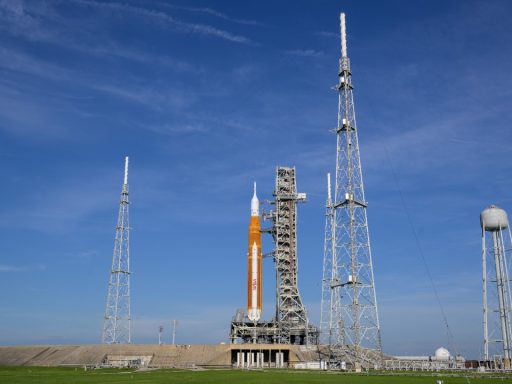
Orbit is not just about vehicles and trajectories, it is also about geography, and here too Musk has been quietly redrawing the map. SpaceX has invested heavily in Starbase, Texas, where it is headquartered, but it has also begun expanding its Sta operations and launch capabilities to the Space Coast, a shift detailed in a corporate update that highlights new infrastructure aimed at supporting Starship flights from Florida. A separate report from Mar notes that SpaceX is preparing for a Starship Super Heavy launch from Florida in late 2025, with planning focused on moving stages from Texas to Florida and integrating the giant booster with existing facilities at KENNEDY SPACE CENTER, a sign that Musk wants redundancy and higher throughput for his largest rocket.
Yet the transition has not been seamless. Coverage from Feb points out that so far in 2025, SpaceX has flown seven times from SLC-40 and zero times from KSC, with executives stressing that it is great to have two launch pads off the Flor coast but acknowledging that Starship launches later this year will be needed to justify the investment. The same Florida-focused report on Starship Super Heavy underscores how much work remains to adapt KENNEDY, SPACE and CENTER infrastructure to a fully reusable super heavy system. In practice, the new orbit plan depends on Starbase for rapid iteration and on the Space Coast for higher-volume, operational flights, a division of labor that will only work if regulatory and logistical bottlenecks at KSC ease in time for the 25-launch target.
AI, a million satellites and the business case for orbit
The most striking change in Musk’s orbital thinking is how tightly he is now coupling Starship to his artificial intelligence and communications ambitions. In early Feb, Musk Merges xAI into SpaceX for Enhanced Space Data Management, a move described as a bold strategic shift that consolidates his AI work directly under the rocket company. A detailed briefing on that decision explains that the goal is Enhanced Space Data Management for space exploration and satellite management, effectively turning Starship into the logistics backbone for a space-based AI infrastructure that will rely on vast quantities of orbital compute and downlink capacity. A separate report on the merger notes that Musk also said his long-term plan for SpaceX is to launch a million satellites, and that to achieve this aim, SpaceX’s Starship rocket program must be able to loft a 200-tonne payload, a requirement that makes high-cadence, high-mass orbits central to the business model rather than a side benefit.