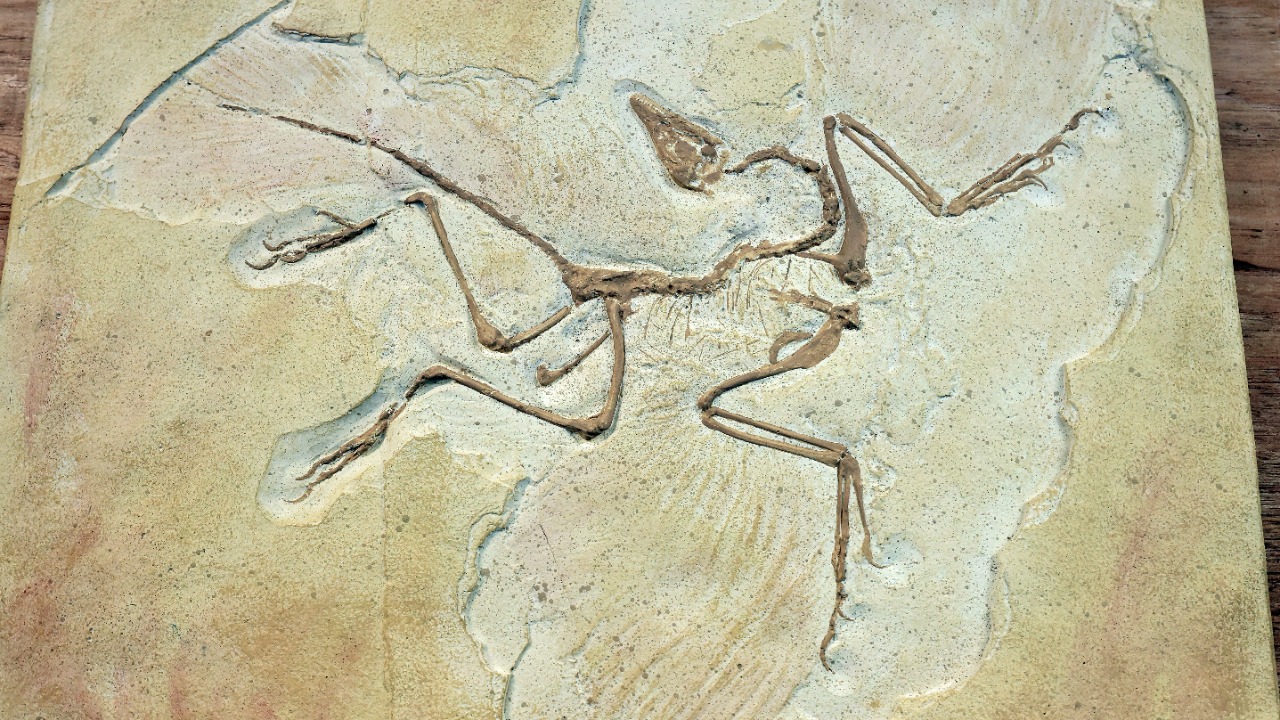

For more than 150 years, Archaeopteryx lithographica has occupied a legendary position in the story of evolution. Discovered in 1861 in the fine-grained limestone beds of Solnhofen Limestone, this fossilized creature seemed to arrive at the perfect scientific moment. Just two years earlier, Charles Darwin had published On the Origin of Species, proposing that life evolved gradually through natural selection. Archaeopteryx appeared to be exactly what Darwin’s critics claimed was missing a transitional form linking reptiles and birds.
At first glance, Archaeopteryx looks familiar. It has feathers, wings, and a body shape that resembles a small crow. But look closer, and its strange anatomy becomes impossible to ignore. It possessed sharp teeth instead of a beak, a long bony tail rather than the short fused tail of modern birds, and three clawed fingers extending from each wing. For generations, scientists focused on these obvious transitional traits. Yet with modern technology, researchers are now discovering that some of the most bizarre features of Archaeopteryx were hiding beneath the surface all along.
One of the most surprising revelations has emerged from high-resolution CT scanning. Early paleontologists could only examine the flattened fossil slabs from the outside. Today, researchers can digitally peer inside the rock without damaging the specimen. These scans have revealed unexpected details about the internal bone structure of the wings. Modern birds possess highly specialized hollow bones reinforced in ways that maximize strength while minimizing weight. Archaeopteryx, however, shows a more complex and less refined internal architecture. Its bones were not simply hollow in the modern sense; instead, they exhibit a transitional structure with thicker inner walls and intermediate air spaces. This suggests it was neither a fully capable powered flier nor a purely ground-dwelling dinosaur. Rather, it appears to represent a stage of evolutionary experimentation, when flight mechanics were still being refined.
The feathers of Archaeopteryx have also yielded astonishing new information. For decades, scientists believed its asymmetrical wing feathers clearly indicated flight capability. While that remains likely, detailed microscopic analysis has shown that the feather shafts may not have been as rigid as once assumed. Some studies using ultraviolet light have revealed subtle layering patterns and structural differences in the preserved impressions. These details hint that Archaeopteryx’s feathers may have functioned somewhat differently from those of modern birds. The presence of dark pigmentation, identified through preserved melanosomes, suggests that the wings were probably black or dark brown. Dark feathers are stronger and more resistant to wear because melanin reinforces keratin. This discovery implies that durability may have been just as important as aerodynamics in the early stages of avian evolution.
Even more surprising is what researchers have learned about the brain. When paleontologists digitally reconstructed the skull cavity of Archaeopteryx, they found a brain larger and more bird-like than that of earlier theropod dinosaurs. The optic lobes were well developed, indicating strong visual processing. The cerebellum, responsible for balance and coordination, was expanded compared to non-avian dinosaurs. Most intriguing of all, the inner ear structures reveal semicircular canals that suggest advanced head stabilization. This means Archaeopteryx likely had refined balance control, an ability that would be essential for maneuvering through trees or stabilizing itself during gliding. However, these features were not as specialized as those in modern birds, reinforcing the idea that this animal occupied a neurological middle ground between dinosaur and bird.
The claws on its wings, long thought to be primitive leftovers from its reptilian ancestors, are now being reconsidered as functional adaptations. Biomechanical studies indicate that their curvature resembles that of climbing animals. This raises the possibility that Archaeopteryx could grip tree bark or scramble along branches. If true, this supports the long-debated “trees-down” hypothesis of flight evolution, in which early feathered dinosaurs first glided from elevated perches before developing powered flight. Yet the legs of Archaeopteryx also show adaptations consistent with running. Its body seems to blend climbing ability with terrestrial agility, suggesting it may have lived a versatile lifestyle that included both ground movement and tree activity.
The long, bony tail is another feature that has taken on new significance. Modern birds possess a short, fused structure called a pygostyle that supports tail feathers while reducing weight. Archaeopteryx retained more than twenty separate tail vertebrae, creating a lengthy skeletal extension. While once dismissed as a purely primitive trait, computer simulations now suggest that this tail may have contributed to flight stability. A feathered tail fan could have acted as a rudder or braking mechanism during glides. Rather than being an evolutionary flaw, the long tail may have offered aerodynamic advantages at slower speeds.
Chemical analysis of the fossilized bones has also produced unexpected insights. Advanced techniques have detected trace elements and iron residues that may have helped preserve soft tissues. Some faint impressions once thought to be random mineral patterns might actually represent remnants of muscle or skin outlines. If confirmed, these details could offer rare glimpses into the musculature of early avian dinosaurs, helping scientists estimate how powerful its wing strokes might have been.
Adding further complexity is the discovery of numerous feathered dinosaurs in northeastern China, particularly in Liaoning Province. Fossils such as Microraptor gui and Anchiornis huxleyi reveal that feathers were widespread among small theropods. These discoveries have reshaped Archaeopteryx’s status. Rather than being the singular “first bird,” it now appears to be one member of a diverse group of feathered dinosaurs experimenting with different body plans and flight strategies. Evolution during the Jurassic and Early Cretaceous periods was not a straight line but a branching network of innovations.
What makes Archaeopteryx truly bizarre is not just any single feature, but the way all its traits combine. Its skeleton contains clear dinosaurian characteristics alongside unmistakably avian adaptations. Its feathers are advanced, yet its breastbone lacks the deep keel that anchors powerful flight muscles in modern birds. Its brain shows significant expansion, but not full specialization. Every system in its body seems to tell a story of transition. It is as though evolution paused mid-process and left behind a snapshot.
The reason these features are only now being fully appreciated lies in technological progress. Early researchers worked with hand lenses and simple microscopes. Today’s scientists employ synchrotron radiation imaging, laser-stimulated fluorescence, and sophisticated 3D modeling software. Each new tool reveals details that previous generations simply could not see. The fossil itself has not changed; our capacity to interpret it has.
Archaeopteryx continues to captivate researchers precisely because it resists simple classification. It is neither entirely bird nor entirely dinosaur. Instead, it represents a dynamic stage of evolutionary transformation, when natural selection was testing new anatomical possibilities. Its bizarre blend of characteristics reminds us that evolution operates through gradual modification, often producing organisms that do not fit neatly into modern categories.
More than a century after its discovery, Archaeopteryx still surprises us. The hidden structures inside its bones, the unexpected nuances of its feathers, and the transitional complexity of its brain all point to a creature more sophisticated than once imagined. Far from being a static museum icon, Archaeopteryx remains an active scientific mystery. With each new technological advance, this ancient proto-bird reveals yet another secret, deepening our understanding of how dinosaurs took to the skies and became the birds we see today.
In the end, Archaeopteryx is not just a fossil. It is a window into one of the most extraordinary transformations in the history of life on Earth and a reminder that even the most studied specimens can still hold astonishing surprises.