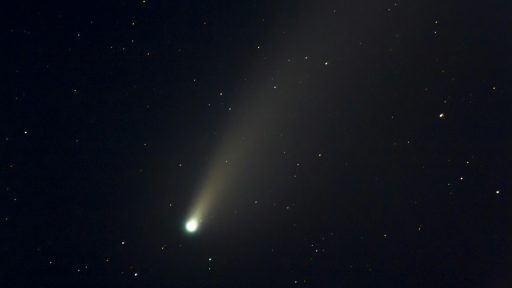
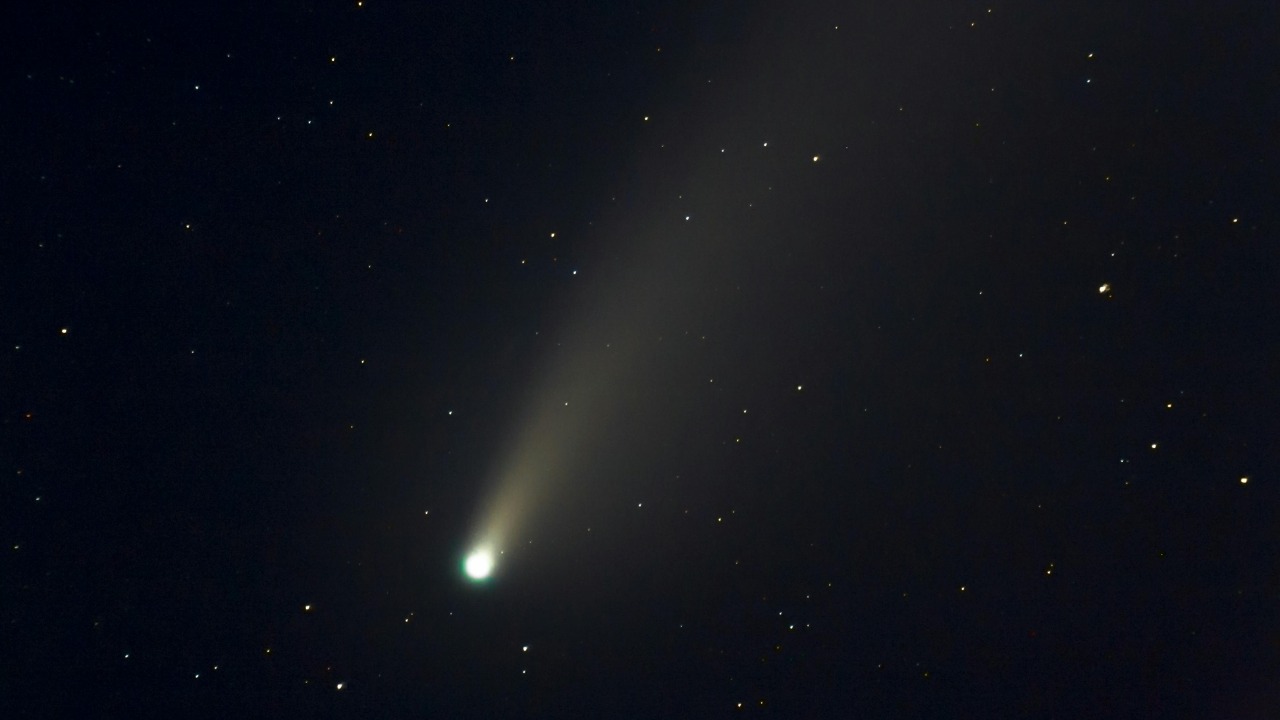

A newly discovered comet is racing toward the inner Solar System with the kind of orbit and brightness potential that instantly grabs astronomers’ attention. The object, cataloged as Comet C/2026 A1 (MAPS), is already being discussed as a possible “Great Comet” candidate, the rare class of icy visitors that can rival planets or even the Moon in our sky.
The central question is whether this comet will grow bright enough to carve a visible streak through the daytime sky, something that has not happened in generations. I want to unpack what scientists actually know so far, how they judge a comet’s prospects, and why even the most promising newcomer can still surprise everyone at the last minute.
What makes Comet C/2026 A1 (MAPS) so intriguing?
Comet C/2026 A1 (MAPS) vaulted into the spotlight because its orbit carries it extremely close to the Sun, a configuration that can supercharge a comet’s brightness. Early calculations suggest that MAPS will swing inside the orbit of Mercury, a region where intense solar heating can turn a modest nucleus into a spectacular display of gas and dust. Astronomers immediately began asking whether this object might cross the threshold from a routine fuzzy patch to a true “Great Comet,” bright enough to dominate the sky and potentially stand out even while the Sun is up, a possibility already flagged in detailed analyses of Comet MAPS.
What sets MAPS apart is not just its close solar pass but also the geometry of its approach relative to Earth. The comet’s path appears likely to place it at a favorable angle for observers, with the potential for a long, sweeping tail and a bright central condensation if the nucleus is both large and volatile rich. Early commentary has already floated the idea that Comet C/2026 A1 (MAPS) could join the short list of objects informally labeled “Great Comet,” a term reserved for those rare visitors that become cultural events as much as astronomical ones.
How bright could MAPS actually get?
Predicting a comet’s brightness is notoriously tricky, but the combination of a close solar pass and a potentially sizable nucleus gives MAPS a plausible path to extreme luminosity. As the comet approaches perihelion, the point of closest approach to the Sun, sunlight will heat its surface and drive jets of gas and dust that can increase its apparent magnitude by several orders. Some early projections, based on standard comet-brightness formulas, suggest that MAPS might reach or even surpass the brightness of Venus if its activity ramps up efficiently, which is why astronomers are already debating whether it could become visible in full daylight as a compact point near the Sun.
That optimism is tempered by the reality that brightness curves for new comets often flatten or even collapse as they near the Sun. A nucleus that looks promising at long range can fracture, exhaust its volatile ices, or simply fail to respond as strongly as models predict. Analysts who have examined the early light curve of Comet C/2026 A1 (MAPS) caution that several more weeks of data are needed before anyone can say with confidence whether it is on track to become a powerhouse or destined to remain a modest binocular object, a note of caution echoed in discussions of how Comet MAPS is developing.
Why astronomers are already talking about daytime visibility
The idea of a comet visible in broad daylight is not hyperbole, it is a specific brightness threshold that a few historic objects have crossed. For a comet to stand out against the blue sky, it typically needs to reach an apparent magnitude of about −4 or brighter, comparable to Venus at its most dazzling. Because Comet C/2026 A1 (MAPS) is expected to pass very close to the Sun, any surge in brightness will be concentrated in a small patch of sky near the solar disk, which is exactly where a daytime comet would appear as a bright, star-like point or a short spike of light.
Early coverage of the discovery has already framed MAPS as a candidate for this rare status, noting that its orbit and projected brightness could make it visible to the naked eye and possibly even in daylight if conditions align. Commentators have pointed out that the comet’s geometry, combined with its close perihelion, could allow it to put on a spectacular show, with some analyses of the newly discovered Comet explicitly raising the possibility of a daytime appearance if the nucleus proves robust.
Lessons from Comet C/2024 G3 (ATLAS) and the “Great Comet of 2025”
To understand what might await us with MAPS, it helps to look at Comet C/2024 G3 (ATLAS), which recently delivered one of the most memorable displays in years. C/2024 G3 (ATLAS) is a non periodic comet that partially disintegrated as it neared the Sun, yet still managed to reach perihelion at a distance of about 0.11 astronomical units and become a naked eye object for observers who knew where to look. The comet’s behavior underscored how even a fragile nucleus can generate a striking show when geometry and timing cooperate, as documented in detailed accounts of C/2024 G3 (ATLAS).
Observers across the Northern Hemisphere reported that ATLAS became bright enough to be seen with the unaided eye under dark, transparent skies, with a distinct tail and a condensed core that earned it the informal label of “Great Comet of 2025.” For several days, it was a fixture in astrophotography and backyard observing sessions, a reminder that comets can still capture the public imagination when they perform. Detailed retrospectives on why Comet G3 ATLAS will be remembered emphasize that its success came despite its partial breakup, a cautionary but encouraging precedent for what a dynamically young comet like MAPS might achieve.
How MAPS compares to other sungrazers racing toward the Sun
Comet C/2026 A1 (MAPS) is not the only icy body currently drawing attention as it heads inward. Another object, Comet C/2025 A1, has been described as a sungrazing comet racing toward the Sun, with enthusiasts already urging people to mark their calendars for a potential show. The excitement around that object highlights how any comet on a tight solar pass can ignite speculation about dramatic brightening, as seen in social media posts that invite observers to follow Comet C/2025 A1 as it approaches.
Compared with these other sungrazers, MAPS stands out because its orbit appears to balance a close solar encounter with a geometry that favors visibility from Earth. Some sungrazers dive so close to the Sun that they disintegrate before they can be seen well, or they remain too near the solar glare for comfortable observation. MAPS, by contrast, is projected to emerge into the dawn or dusk sky at a time when its brightness may still be climbing, which is why astronomers are already weighing whether it could rival or surpass the performance of recent comets like ATLAS in both intensity and duration.
Why predictions remain uncertain, even with modern data
Despite the wealth of orbital data and photometric measurements available, comets remain stubbornly unpredictable. The core of the problem is that a comet’s brightness depends on the physical properties of its nucleus, including size, composition, and structural integrity, which are difficult to infer from a faint speck of light. A nucleus that appears promising can harbor large voids or weak layers that collapse as heating intensifies, leading to sudden outbursts or catastrophic fragmentation that either boost brightness temporarily or cause the comet to fade prematurely.
Analysts tracking Comet C/2026 A1 (MAPS) have already stressed that several more weeks of observations are needed before its true potential can be assessed. Early reports emphasize that the comet’s development must be monitored carefully to see whether its activity curve continues to steepen or begins to level off, a point made explicitly in discussions of when we will know if Comet MAPS is becoming a potent naked eye object. Until that pattern is clear, any talk of a guaranteed daytime spectacle remains speculative, and responsible observers are careful to frame their excitement with that caveat.
What “Great Comet” status really means
The phrase “Great Comet” is not an official scientific category, but it carries a specific meaning in the culture of astronomy. It is reserved for comets that become exceptionally bright, often visible in twilight or even daylight, and that develop dramatic tails or halos that capture public attention far beyond the usual community of skywatchers. Historically, these have included objects like Comet Hale Bopp and Comet McNaught, which became household names because they were impossible to miss for anyone who glanced up at the right time.
In that context, Comet C/2026 A1 (MAPS) is being evaluated not just on raw brightness projections but on its potential to become a shared experience. Analysts who first highlighted MAPS as a possible Great Comet candidate pointed to its close solar pass and favorable geometry as key ingredients, noting that its path could allow it to be seen from both hemispheres and possibly even in broad daylight if its activity cooperates, as suggested in early assessments of Could Comet MAPS. Whether it ultimately earns that informal title will depend on how it behaves in the weeks around perihelion, when its true character will be revealed.
What observers can realistically expect to see
For casual skywatchers, the most important question is not the exact magnitude but what the comet might look like from a backyard or city park. If Comet C/2026 A1 (MAPS) follows an optimistic trajectory, observers could see a bright, star like head with a noticeable tail stretching across a significant portion of the sky, first in the pre dawn hours and later after sunset. Under darker rural skies, the tail could appear as a soft, fan shaped glow, while in urban environments it might be reduced to a shorter streak or even just a bright point, depending on light pollution and atmospheric conditions.
Even in a more conservative scenario, MAPS has a good chance of becoming at least a binocular object, visible as a fuzzy patch with a small tail through modest equipment. Enthusiasts are already advising people to prepare by familiarizing themselves with the constellations along the comet’s projected path and by planning trips to darker locations if possible, advice that echoes the guidance offered when newly discovered comet in our skies. The possibility of a daytime sighting, while tantalizing, should be treated as a bonus rather than a guarantee, with the main show likely unfolding in the low twilight sky.
How I plan to follow MAPS as it approaches perihelion
As Comet C/2026 A1 (MAPS) continues its inward journey, I plan to track three main indicators: its brightness curve, any signs of structural instability, and the evolving geometry of its position relative to the Sun and Earth. A steadily steepening light curve would suggest that the nucleus is responding vigorously to solar heating, increasing the odds of a striking display. Conversely, sudden plateaus, erratic outbursts, or reports of fragmentation would hint that the comet might struggle to maintain its brightness through perihelion, a fate that has befallen many promising objects in the past, including partially disintegrated comets like ATLAS.
I will also be watching how professional and amateur observers refine the orbit and visibility windows, since small changes in the predicted path can significantly affect when and where the comet is best seen. If updated models confirm that MAPS will emerge into a dark enough sky while still near peak brightness, the chances of a truly memorable event increase, even if daytime visibility remains uncertain. For now, the most honest answer to whether this newly found comet will shine in daytime is that it might, under the right circumstances, but its real promise lies in the growing possibility of a bright, extended show that could turn millions of casual observers into temporary comet chasers.