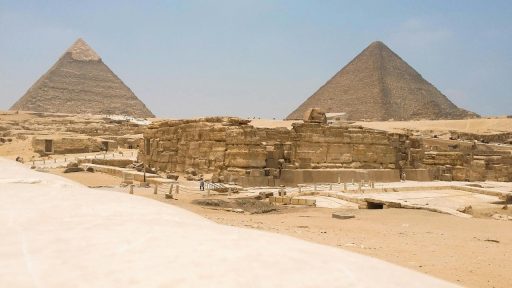
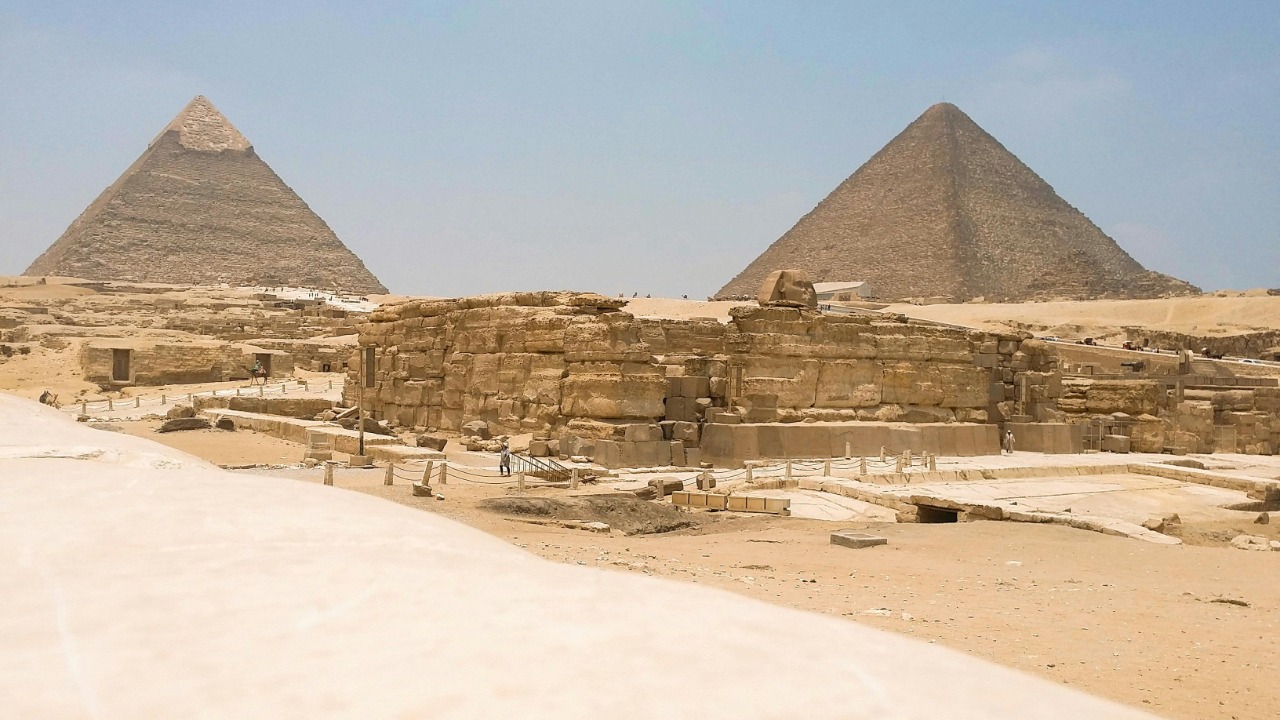

For generations, the Giza pyramids have stood as the ultimate engineering riddle, their sheer scale seemingly out of step with the tools available 4,000 years ago. Now a convergence of satellite imaging, particle physics and structural analysis is pointing to a surprisingly elegant answer that begins not in the desert, but in a long‑buried river channel. A newly mapped branch of the Nile, combined with evidence of hydraulic lifts and internal pulleys, suggests the monuments rose through a sophisticated water‑powered logistics system rather than brute force alone.
Instead of imagining endless human chains dragging blocks across sand, I now see a landscape threaded with canals, quays and shafts where water, gravity and simple machines did much of the heavy lifting. The emerging picture does not diminish the achievement of the Ancient Egyptians at Giza 4,700 years ago, it makes their accomplishment look even more technically advanced.
The buried Nile branch that rewrites the building site
The most transformative clue comes from orbit. Using radar satellites to peer beneath the sand, an international team has traced a hidden river course that once flowed along the western desert margin, right past the pyramid fields. The researchers mapped this ancient channel, which they named Ahramat, meaning “pyramids” in Arabic, and showed that it once ran beside more than 30 royal monuments. That single finding neatly explains why so many massive tombs cluster along a narrow desert strip: they were effectively waterfront projects, positioned to exploit a natural shipping lane.
Lead author Eman Ghoneim and her colleagues combined satellite radar with field surveys and sediment cores to confirm that this was a genuine Nile branch, not a mirage of buried dunes. In interviews, Speaking about the work, Ghoneim stressed that the channel’s length was “really, really long” and that its width in places was “huge”, consistent with a major waterway capable of carrying heavy cargo. A complementary analysis in Nature Communications Earth, underlines that this Ahramat branch once served at least 31 pyramids, including the Giza complex, before drought and shifting sediments buried it beneath farmland and desert.
From space data to stone delivery: how water moved 2.3‑tonne blocks
Once the Ahramat channel is restored to the map, the logistics of pyramid building start to look less impossible. Instead of dragging limestone and granite across tens of kilometers of desert, workers could have loaded them onto boats and barges, then offloaded them at quays directly below the construction plateaus. One study notes that the long‑forgotten branch of the Nile likely formed a connected system of waterways that brought stone right to the foot of the desert escarpment. Experts now argue that Egyptians used this nearby waterway to move millions of 2.3-tonne blocks, turning what once seemed like an overland nightmare into a manageable river transport problem.
Multiple lines of reporting converge on the same point: Scientists working in Egypt had long suspected a missing water route, but until the radar work there was no consensus on its exact path or proximity to the monuments. A technical brief notes that Recently acquired satellite and ground‑penetrating radar data finally pinned down a tributary that once hugged the plateau, solving the long‑standing puzzle of how a huge labor force and stone supply could be sustained so far from the modern river. Another technical summary explains how Ghonheim and her team used radar waves to trace a 64‑kilometer, or roughly 40‑mile, ancient branch, while a social‑media digest of the study emphasizes that New archaeological findings now tie that watercourse directly to the transportation of massive stone blocks.
Hydraulic lifts and water‑powered engineering inside the pyramids
River access alone does not explain how blocks climbed hundreds of vertical feet, which is where hydraulic engineering enters the story. A growing body of research suggests that the Ancient Egyptians did not rely solely on earthen ramps, but also on water‑based lifting systems that used pressure and buoyancy to raise stone. One analysis of the Step Pyramid at Saqqara, Through a reconstructed hydraulic network, argues that water was guided to a central well 28 meters deep, then used to help lift building materials along the monument’s axis.
That idea has been sharpened by structural modeling and civil‑engineering studies. A detailed investigation, Published in PLOS ONE, describes how French civil engineer French specialist Xavier Landreau modeled hydraulic lifts capable of raising massive stone blocks within a pyramid’s internal shafts. A separate commentary on Saqqara notes that technique options likely included ramps, cranes, winches, toggle lifts, hoists and pivots, all potentially integrated with water channels and a complex treatment system. One social‑media explainer goes further, arguing that Archaeologists have now identified an intricate hydraulic system that may have powered construction at the Great Pyramid itself.
Pulleys, simple machines and the hidden voids of the Great Pyramid
Water was not the only force doing work inside these monuments. A fresh engineering study, highlighted in early 2026, proposes that the Great Pyramid incorporated an internal network of pulleys and counterweights. According to summaries of the work, Scheuring and colleagues argue that the Great Pyramid used such systems to move blocks rapidly up through its core, a view echoed in coverage that describes how Scientists in Egypt now see pulleys and counterweights as central to the monument’s speed of construction. A related report notes that Egyptians may have used this internal machinery to build the Great Pyramid so fast that it challenges older assumptions about construction timelines.
Those ideas dovetail with what we know about simple machines. Educational material on Levers That Lift shows how levers, pulleys and wheel‑and‑axle systems can multiply force, especially when combined with gravity and water. A popular synthesis of recent research notes that While we may never have the full manual for How the Pyramids Were Built, the evidence increasingly points to a blend of clever simple machines and fluid dynamics. One social‑media thread even frames the new hydraulic and pulley models as proof that the Ancient Egyptians at Giza 4,700 years ago were deploying techniques that rival our best 21st‑century craftsmanship.
Muon scans, underground tunnels and what we still do not know
While space‑based radar has redrawn the landscape outside the pyramids, particle physics is transforming our view of their interiors. The ScanPyramids mission, led by Cairo University and (Heritage Innovation Preservation), uses cosmic‑ray muons to detect hidden cavities. Early results revealed a mysterious void above the Grand Gallery, the 153-foot-long corridor that leads to the burial chamber, with one report noting that the Grand Gallery is mirrored by a cavity at least a hundred feet long. A companion piece explains that the cavity, described on a Thursday in the journal Nature, is at least 30 meters long, raising the possibility that it once housed counterweights or hydraulic equipment.
Follow‑up work has combined muon radiography and endoscopic cameras to refine that picture. One explainer on the new chamber describes Using muons to map density differences and hints that the voids could be part of a construction system rather than ceremonial rooms. A technical overview of the project notes that Page after page of data from non‑invasive techniques is being used to test competing construction models. Parallel investigations at other monuments, such as the Menkaure pyramid, have revealed tunnels and chambers that suggest the three main pyramids at Giza sit atop extensive underground structures. A regional newspaper summary adds that the precision of the Khafre Pyramid and its hidden spaces raises questions about whether the pyramids served as more than tombs, perhaps doubling as giant machines for ritual, political or even hydraulic purposes.