
The most surprising exoplanet finds of 2025 pushed planetary science far beyond the familiar template of small rocky worlds and giant gas planets. From shredded atmospheres to worlds with multiple suns, the year’s discoveries showed how strange planetary systems can be while still obeying the same physics that governs our own neighborhood. Together they sharpened the search for life and forced astronomers to rethink how planets form, evolve, and sometimes fall apart.
These worlds are not just curiosities. They are test cases that reveal how gravity, radiation, and chemistry sculpt planets outside the Solar System, and they are beginning to sort exoplanets into distinct families with their own rules. As I look across the latest catalog, the wildest finds of 2025 are the ones that most clearly expose those rules by breaking almost every expectation we carried over from our own backyard.
Super‑puffs, hot Jupiters and planets that refuse to behave
Some of the most dramatic 2025 discoveries involved planets that seem to ignore the standard playbook for size and density. A standout is a so‑called super‑puff, a world so low in density that it resembles a ball of cotton candy, whose atmosphere is actively leaking into space and challenging models of how long such fragile planets can survive. Observations with the James Webb Space showed that this object is losing its atmosphere in real time, turning it into a natural laboratory for atmospheric escape.
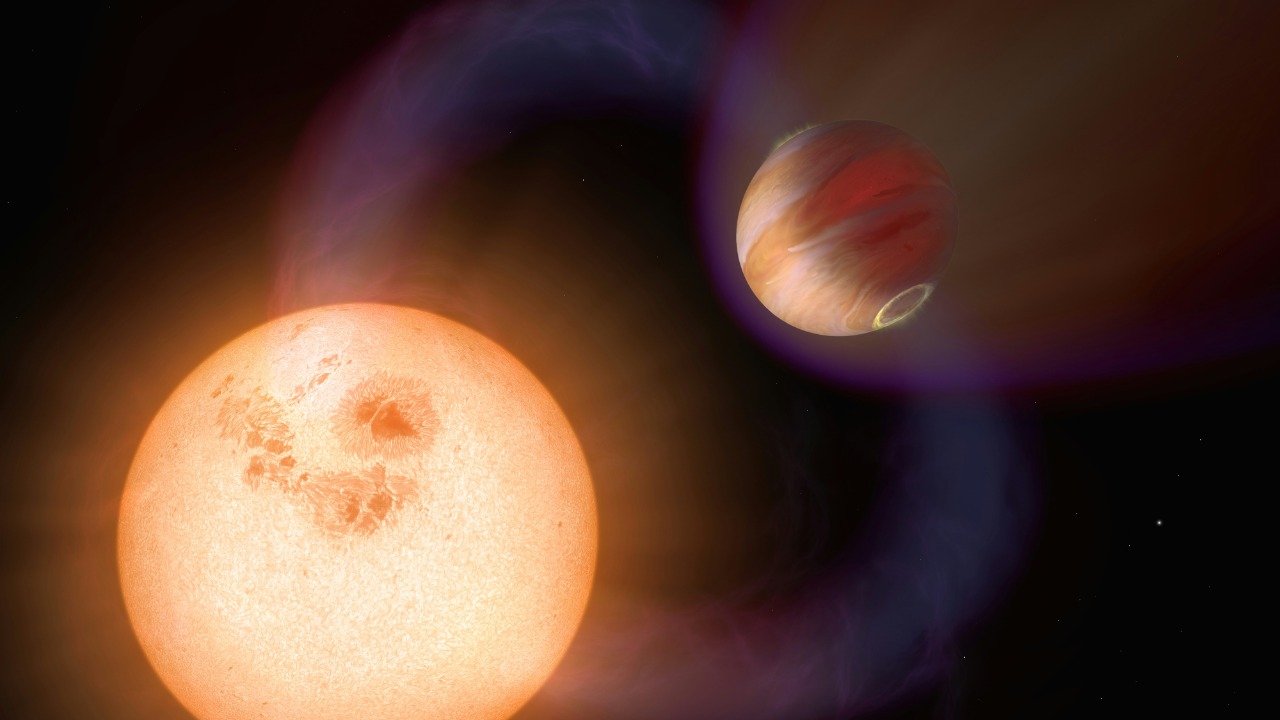
Equally extreme are the ultra‑hot gas giants that orbit perilously close to their stars, where temperatures soar high enough to vaporize metals. One of the most eye‑catching examples is Tylos, also known as WASP‑121b, an ultra‑hot Jupiter whose atmosphere appears layered with exotic materials and whose structure helped inspire some of the year’s most vivid artist impressions. Earlier coverage of 2025’s exoplanet highlights placed Tylos alongside other “wildest” worlds, noting how its distorted shape and blazing dayside make it a benchmark for studying Jupiter‑class planets under extreme irradiation.
Worlds with tails, hurricane winds and multiple suns
Other discoveries showed that even familiar categories like hot Jupiters can look radically different under the right conditions. One such planet, WASP‑69b, orbits so close to its star that its atmosphere is being blown into a vast tail, making the planet resemble a giant comet rather than a neatly wrapped sphere. Researchers at the University of California, reported that this tail stretches at least as long as the planet is wide, a sign of intense stellar radiation and powerful outflows that strip lighter gases away.
If WASP‑69b looks like a comet, Tylos looks like a storm system turned inside out. Winds on this world race at incredible speeds, reaching 26.8 km per second, or 16.7 m per second, more than twice Earth’s escape velocity, which means the atmosphere is constantly being shuffled from the blistering dayside to the relatively cooler nightside. Social media posts that highlighted these hurricane‑scale flows framed them as a reminder that You think Earth is wild, Wait until you see how such winds reshape the chemistry and cloud patterns on Tylos and similar worlds.
Habitable‑zone hopes, crowded catalogs and a new comparative science
Not every headline in 2025 was about destruction. Some of the most closely watched observations focused on K2‑18b, a sub‑Neptune that is about 2.6 times the radius of Earth and circles its star every 33-day orbit within the habitable zone. Astronomers used new spectra to probe whether this world might host a deep ocean or a hydrogen‑rich envelope, and while the signals were too weak to draw definitive conclusions about life, the scrutiny underscored how sub‑Neptune planets have become prime targets in the search for conditions that resemble early Earth. The same round‑up of 2025’s most exciting exoplanet work also revisited “Tatooine” systems with multiple suns and revisited dashed hopes for TRAPPIST‑1e, showing how habitability claims can be strengthened or overturned as new data arrive from James Webb Space.
Behind these headline worlds sits a rapidly expanding statistical foundation. The official List of exoplanets discovered in 2025 adds dozens of new entries, each with a Name, Mass, Radius and orbital Period that help researchers map out the full diversity of planets beyond the Solar System. That growing census feeds directly into Comparative planetology, a survey‑driven approach that compares many systems at once to understand how entire classes of planets, from super‑puffs to hot Jupiters, shape the architecture of galaxies. In that context, the wildest exoplanets of 2025 are not outliers at all, but essential datapoints that reveal how typical planets might look when viewed across the vast and varied landscape of Exoplanets, as captured in the Latest Exoplanets coverage and in detailed profiles of extreme objects like Tylos.