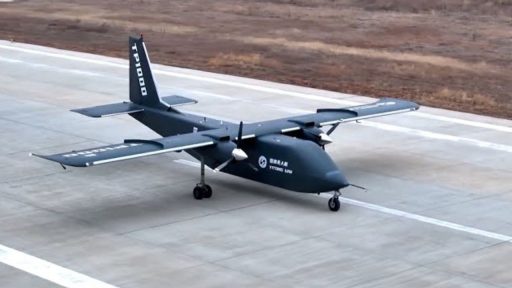
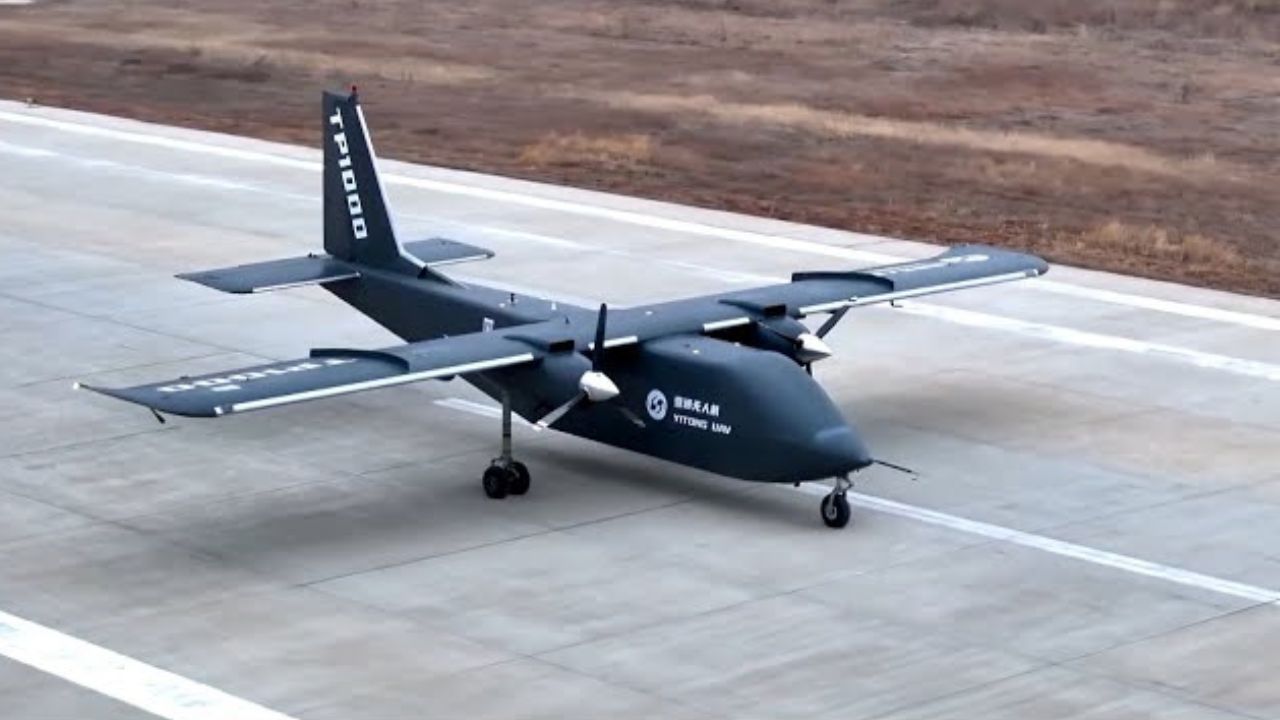

China’s Aviation Industry Corporation (AVIC) has completed the maiden flight of its self-developed Tianma-1000 heavy unmanned cargo aircraft, a ton-class drone designed to transport one ton of cargo without a pilot on board. The successful test flight of this large unmanned platform marks a significant step in China’s efforts to expand autonomous logistics capabilities for both civilian and strategic uses.
Development Background
The Tianma-1000 is described in Chinese reporting as a self-developed project by the Aviation Industry Corporation of China, conceived specifically as a heavy unmanned cargo aircraft to move one ton of freight in a single load. According to information attributed to AVIC and relayed through defense industry reporting, the program is framed as part of a broader drive to build indigenous large unmanned platforms that can operate over medium and long distances while carrying substantial payloads. For Chinese aerospace planners, a domestically controlled design in this weight class reduces reliance on foreign cargo aircraft and gives engineers full control over airframe, propulsion and control-system upgrades.
Developers have positioned the Tianma-1000 as a response to growing demand for unmanned transport solutions that can operate in environments where crewed aircraft are either too costly or too risky. Chinese sources emphasize that the aircraft is intended to build on earlier generations of unmanned systems, scaling up from small and medium drones to a platform that can handle ton-class cargo missions. In practical terms, that evolution could allow logistics operators, emergency responders and military units to move heavier equipment and supplies into remote or contested areas, extending the reach of China’s existing drone ecosystem into roles traditionally filled by light cargo planes or helicopters.
Technical Specifications
Public descriptions of the Tianma-1000 highlight its classification as a one-ton cargo drone, with the design centered on lifting and transporting a payload of approximately 1,000 kilograms in a single sortie. Chinese state-linked coverage of the Tianma-1000 unmanned cargo notes that the airframe has been engineered specifically around this payload requirement, indicating a focus on structural strength, cargo bay configuration and center-of-gravity management to keep the aircraft stable under varying load conditions. By designing the platform from the outset as a cargo carrier rather than adapting a manned aircraft, AVIC appears to be optimizing for freight volume, loading efficiency and simplified maintenance rather than passenger comfort or cockpit ergonomics.
Beyond raw payload, the Tianma-1000 is described as a heavy unmanned cargo drone that incorporates advanced autonomous features tailored for logistics operations, distinguishing it from lighter unmanned variants that typically focus on surveillance or small parcel delivery. Reporting on the aircraft’s systems points to integrated unmanned control mechanisms, onboard flight management and remote command links that allow the drone to follow preplanned routes while retaining the ability to respond to control inputs from ground operators. For logistics stakeholders, those capabilities matter because they determine how reliably the aircraft can fly in complex airspace, how safely it can integrate with existing traffic management systems and how flexibly it can be retasked to support urgent missions such as disaster relief or time-sensitive resupply.
Maiden Flight Details
The Tianma-1000 completed its first flight test in a controlled environment that Chinese sources describe as a dedicated test field, where engineers could closely monitor the aircraft’s behavior and validate its core systems. According to accounts of the event, the self-developed ton-class unmanned took off, executed a planned flight profile and landed under unmanned control, with the sequence designed to verify takeoff performance, in-flight stability and landing accuracy. The test was also used to assess the performance of the drone’s autonomous navigation, data links and ground control interfaces, all of which are critical for safe operation when no pilot is on board.
Coverage of the maiden flight stresses that the aircraft’s systems functioned as intended, with no reported issues in the initial performance of the Tianma-1000 during the sortie. Reports on the maiden flight of describe the event as a transition from the design and ground-testing phases into full flight testing, a milestone that typically marks the point at which engineers can begin refining performance parameters based on real-world data. For operators and regulators, a successful first flight is significant because it demonstrates that the aircraft can safely leave the ground under its own power and follow commands, clearing the way for more demanding tests that will explore range, endurance, maximum payload and operations in varied weather conditions.
Strategic Implications
Chinese analysts and program backers present the Tianma-1000 as a platform that could reshape how cargo is moved in both civilian and military contexts, particularly in regions where infrastructure is limited or where security conditions make crewed flights less attractive. By fielding a heavy unmanned cargo drone that can carry one ton of freight, AVIC is positioning China to compete in a segment of the aviation market that is only beginning to emerge globally, where large drones handle missions such as resupplying remote mining sites, delivering humanitarian aid after natural disasters or supporting offshore energy platforms. The successful test of the Tianma-1000 heavy unmanned is therefore seen domestically as a signal that China intends to be a leading supplier and operator of such systems rather than a late adopter.
Compared with earlier Chinese unmanned developments that focused on reconnaissance, strike or small-package delivery, the ton-class Tianma-1000 introduces a step change in payload handling that could alter how supply chains are organized in remote or high-risk areas. The ability to move one ton of cargo in a single unmanned flight means that items such as generators, medical equipment, construction materials or ammunition can be delivered without exposing aircrews to danger, and without relying on ground convoys that may be slowed by terrain or security threats. As testing progresses and if the aircraft proves reliable in varied conditions, logistics planners in China will have a new tool for rapid deployment and sustained resupply, and international observers will be watching closely to see how this capability influences both commercial freight models and military logistics doctrine.