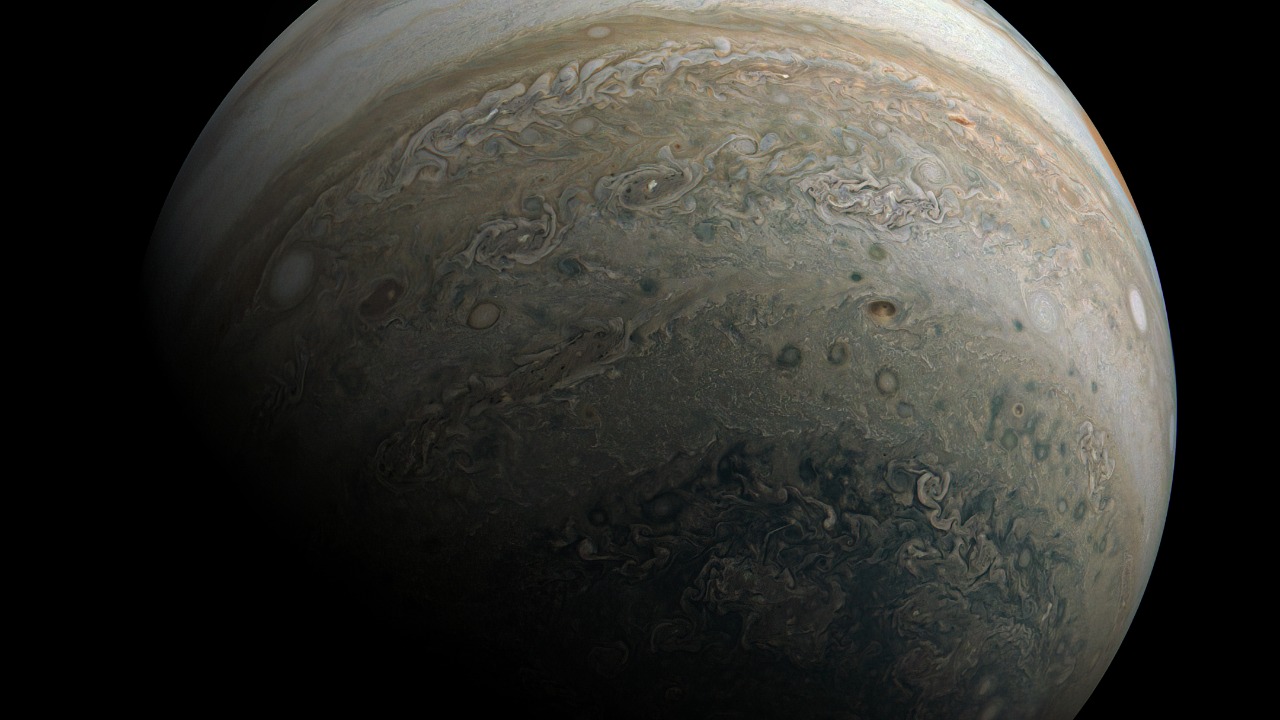

Jupiter is about to dominate the midwinter sky, reaching its brightest and most accessible point in the current apparition when it arrives at opposition on January 10. For a few nights on either side, the giant planet will be visible all night, rising in the east around sunset and setting in the west near sunrise. With a little planning, I can use this window to see Jupiter at its largest apparent size, with crisp detail in even modest backyard equipment.
Why this opposition is the best time to see Jupiter
At opposition, Jupiter lines up opposite the Sun in our sky, with Earth sitting between the two worlds, which makes the planet appear bigger and brighter than at any other time in its orbit. During the 2025–2026 apparition, Jupiter reaches this configuration on January 10, when it will be high in the night sky and visible for many hours, a geometry that one detailed guide describes as the moment when Jupiter will reach opposition and become the optimal target for observers. Another observing forecast notes that on 2026, January 10, the event is framed as “2026, January 10: Jupiter at Opposition Brightens the Night Sky,” underscoring how dramatically the planet will stand out against the background stars when Jupiter at Opposition Brightens the Night Sky. For casual stargazers, that means a naked-eye beacon that rivals any other object after sunset apart from the Moon.
The orbital mechanics add a subtle twist that is worth keeping in mind if I want to catch Jupiter at its absolute closest. Because both Jupiter and Earth follow slightly elliptical paths, the moment of minimum distance does not always fall exactly on the date of opposition. In this apparition, Jupiter is actually closest to Earth on January 9, a day before opposition, a nuance explained in a technical breakdown that notes Jupiter closest to Earth January 9, 2026 and asks, “Have you noticed a very bright object ascending in the east earlier each evening?” A companion overview of the broader season points out that Earth will fly between the biggest planet in our solar system, Jupiter, and the Sun, emphasizing that in 2025–2026, Jupiter in 2025–2026 presents a bright disk that rewards even small telescopes. Together, these alignments make the nights around January 9 and 10 the prime time to step outside and look east.
When and where to look in the January sky
To find Jupiter, timing and direction matter more than specialized gear. In the evenings leading up to opposition, the planet rises earlier each night, climbing higher in the east after dusk and tracking across the southern sky before sinking toward the west before dawn. A January sky preview notes that on Saturday, Jan. 3, observers should look to the east for the brilliant planet Jupiter shining several finger widths to the lower right of nearby stars, and that by Friday night, Jan. 9, Jupiter peaks at opposition and is visible all night, a pattern summarized in a map-based guide to the night sky, January 2026. Another observing resource frames the same stretch of days as a period when Earth flies between Jupiter and the Sun, explaining that as Earth moves along its orbit, Earth flies between Jupiter and the sun and the planet reveals a bright disk that is easy to spot even from light polluted suburbs.
Knowing where Jupiter sits among the constellations can make the search even easier. A dedicated 2026 observing guide notes that Jupiter at opposition on January 10, 2026, lies in the constellation Gemini, describing how the planet stands out among the Twins and can be tracked with binoculars as it drifts eastward against the starry background, a motion highlighted in a Guide to Observing Jupiter. A follow up forecast for a few days later points out that on Jan. 14, a waning crescent Moon will join the scene, and that among the Bright Outer Planets, Mars, The Red Planet, is still masked by sunlight while Jupiter remains prominent near Pollux, sitting 7.6° from the star in the Twins, a configuration described in detail in a note on Bright Outer Planets. For anyone stepping outside around that date, the pairing of the Moon, Pollux, and Jupiter will act like a celestial signpost pointing straight to the gas giant.
How to get the best view, from binoculars to telescopes
Once I have Jupiter in sight, the next step is to make the most of the view, whether I am using my eyes, binoculars, or a telescope. A short video primer on the event explains that when Jupiter is in opposition, this is when the planet appears opposite of the Sun in the sky and also when the planet is at its brightest, a combination that makes it ideal for beginners to try planetary observing, as summarized in a concise clip on Jupiter at Opposition. A more detailed written guide emphasizes that the planet Jupiter is always a rewarding target and that even a pair of binoculars can reveal its four largest moons, advice that appears in a comprehensive Observing Jupiter handbook. For many city observers, that means a simple 8×42 birding binocular or a compact 10×50 model is enough to turn Jupiter from a bright point into a tiny system of worlds.
For telescope users, the quality of the eyepiece and the steadiness of the atmosphere matter as much as raw magnification. An in depth observing guide notes that although Jupiter is big and bright, many serious planetary observers prefer high quality Plössl or orthoscopic eyepieces instead of complex ultra wide designs, because the simpler optics can deliver sharper contrast of the polar regions and the cloud belts, a point made explicitly in a detailed Jupiter observing guide. Another forecast for 2026, January 10, stresses that while seeing the planet at its highest point in the sky reduces the amount of atmosphere I am looking through, it is also useful to watch as Jupiter drifts eastward against the starry background over several nights, a behavior described in a planning note on Opposition Brightens the Night Sky. By combining those tactics, I can turn the brief window around opposition into a multi night tour of Jupiter’s changing face, from the shifting positions of its moons to the subtle rotation of its cloud bands.